


Accepting the long game is the hardest part of any work on yourself, and gentle parenting makes that clear from the very first week. We are told that change should arrive quickly, in a flash of insight, and that a good parent simply gets it right. Real life rarely works that way.
This article looks at why we struggle with slow processes, what the IPAN norm does to our patience, and why uncomfortable emotions like shame are not proof of failure but useful signals. None of it requires perfection, only a willingness to keep going.

Quick takeaways
- The IPAN norm (immediacy, performance, belonging, normality) makes long processes feel like failure.
- Quick epiphanies are a myth; real change comes through trial, error and relapse.
- Emotional ups and downs are normal and not a sign that you are doing badly.
- Saying “I’m not okay, help me” is a sign of self-respect, not weakness.
- Shame is uncomfortable but useful: it flags relational misfires worth repairing.
- Guilt handled badly turns into rigidity and control; handled well, it becomes learning.
The IPAN Norm and Our Impatience
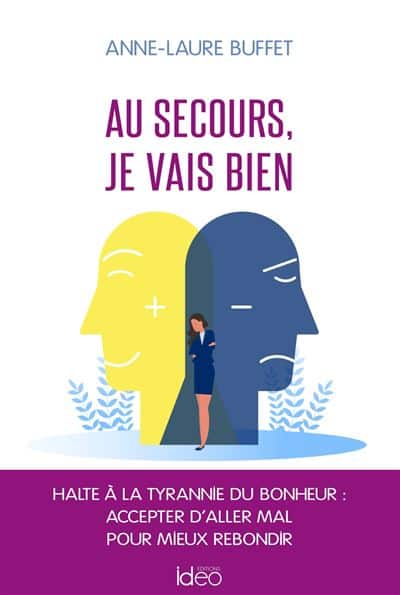
In her book Au secours, je vais bien, Anne-Laure Buffet uses the acronym IPAN to describe a way of functioning that blocks us from thinking in the long term, from tolerating trial and error, and from accepting setbacks during any process of self-work or habit change. These four pressures weigh on us constantly, at home and at work.
Immediacy means wanting the answer or the information right away. Performance means always being up to standard and never admitting a mistake. Belonging means being recognised by a group that shares our values, and normality means never disturbing the established order through our behaviour.
Why the flash of insight is a myth
Buffet regrets the false idea that self-work happens through a single epiphany, a eureka moment that unlocks everything and produces a quick, lasting, high-performing result. Children are exposed to the same pressure: overstimulation by adults leads to emotional disinvestment, because the warmth of love is replaced by the pursuit of achievement. Even a simple classic puzzle toy becomes a test of performance rather than play.

You Cannot Feel Good All the Time
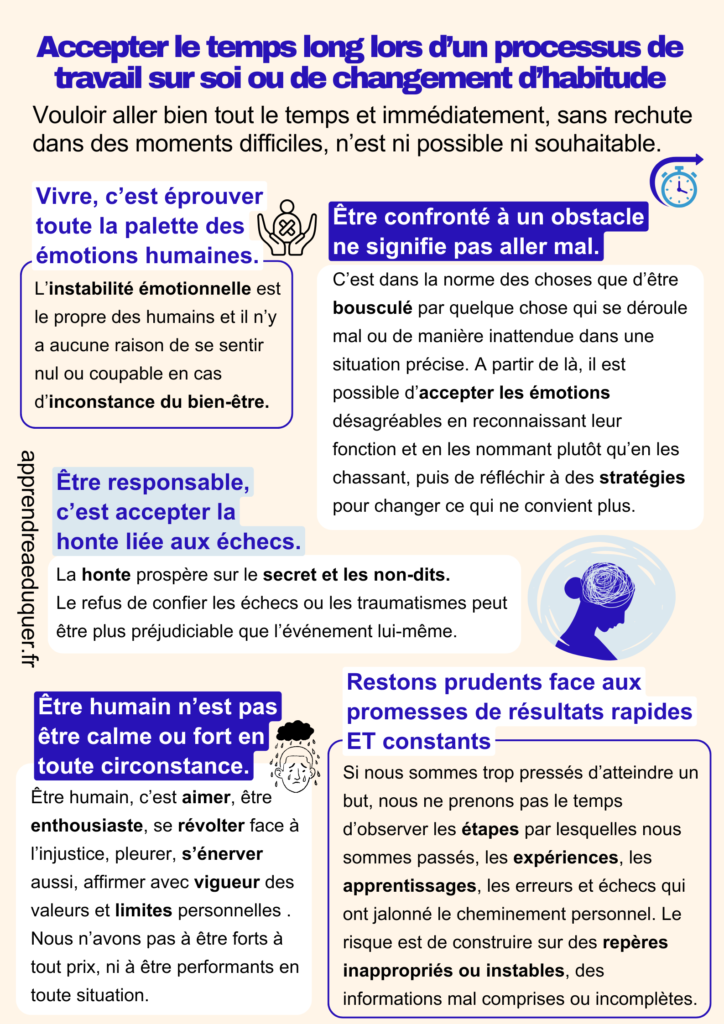
Wanting to feel well constantly, with no relapse into difficult moments, is neither possible nor desirable. Living means experiencing the full range of human emotions, and emotional instability is simply part of being human. There is no reason to feel worthless or guilty when your wellbeing fluctuates.
Buffet points out that facing an obstacle does not mean you are doing badly. Being shaken by something that goes wrong or unfolds unexpectedly is entirely normal. From there, you can accept unpleasant emotions by naming them and recognising their function instead of chasing them away, then think about strategies to change what no longer suits you. As César Bona reminds us, growing as a parent is about making ourselves better, not about being perfect.
“I’m not okay, help me”
Buffet suggests that daring to say “I’m not okay, help me” is paradoxically a sign that we are doing well, because we are fully aware that what we are living through harms us and that we cannot fix it alone. Asking for advice implicitly says: I have enough faith in myself and enough self-love not to impose or endure a situation that hurts me. Practical support, such as helpful parenting apps or a trusted friend, can carry you through the weeks when motivation runs low. Remember that children come our lives, not to test our worth.
| Situation | Rushing (IPAN) | Accepting the long game |
|---|---|---|
| A hard morning with the kids | “I failed, I’m a bad parent” | “That was hard; what can I repair?” |
| Learning a new habit | Expect results this week | Expect weeks of uneven practice |
| Feeling ashamed after shouting | Hide it, over-control | Name it, apologise, adjust |
| Asking for help | Seen as weakness | Seen as self-respect |
| Child’s play | Must be productive | Unstructured and warm |
Responsibility Means Accepting Shame
Being responsible means accepting the shame attached to failure, and shame is a useful, legitimate emotion. Psychotherapist Babette Rothschild, a specialist in post-traumatic stress, reminds us that nobody enjoys feeling ashamed: it contracts the body, brings tears, self-criticism and looping negative images.
Some traumatised people feel shame about what happened to them. Yet like every other emotion, shame is necessary for survival. Put simply, it signals that something is not right in a relationship, that there has been a social misfire. Without that alert, we could not notice relational dysfunctions and would lose the chance to avoid, change or repair them.
Shame as a social compass
Because shame shapes the behaviours accepted in a sociocultural group, it pushes us toward conduct that favours inclusion and acceptance. We are driven by a biological process that seeks to maintain life, and that maintenance is easier within a peaceful social group. Social emotions, shame included, preserve the group so that each member survives.
Turning “Failures” Into Experience
We can treat what we take for relational failures, such as shouting at our children, as experiences. Feeling sadness and perhaps fear at the root of guilt, fear of losing the connection, of harming the child, of not knowing how to do otherwise, lets us learn from our actions and grow. Stories like how bricks helped one child show that healing can begin in small, ordinary moments.
If we refuse that inner work, guilt can push us into over-functioning: becoming rigid, intolerant, intransigent, or overly preoccupied with controlling the child. The same trap appears when we compare ourselves endlessly with the polished images behind tender family ads or the effortless lives on social media.
Repair, not perfection
Repairing after a rupture matters more than never rupturing. Naming what happened, apologising simply, and stating what you will try next time teaches children that relationships survive mistakes. A calm routine around home haircut tutorials or a shared car travel game gives you low-stakes moments to practise patience together.

Building a Life That Allows Slow Change
Accepting the long game also means arranging daily life so that slow change is possible. That can mean fewer activities, unhurried mornings, and protecting moments that look unproductive but restore everyone. Reading about choosing a preschool or iron-rich foods is useful, but the deeper work is accepting that progress will be uneven.
Small, repeatable rituals help more than grand resolutions. A short walk, a shared story, a five-minute pause before reacting: these are the ordinary bricks of change. They also model for children that effort matters more than outcome, which is exactly the message the IPAN norm erodes.
My hands-on take
I remember the first time I tried to stay calm through a tantrum and lasted about ninety seconds before raising my voice. My instinct was to treat the whole evening as a failure, but something shifted when I started writing down what happened without judgement. Most weeks looked messy; a few looked fine. Over months, the messy ones got shorter.
What helped most was lowering the bar deliberately. I stopped expecting a breakthrough and started counting small repairs: a calm apology, a shared joke afterwards, a pause before reacting. That is the long game in practice, and it is far kinder than waiting for a eureka moment that never comes.
Frequently asked questions
How long does habit change actually take?
There is no fixed timeline, and the article deliberately avoids promising one. What matters is expecting trial, error and relapse rather than a single breakthrough, so setbacks stop feeling like proof of failure.
Is shame always a bad emotion?
No. Shame is highly unpleasant but serves a survival function, signalling that something has gone wrong in a relationship. That alert gives you the chance to notice, repair and adapt.
What does IPAN stand for?
Immediacy, Performance, Belonging and Normality, as defined by Anne-Laure Buffet. Together these pressures make it hard to think long term or tolerate mistakes.
Does this apply to children too?
Yes. Buffet argues children are affected by the same norm, and that overstimulation by adults can replace emotional warmth with a search for achievement.
Product Reviews
 Best Toys for Dogs With High Prey Drive |
Best Outdoor Toys for 3-4 Year Olds |
Best Outdoor Toys for 6 Year Olds |
Best Harness for Poodle |
Best LEGO Sets for Adults |
Best Travel Toys for 4 Year Olds on Airplane |
Best Toy Stores in Washington DC |
Best Potty Training Toys |
Best Toys for Tripod Dogs |
Maillot equipe de france







