


A feeling of imperfection is one of the most painful patterns a person can carry into adulthood, because it hides behind competence, achievement, and a carefully managed image. It is the quiet conviction that you are fundamentally flawed and that, if people saw the real you, they would pull away.
This pattern is not built on an actual defect. It is built on an early environment in which you did not feel worthy of love and respect. Understanding where it came from is the first step toward loosening its grip.

Quick takeaways
- The imperfection schema is a deep belief that you are defective and unworthy of love.
- It forms in childhood through criticism, rejection, neglect, or unfavourable comparison.
- Shame becomes internalised as a critical inner voice that sounds like your own.
- Adults protect a false self and fear that any flaw will expose them.
- Coping shows up as avoidance or counter-attack, such as defensiveness or prestige-seeking.
- Awareness, naming the behaviours, and small acts of honesty reduce its grip.
What the imperfection schema actually is
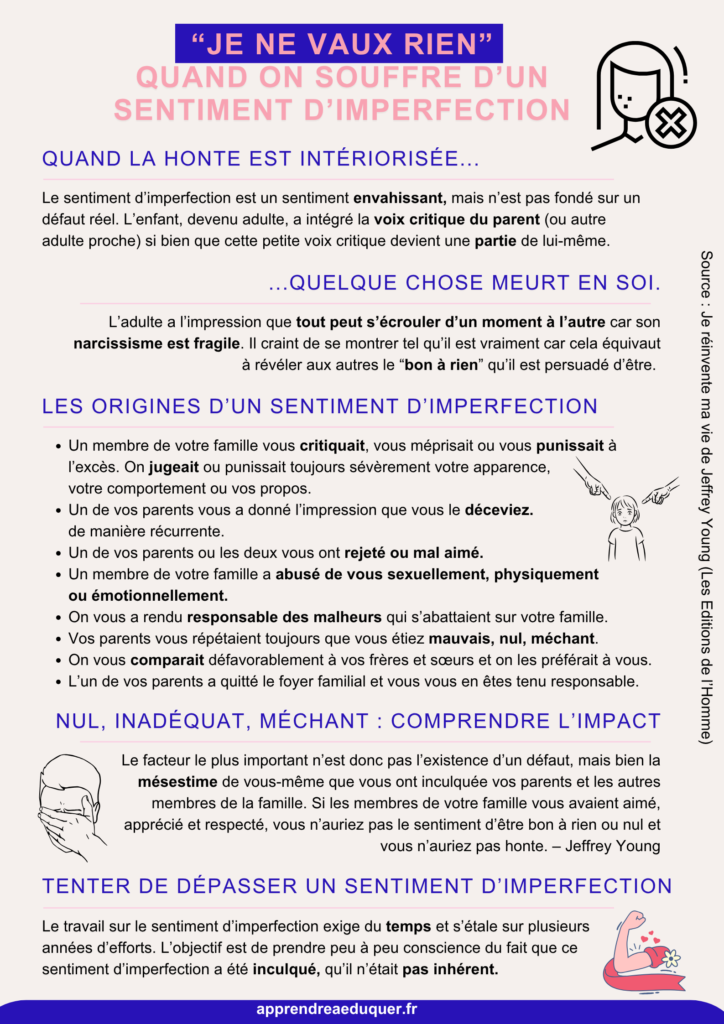
Schema therapy, developed by psychologist Jeffrey Young, describes early maladaptive schemas as deep lifelong patterns that form in childhood and shape how we read ourselves and other people. The imperfection schema is the belief that you are defective, inadequate, or unworthy of love, and that this flaw must be hidden at all costs.
Young traces it back to an impression of not having felt worthy of love and respect during childhood. One or both parents, or close caregivers, were highly critical, dismissive, or rejecting. The child concludes not that the treatment was unfair, but that it was deserved.
Shame that becomes part of the self
In Young's account, shame was everywhere in that childhood, and it attached to the personality itself rather than to a specific behaviour. The child believed they deserved no better, blamed themselves for everything, and felt bad rather than angry about the way they were treated. Over time, the critical parental voice is internalised and becomes a voice of one's own.

How it shows up in adult life
In adulthood the feeling of imperfection is pervasive but not grounded in a real flaw. Because narcissism is fragile, the person feels that everything could collapse at any moment. Showing oneself as one really is feels equivalent to revealing the "good-for-nothing" one is convinced of being.
The person comes to believe that only a false self is worthy of love. This produces a lack of authenticity, and the slightest failing triggers nervousness and anxiety. Young describes it as a kind of mourning: spontaneity, joy, trust, and intimacy give way to a tightly sealed shell, a harder and less vulnerable self. Whatever the toughness on the outside, something inside is grieving.
Parenting your own children can bring these patterns to the surface, which is why many parents find themselves rethinking their own childhood while reading about newborn bonding or planning calm routines. Shared moments like snow games can gently loosen that protective shell. The protective shell is often most visible in intimate family moments, and knowing how to accompany someone through grief can help too.
| Coping behaviour | What it protects | A gentler alternative |
|---|---|---|
| Constant defensiveness | The fragile self-image | Pause, ask a question, respond later |
| Needing reassurance | Fear of rejection | Name the fear and sit with it briefly |
| Hiding true emotions | The false self | Share one honest feeling with a trusted person |
| Avoiding intimacy | Fear of being seen | Stay a little longer in small doses |
| Chasing prestige | Worth tied to status | Notice the need without acting on it |
| Accepting mistreatment | Belief you deserve no better | State one clear boundary |
The childhood origins Young identifies
Young considers that the parents who foster this schema are those who judge the child unfavourably and punish them, and that comparison with a favoured sibling can also play a role, especially an older sibling whose performance looks better simply because of age.
The key factor is not the existence of a defect but the low regard for yourself that was instilled by parents and other family members. Had your family loved, appreciated, and respected you, you would not feel worthless and you would not feel shame.
- A family member criticised, despised, or excessively punished you, always judging your appearance, behaviour, or words severely.
- One parent made you feel you were a recurring disappointment.
- One or both parents rejected you or loved you poorly.
- A family member abused you sexually, physically, or emotionally.
- You were held responsible for every misfortune that hit the family.
- Your parents repeatedly told you that you were bad, useless, good for nothing.
- You were compared unfavourably with siblings who were preferred over you.
- A parent left the home and you blamed yourself for it.
These experiences are heavy, and families often carry them alongside other pressures, from celiac diet basics at the dinner table to the everyday strain of adoption and foster care arrangements. Even routine matters like baby's medical check ups and being careful with bath products can add to the load. None of it is the child's fault.

Recognising the coping styles: avoidance and counter-attack
Young suggests listing the behaviours that show you are managing the feeling of imperfection by fleeing or by counter-attacking, meaning avoiding or compensating. Naming them plainly is what makes change possible.
Typical examples include being systematically defensive in the face of criticism, giving outsized importance to social rank and prestige, needing constant reassurance, misusing alcohol or drugs, avoiding intimate situations, denying personal flaws, and hiding true thoughts and emotions. Each of these protects the false self, but each also keeps the shame alive.
Listening to the feeling instead of silencing it
The next step is to tune in to the feelings of imperfection and shame and list their manifestations: when you are unsure of yourself, when you feel inadequate, when you fear rejection, when you compare yourself to others or feel jealous, when the slightest lack of consideration upsets you, when the smallest criticism makes you defensive, and when you allow yourself to be mistreated because you do not believe you deserve better.
This work is slow and often uncomfortable. It helps to build small moments of genuine play and connection, whether that means pool games with your children, trying fun costume ideas together, or simply letting yourself be seen without performing.

Practical suggestions for loosening the pattern
Young's suggestions are less about erasing the schema than about reducing its hold. Start by becoming aware of the feelings of imperfection and shame that marked your childhood, and let yourself feel the wounded child within who is still looking for approval and respect.
Then work on ending the avoidance and counter-attack behaviours one at a time. This might mean answering a criticism without immediately defending yourself, or staying in a moment of intimacy instead of retreating. Small, repeated acts of honesty gradually teach the nervous system that being seen is survivable.
Finally, examine the relationships that reinforce the schema and the people who trigger it. Some environments reward performance and punish authenticity, and it is worth noticing which ones you keep choosing. Rethinking the home atmosphere, from household chores shared fairly to calmer evening routines, can support this shift.
My hands-on take
I first came across the idea of the imperfection schema during a period when I was achieving a lot and feeling almost nothing. Reading about the false self was uncomfortable, because I recognised the polished version of me that answered emails promptly, never complained, and quietly assumed that any mistake would end everything.
What helped most was not a grand insight but a small habit. I started telling one person, once a week, something I would normally hide, usually a minor failure or a worry I thought was too petty to mention. Nothing terrible happened. Over months, the critical voice lost some of its authority, and I noticed I could stay in a difficult conversation instead of deflecting it. I still catch myself performing, but I now recognise the moment and can choose differently.
Frequently asked questions
Is the feeling of imperfection based on a real flaw?
No. Young stresses that the feeling is pervasive but not founded on an actual defect. What was internalised is the low regard conveyed by caregivers, not an accurate assessment of who you are.
Can this pattern change in adulthood?
Yes, though it takes time. The work involves recognising the schema, naming the avoidance and counter-attack behaviours, and gradually replacing them with more authentic responses.
How do I know if I have this schema?
Look for a persistent sense of shame, fear of being exposed, difficulty being authentic, and strong reactions to criticism. A therapist trained in schema therapy can help you explore it safely.
Does being a parent make it worse?
It can bring old patterns to the surface, because family life invites closeness and vulnerability. Many parents find this an opportunity to understand their own childhood more clearly.
Product Reviews
 Best Toys for Dogs With High Prey Drive |
Best Outdoor Toys for 3-4 Year Olds |
Best Outdoor Toys for 6 Year Olds |
Best Harness for Poodle |
Best LEGO Sets for Adults |
Best Travel Toys for 4 Year Olds on Airplane |
Best Toy Stores in Washington DC |
Best Potty Training Toys |
Best Toys for Tripod Dogs |
Maillot equipe de france







