


Understanding teenagers becomes far less daunting when you have a tool that decodes what is really going on behind the slammed door. This illustrated guide to the teenager in crisis does exactly that, using positive discipline to reframe the famous "adolescent crisis" rather than simply endure it.
Resolutely visual and accessible, the book blends humour with pedagogy and offers precious advice for keeping the link alive during the perilous teenage years. It is written by a clinical psychologist who runs positive discipline workshops and an illustrator passionate about psychology, a pairing that makes the content both expert and easy to absorb.

Quick takeaways
- A visual, humorous guide that decodes teenage behaviour instead of labelling it a crisis.
- Two mirrored parts: 27 situations for parents, 18 for teenagers, answering each other.
- Grounded in positive discipline: needs, emotions, attachment and brain development.
- Shifts the question from punishment to the skills you want your teen to build.
- Includes a bonus guide for managing your own adult anger.
- Best used as a reference, dipped into as situations arise.
A Book That Decodes Rather Than Judges
What makes this book stand out is that it is both theoretical and practical at once. The expertise of a positive discipline trainer meets the clarity of an illustrator, so the diagrams and drawings carry as much weight as the text. It works as a genuine tool rather than a lecture.
The book has a double originality. First, it presents everyday situations as visual schemas and cartoons, which makes abstract ideas instantly recognisable. Second, it splits into two parts: one addressed to parents of teenagers and one addressed directly to teenagers themselves. The two halves answer each other, which is where the real insight lies.
For example, parents complain that their teen only thinks of them when he needs something, while the teen cannot understand why his parents still expect him to come along. Seeing both sides side by side softens the blame on each. If you have ever felt blindsided by a sudden shift in mood, the pregnancy brain changes article is a useful reminder that brain development shapes behaviour at every stage, not just adolescence.

Twenty-Seven Situations Decoded for Parents
The first part walks parents through twenty-seven concrete situations. Among them: "He only thinks of us when he needs something", "He eats badly", "He doesn't help around the house", "His smartphone is grafted to his hand", and "He brings home someone we don't like". Each one is unpacked without drama, so you can recognise your own household and respond with more calm.
These scenarios are not there to shame anyone. They are there to help you reason in terms of needs, emotions, attachment and development rather than punishment and repression. The guiding question shifts from "what is the most effective punishment to make my teen stop?" to "what skills do I want my teenager to acquire?". That single change of frame alters everything about how a conflict unfolds.
Some situations touch on health and daily habits, and it helps to approach them with the same curiosity. If your teen is secretive about physical discomfort, the piece on genital disorders children explains why open, matter-of-fact language matters. Likewise, when posture and heavy school bags become a battleground, the advice on protecting children's backs gives you practical ground to stand on rather than nagging.

| Parent's concern | Teen's perspective | Useful reframe |
|---|---|---|
| He only calls when he needs something | I need space but still need you | Attachment remains, expression changes |
| His phone is glued to his hand | They don't trust me with screens | Agree on shared rules, not surveillance |
| He doesn't help at home | I'm never asked, only ordered | Assign clear, regular responsibilities |
| He brings home someone we dislike | My friends are my identity | Discuss behaviour, not the person |
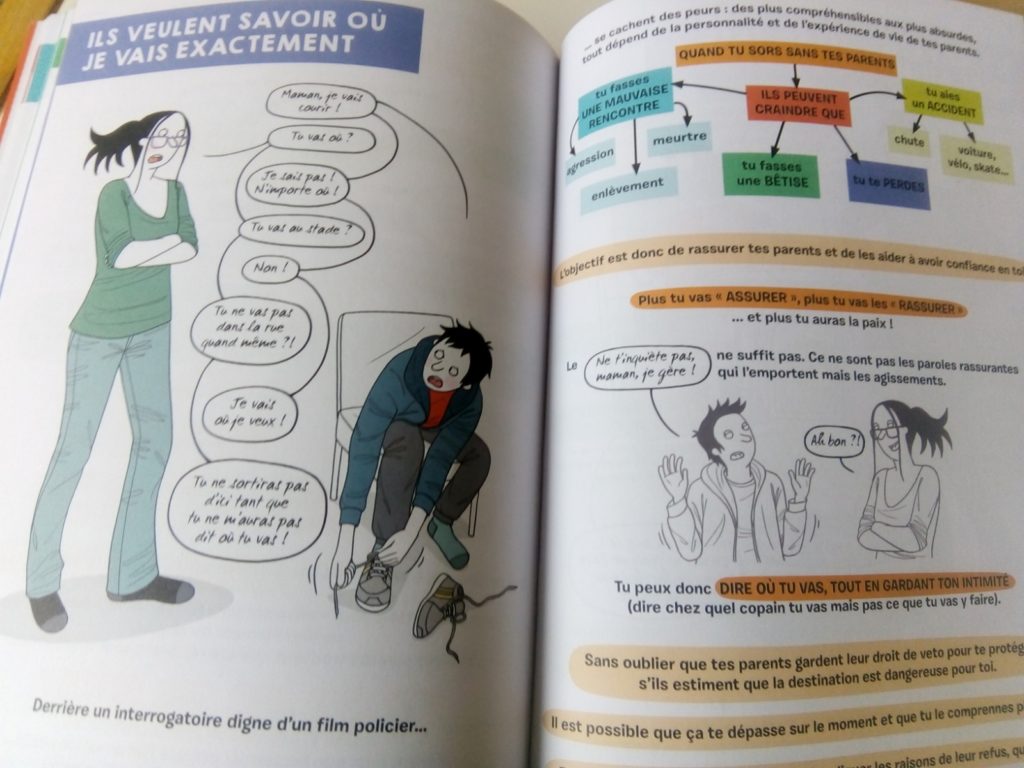
| They want to know where I am | They imagine the worst | Share plans, keep it factual |
Eighteen Situations Written for Teenagers Themselves
The second part speaks directly to teenagers through eighteen situations, such as "They talk down to me or lecture me", "They don't trust me with screens", "They want to know exactly where I am", and "They imagine all sorts of things about my sexuality". Written in the teen's own register, it names the frustration without endorsing every choice.
Parents benefit from this section just as much, because it lets them step into their teenager's shoes for a few pages. Reading how it feels to be distrusted over a phone, or to be interrogated about every outing, often reframes a parent's own tone. This is where the book quietly builds empathy in both directions.
Boundaries still matter, of course, and the book is clear that understanding is not the same as permissiveness. A household that explains the reasoning behind a rule tends to meet less resistance than one that simply imposes it. The reflection on blackmail and education is a good companion here, since it shows why pressure tactics backfire with children of any age.

The Foundations of Caring, Emotional Education
Running through the whole book are the foundations of emotional and caring education. You will find active listening, attachment, reasoning in terms of cognitive and motor capacities, and the reminder that a teenager may simply not know, not understand, or not yet be capable of certain things.
There are also neuroscientific explanations of how the brain changes during adolescence, covering identity shifts and changes in rhythm and sleep. Understanding emotions and needs, especially the need for affection, sits alongside learning to let go and to solve problems together rather than for your teen. These are the same principles that help at any age, whether you are managing new mom stress or navigating the teenage years.
The book encourages reasoning differently so you can act differently. Instead of asking what sanction will work, you ask what your teenager is trying to express. That shift is not always easy, and it helps to have small daily anchors, like the ideas in snow games for shared time that rebuilds connection without a heavy conversation.
Bonus Material and How to Use the Book
Two bonuses round out the volume. A guide at the end helps adults tame their own anger, which is often the missing piece in parenting advice. The book also points readers toward further resources for ongoing support.
The foreword is honest: the book is not magic. Its purpose is to offer keys to mutual understanding for more harmony within families, and that framing keeps expectations realistic. Used as a reference rather than read once and shelved, it works best when you dip into the situation that matches your week.
Families juggling screens, activities and logistics will find the approach fits real life rather than an ideal one. If your days are stretched thin, the tips on maximizing car space and on educational children's apps show how practical adjustments reduce friction and free up energy for the conversations that matter.


My hands-on take
I keep this book on the kitchen shelf rather than in a study, because that is where the tense conversations tend to happen. The first time I opened it, I went straight to the smartphone chapter, expecting to feel vindicated. Instead I found myself reading the teenager's page next to it, and recognising the tone I use when I am worried rather than when I am calm.
What I actually changed was small. I stopped asking where my teen was going and started asking what the plan was, which sounds like the same question but lands very differently. I also used the anger guide at the back more than once, mostly as a reminder to pause before answering. The book did not fix anything overnight, and it never promises to. It simply gave me a calmer way to look at the same situation, which turned out to be the part I could control.
Frequently asked questions
Is this book only for parents of teenagers in serious difficulty?
No. It addresses ordinary everyday friction, from messy habits to screen use, and is useful for any family with an adolescent. The tone is reassuring rather than alarmist.
Can teenagers read it themselves?
Yes. The second half is written directly for them, with eighteen situations in their own register. Parents are encouraged to read it too, to see things from the other side.
Does it replace professional help?
No. It offers keys to mutual understanding and everyday problem-solving, not therapy. If a situation feels serious, it should sit alongside professional support.
How should I use it in practice?
Treat it as a reference. Find the situation closest to your current struggle, read both the parent and teen pages, then try one small change rather than overhauling everything.
Product Reviews
 Best Toys for Dogs With High Prey Drive |
Best Outdoor Toys for 3-4 Year Olds |
Best Outdoor Toys for 6 Year Olds |
Best Harness for Poodle |
Best LEGO Sets for Adults |
Best Travel Toys for 4 Year Olds on Airplane |
Best Toy Stores in Washington DC |
Best Potty Training Toys |
Best Toys for Tripod Dogs |
Maillot equipe de france







