


Food bribery feels like a quick fix at the dinner table, but it quietly damages the relationship between children and eating. Pediatrician Arnault Pfersdorff, in his short book on children who do not eat, warns parents of "small eaters" and "difficult eaters" about how harmful it is to bargain with food just to get a child to eat.
He reminds us that when parents feel forced to use this "trick," it may simply mean the child is no longer hungry. In that case, the bargaining turns into a process of force-feeding. So how do you avoid food bribery while still feeding your child well?

Quick takeaways
- Food bribery undermines a child's trust in their own hunger and fullness cues.
- Play and movement are rights, never rewards for finishing a plate.
- Let children serve themselves and say when their tummy is full.
- Dessert is part of the meal, not a prize for eating vegetables.
- Talking about "good health" to a young child can create unnecessary fear.
- Offer, value, encourage and invent rather than negotiate or force.
Why Food Bribery Backfires
Certain phrases are so common that most of us have heard them, yet they are both useless and harmful. They degrade the parent-child relationship and undermine a child's confidence in their own bodily sensations. Over time they also root mistaken beliefs, especially associating food with fear.
When a child refuses to eat, the reflex is often to negotiate. But bargaining teaches children to ignore hunger cues and to see eating as a task to complete rather than a pleasant experience. If mealtimes have become a battleground, you may find broader strategies useful in learning from children, since observation often reveals more than pressure ever will.
The real problem is not the child
In many cases the adult has set a goal to reach: an empty plate, whatever the child thinks or however their appetite stands. Authority then leads to standoffs where the only loser is the child.
"If You Finish Your Plate, You Can Go Play"
Pfersdorff regrets that this statement sends children the message that the amount of food swallowed and the right to play are linked. The right to play, to move, to run outside, should never be conditioned on a quantity of food.
Think about what this teaches: that movement is a reward earned by eating, and that a full stomach is a ticket to freedom. Children absorb these messages quickly, and they carry them into other areas of life. The same principle of not turning basics into bargaining chips applies when you navigate baby care, where routines work best when they are predictable rather than traded. A good teacher family relationship reinforces this consistency between home and school.
Play is a developmental need, not a privilege. Keeping it separate from food preserves both a healthy appetite and a healthy attitude toward movement. Just as with concerning online challenges, clear boundaries protect children.

| Phrase to avoid | What it teaches | Gentler alternative |
|---|---|---|
| Finish your plate to play | Play is earned by eating | Let play follow the meal regardless |
| Stay until you finish | Adult knows better than the child | Ask "stop or more?" |
| No dessert until you finish | Dessert is a reward | Serve dessert as part of the meal |
| Eat soup to grow | Food is linked to fear | Talk about taste, not health risks |
| Clean plate equals success | Quantity matters more than appetite | Let the child self-serve |
"You Won't Leave the Table Until You Finish"
The problem with this kind of statement is that the child's satiety is ignored by the adult, who assumes they know better than the child what the child needs and feels, still hungry or not. The subject is no longer the child but the adult who has set an objective to reach.
Alternatives exist. Let the child serve themselves so they estimate how much food they need. Ask the child what their tummy is telling them: stop or more? Simply acknowledge that the child does not want any more. These small shifts respect appetite and build trust.
For families juggling several children at one table, the dynamics get even more complex, and the guidance on sibling fights can help you keep the peace without turning meals into a contest.
"No Dessert Until You Finish What's on Your Plate"
A dessert is not a reward; it is simply part of the meal, just like the starter and the main course. A balanced diet is obviously a source of good health, but food bribery is no guarantee of a balanced diet.
Pfersdorff teases parents by asking them to remember how they behaved as children faced with a plain boiled endive, a ratatouille, or a plate full of beans. He points out that a child has a whole lifetime ahead to discover this extraordinary range of foods. And they have the right not to like some of them.
It is entirely conceivable to respect a child's tastes. Do you truly love every vegetable, every meat and every fish? Not to mention oysters, snails, beef tongue or lamb's brain? If so, since when? Try the test. If you want to raise children who respect living things, the ideas in respecting animals can complement this gentler approach to food.
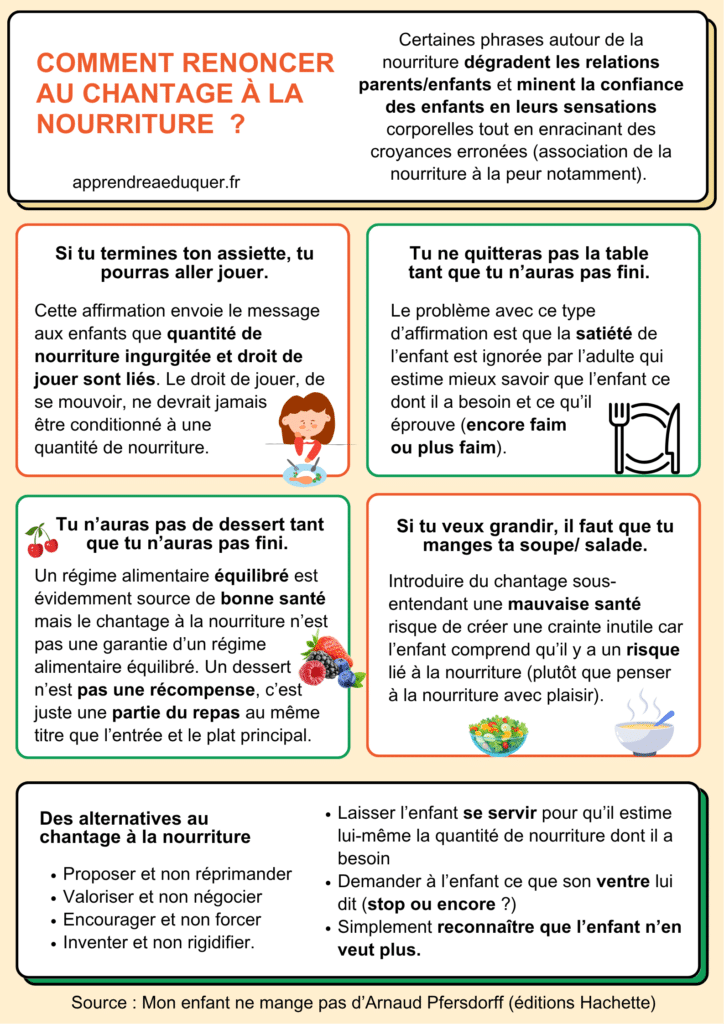
"If You Want to Grow, You Have to Eat Your Soup"
Talking about "good health" to a young child makes little sense because they do not know what it means. Pfersdorff believes that introducing bargaining while talking about good health risks creating unnecessary fear, because the child understands there is a danger linked to food rather than thinking of food with pleasure.
His advice is simple: offer rather than scold, value rather than negotiate, encourage rather than force, invent rather than rigidify. Your child has everything to gain, and so do you. They have their own personality, tastes and preferences, just like you.
Keep the joy in eating
Meals are one of the first places a child learns about pleasure, autonomy and trust. Protecting that space is worth far more than a clean plate. If you are preparing for a new baby while managing a picky eater, the practical tips in postpartum doula support can help you plan the transition calmly.
Building a Calmer Mealtime
Moving away from food bribery does not mean giving up on variety. It means changing the tools: serve small portions, keep offering new foods without pressure, and let the child decide how much to eat. Repeated exposure matters more than any single meal.
Some families find that keeping the table free of distractions helps children tune into their own hunger. Others use play and conversation to make meals feel safe. If your child is easily distracted or restless, the games suggested for car travel games can inspire simple, low-pressure rituals you adapt to the table. Helpful breastfeeding support apps can also make feeding routines feel more manageable, and learning how to interact with children on the Autism spectrum can guide calmer, more supportive mealtimes.
Above all, remember that appetite fluctuates. A child who eats little at one meal often makes up for it later. Trusting that rhythm is the foundation of a relaxed relationship with food.


My hands-on take
I remember the phase when dinner became a nightly negotiation in our house. My child would push the plate away and I would hear myself saying, "Just three more bites and then you can get down." It never worked the way I hoped. The bites were swallowed under protest, and the next evening we started all over again.
What changed things was stepping back. I started letting my child serve themselves, even when the portions looked tiny, and I stopped linking dessert to the plate. Some nights they ate almost nothing; other nights they surprised me. The tension at the table dropped, and meals slowly became something we shared rather than something we fought over. It is not perfect, but it is calmer, and that feels like real progress.
Frequently asked questions
Is it ever okay to use dessert as a reward?
A dessert is simply part of the meal, not a prize. Using it as a reward teaches children to value sweets over other foods and to ignore their own fullness. Serving it alongside the meal keeps things neutral.
What if my child refuses to eat anything at dinner?
Appetite fluctuates, and one light meal is rarely a problem. Offer the food without pressure, acknowledge that they may not want more, and trust that hunger will return. Forcing or bargaining tends to make refusal stronger.
How do I get my child to try new vegetables?
Keep offering small portions without pressure and let the child decide. Remember that you do not love every food either, and a child has a lifetime to discover new tastes. Repeated, relaxed exposure works better than negotiation.
Does this mean I should never encourage my child to eat?
Encouragement is fine; forcing and bargaining are not. Offer, value and invent rather than negotiate. Respecting your child's tastes and signals builds a healthier relationship with food over time.
Product Reviews
 Best Toys for Dogs With High Prey Drive |
Best Outdoor Toys for 3-4 Year Olds |
Best Outdoor Toys for 6 Year Olds |
Best Harness for Poodle |
Best LEGO Sets for Adults |
Best Travel Toys for 4 Year Olds on Airplane |
Best Toy Stores in Washington DC |
Best Potty Training Toys |
Best Toys for Tripod Dogs |
Maillot equipe de france







