


Shame is a useful and legitimate emotion, even though most of us would rather avoid it. It shows up as a tightening in the body, a wish to cry, self-criticism, and negative images that loop in the mind.
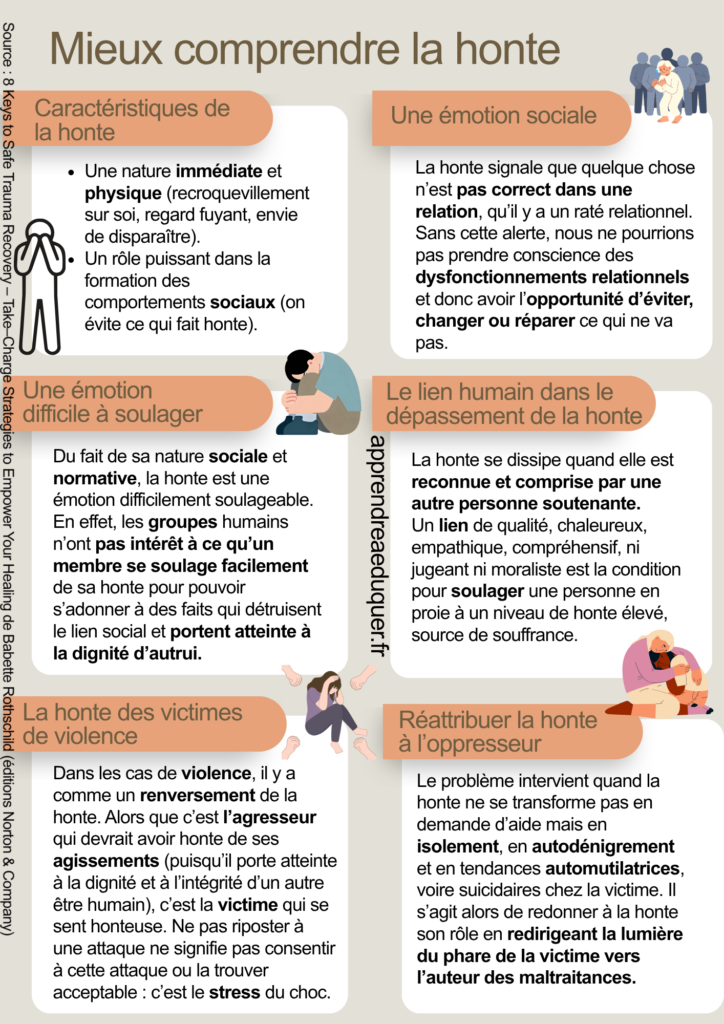
Babette Rothschild, an American psychotherapist who specializes in post-traumatic stress, reminds readers in her book 8 Keys to Safe Trauma Recovery that no one enjoys feeling ashamed. Yet like every other emotion, shame is necessary for survival. In simple terms, shame signals that something is not right in a relationship, that there has been a social misfire.

Without this alert, we could not notice relational dysfunction, and we would lose the chance to avoid, change, or repair what is going wrong. Rothschild compares shame to a lighthouse that shines a beam on what must be corrected.
Quick takeaways
- Shame is a normal, useful emotion that signals a relational problem.
- It pushes us toward behaviors that keep us included in a group.
- Too little shame removes moral barriers; too much shame paralyzes and harms.
- Victims of violence often carry shame that belongs to the aggressor.
- Shame does not discharge like anger or sadness; it eases through connection.
- Knowing how stress reactions work helps victims stop blaming themselves.
Why shame is a social signal
Because shame shapes the behaviors accepted within a sociocultural group, it pushes us toward conduct that favors inclusion and acceptance. We are driven by a biological process that seeks to preserve individual life, and that preservation is easier within a peaceful social group. Social emotions, shame among them, help maintain the group so that each member can survive.
This is why shame feels so physical and immediate: we hunch over, look away, want to disappear. It also explains why the human bond matters so much when overcoming shame. A child who feels ashamed needs a calm adult nearby, much as a parent offering toys for newborns stays close and responsive in the early months.
Too much or too little
As with everything in human experience, extremes cause problems. Feeling too much or too little shame is unhelpful and even harmful, both individually and collectively. Someone who feels no shame lacks the moral barriers that stop them from harming others. At the other end, someone can feel so much shame that they become paralyzed and ill.
When shame gets turned around
This heavy shame is often felt by victims of physical assault, harassment, discrimination linked to homosexuality, rape, or incest. It frequently attaches to the belief of not having defended oneself or others, not having fled, or not having alerted anyone. In cases of violence, shame is somehow reversed: the aggressor should feel ashamed, since they attack another person's dignity and integrity, yet the victim carries the shame.
Shame then stops working to halt the abuser and instead alerts the victim to a dysfunction. It can confirm how deeply immoral and violent the acts suffered were. The problem arises when shame turns not into a request for help but into isolation, self-denigration, and self-harming or suicidal tendencies. The task is to redirect the lighthouse beam toward the perpetrator. Parents navigating difficult moments may find steadying routines helpful, such as toddler bed transition steps that keep home life predictable, and knowing how much milk to prepare can ease the return to work. For broader guidance, consider whether to educate children by directing their process or letting them flow.

| Sign | What it may mean | Supportive response |
|---|---|---|
| Hunching, looking away | Immediate physical shame response | Stay calm, lower your voice |
| "I'm stupid, I ruin everything" | Self-denigration | Separate behavior from worth |
| Withdrawal and silence | Shame turning into isolation | Offer quiet, non-judgmental presence |
| Blaming self after harm | Reversed shame in victimhood | Redirect responsibility to the aggressor |
| No remorse after hurting others | Too little shame | Set clear limits and repair |
The characteristics of shame
Shame is marked by its immediate, physical nature, its powerful role in forming social behavior, and the importance of human connection in moving past it. Because of its social and normative nature, shame is hard to relieve. Human groups have no interest in letting a member easily discharge shame and then repeat acts that destroy social bonds and harm others' dignity.
Yet people who feel shame after a traumatic event need relief. Shame does not discharge the way other emotions do, such as crying for sadness or shouting for anger. It dissipates when it is recognized and understood by another supportive person. A warm, empathetic, understanding bond, neither judgmental nor moralistic, is the condition for relieving someone overwhelmed by shame. Everyday connection matters here, whether through a simple box shared in play or a quiet conversation.
Learning how stress reactions work
According to Rothschild, being informed about the mechanism of traumatic stress can help people understand why reactions of freezing and not reporting are not abnormal. During a traumatic event, a stress reaction switches on. It protects through defense (struggling, shouting to alert others) or flight when possible. When neither option is available, the body freezes to cushion the shock.
These three stress reactions are the protections nature gave us to survive traumatic shocks. Post-traumatic stress can develop when these short-term reactions last over time instead of fading. The amygdala, the brain's emotion center, keeps releasing stress hormones at the slightest reminder, so the reactions repeat. It is not the victim's fault if they did not react during an assault or develop symptoms such as startling at certain sounds. Children benefit from caregivers who understand this, and even small moments, like how they learn to speak, show how much support shapes development. Understanding pregnancy symptoms early can also help parents prepare for the changes ahead, just as magical characters shape a child's imagination.
Supporting a child through shame
When a child feels ashamed, the first step is to stay calm and curious rather than corrective. Name what you notice without shaming further: "It looks like something feels heavy right now." This keeps the lighthouse beam on the situation, not on the child's worth.
Second, separate the behavior from the person. A child who broke something or hurt a sibling can repair the harm without being told they are bad. Repair builds responsibility; humiliation builds isolation. Third, model repair yourself by apologizing when you lose your temper.
Finally, remember that shame needs a warm relationship to dissolve. A steady routine, shared play, and honest conversation do more than lectures. Even choosing affordable toys together or reading books with flaps side by side creates the calm closeness a child needs to feel safe again.

My hands-on take
I have seen shame show up in small, ordinary moments: a child who drops a plate and freezes, waiting to be told they are clumsy. What helped most was slowing down and saying, "It was an accident, let's clean it together." The tension in their shoulders eased almost immediately.
I also learned to watch my own reactions. When I apologized for snapping, my child seemed relieved, as if permission had been granted to be imperfect. Shame needs a warm relationship to dissolve, and that relationship starts with me staying calm and curious rather than corrective.
Frequently asked questions
Is shame always a bad emotion?
No. Shame is a legitimate signal that something is wrong in a relationship. It helps us notice social misfires and repair them, which supports inclusion in a group.
Why do victims of violence feel ashamed?
Victims often blame themselves for not defending themselves, fleeing, or alerting someone. In reality the shame belongs to the aggressor, and redirecting that beam is part of healing.
How can I help a child who feels ashamed?
Stay warm and non-judgmental, separate the behavior from the child's worth, and focus on repair rather than humiliation. Shame eases through a supportive relationship, not through lectures.
What makes shame different from other emotions?
Shame does not discharge through crying or shouting the way sadness or anger do. It dissipates when it is recognized and understood by another supportive person.
Product Reviews
 Best Toys for Dogs With High Prey Drive |
Best Outdoor Toys for 3-4 Year Olds |
Best Outdoor Toys for 6 Year Olds |
Best Harness for Poodle |
Best LEGO Sets for Adults |
Best Travel Toys for 4 Year Olds on Airplane |
Best Toy Stores in Washington DC |
Best Potty Training Toys |
Best Toys for Tripod Dogs |
Maillot equipe de france







