


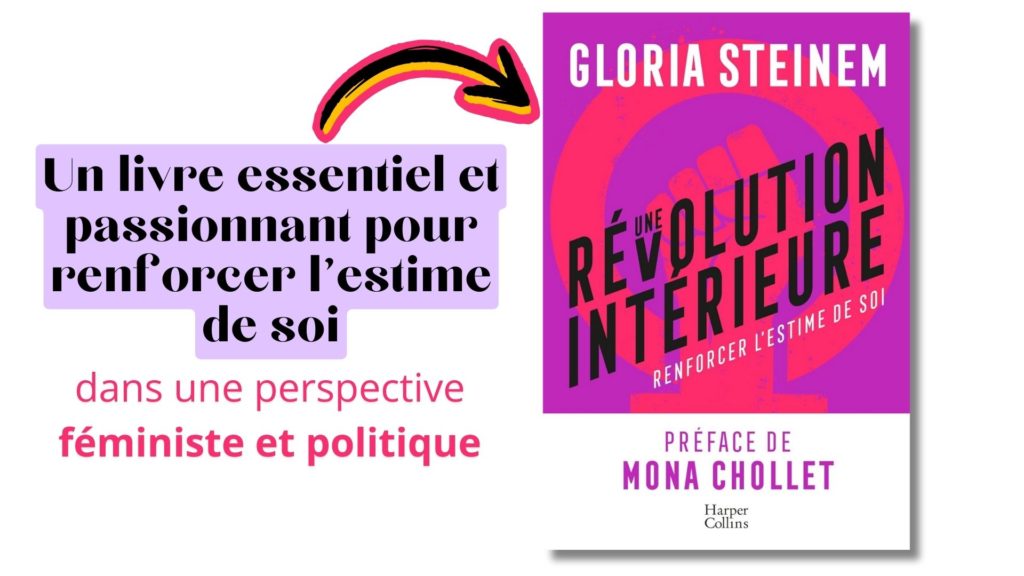
Feminist self-esteem is not a wellness trend; it is a way of seeing how social injustice wears down a woman's confidence, and how that confidence can be rebuilt. Gloria Steinem's Une révolution intérieure, first published in 1991, remains a pillar of contemporary feminism and a manual for taking back your own life.
This is no softened self-help volume. It is a manifesto that braids literature, history, politics, colonialism, education, ecology and sociology, where the personal and the political answer each other on every page.

Steinem writes as someone who has spent a lifetime fighting social injustice, and she compares feminism with the struggle against racism, denouncing both and offering individual as well as collective responses.
Quick takeaways
- Self-esteem is political: injustice, not personal failure, erodes it.
- Marketing cannot absorb genuine inner strength.
- Naming a problem is a necessary step toward solving it.
- Shared power at home rehearses democratic life.
- Autonomy grows through mastery, not rescue.
- The book still reads as a living manifesto.
Why This Book Refuses the Self-Help Label
Steinem's starting point is that injustice erodes self-esteem in women and in men alike, and that this damage is not a private failing but a shared condition. She wrote the book as a manual to help readers reclaim their own lives, treating self-esteem as a source of inner strength for women and minorities.
Crucially, she insists this strength is subversive: it cannot be recuperated by the dominant or repackaged by marketing. That distinction matters for parents who want to raise confident children without handing their sense of worth to advertisers, and it echoes the broader conversation about parenting lessons we pass on without noticing. It also sits alongside practical concerns like newborn bilirubin, where early reassurance matters just as much.
The book is also a pleasure to read for its curiosity. Steinem ranges across African-American history, the Brontë sisters, Egyptian religions, the horrors of craniology and Margaret Mead's anthropology, and she devotes several pages to the difference between romance and love.
Readers meet familiar references too, such as Alice Miller and Alfie Kohn, which gives the argument a solid grounding in psychology and education, much like the surprising calculations behind Lego's worth per kg.
The Social Brakes on Personal Confidence
Steinem examines antisemitism, racism, colonial mentality, religion, the destruction of nature, homophobia, schooling, diplomas and the arts. Each topic opens a perspective on the social, cultural and psychological brakes that restrain personal self-esteem.
Her sharpest observation is about socialisation: women and men alike learn to internalise a lack of seriousness toward anything coded feminine, including women themselves. Recognising that reflex is the first step toward dismantling it, and the same patience applies when helping grandparents follow family rules that challenge old habits. The same steady, unforced approach helps when toys pile up and clutter starts to crowd the calm you are trying to build.
She also shows how small everyday choices carry weight, from the makeup a teenager asks for to the way a child's hair is groomed, both of which touch on how girls learn to see themselves through others' eyes.
For parents, the lesson is to watch the messages children absorb long before they can name them, and to question the ones we repeat ourselves.

| Step | What it means | Everyday practice |
|---|---|---|
| 1. Seeing | Refusing others' definitions | Ask children what they think first |
| 2. Telling | Sharing supposed secrets | Keep shame out of household talk |
| 3. Naming | Giving problems a name | Name unfairness out loud |
| 4. Connecting | Finding shared experience | Join groups and communities |
| 5. Autonomy | Owning space and income | Let children manage something |
| 6. Shared power | Living democracy | Rotate decisions at home |
| 7. Interdependence | Being truly oneself | Balance help and independence |
Seven Steps to Reclaiming Self-Esteem
Steinem compares the journey toward the self-esteem we should all enjoy from birth with the political independence of minority groups. The path runs through seven stages, each of which can be practised in daily life.
From Seeing to Interdependence
The first step is seeing with our own eyes rather than through others', as when a woman stops being defined by the male gaze. The second is telling what we believed were shameful secrets and discovering they are neither secret nor shameful, from a survivor of sexual assault to a man who was a victim of incest.
The third is naming problems that had no name because they seemed normal, as happened with homophobia, coercive control or eurocentrism. The fourth is drawing close to those who share similar experiences, whether disability associations or indigenous conferences.
The fifth is reaching empowerment and political autonomy, from a woman with her own space and income to a nation declaring independence. The sixth is building bonds within shared power, living democratic principles in family, school and work, which is also how cause and effect understanding begins in childhood. The seventh is balancing dependence and interdependence so each person is truly herself.
Small everyday practices, like caring for long hair or making tie dye shirts together, can quietly nurture that growing confidence.

Reading Steinem as a Parent
What makes the book useful at home is its refusal to separate the personal from the political. A child's self-esteem is shaped by the room they are given to speak, the chores they are trusted with and the examples they see, not by slogans.
Steinem's insistence that femininity deserves seriousness translates into concrete choices: who is listened to at the dinner table, whose interests are treated as important, and how conflict is handled. Parents who model shared power give children a lived rehearsal for the sixth step.
The book also warns against rescue narratives that keep people dependent. Encouraging autonomy, even imperfectly, respects the fifth step, and choosing toys and activities that let children master something on their own supports the same instinct.
None of this requires a perfect household. It requires attention, and a willingness to name what was previously treated as normal.

Why It Still Matters Today
Published in 1991, Une révolution intérieure has not aged into nostalgia. Its analysis of how marketing and dominant groups absorb subversive energy reads as freshly as any current critique of empowerment branding.
Steinem's method of holding complexity, letting history and policy sit beside personal experience, gives readers a way to think rather than a list to follow. That is why the book remains a monument and a pillar of present-day feminism.
For anyone raising children, it offers something rarer than tips: a lens. You finish it more clear-eyed about the forces shaping confidence, and more combative about the ones that should not be there.
The hope Steinem leaves is that self-esteem, once reclaimed, is not a private treasure but a shared resource.
My hands-on take
I came to this book expecting a gentle read and instead found myself cycling through anger, indignation, sadness, enthusiasm and shame before landing on compassion. What stayed with me was the chapter on naming problems that had no name, because I recognised several of my own habits in it.
Since then I have tried a small experiment at home: before correcting a child's opinion, I ask what they noticed first. It is a tiny shift, but it makes the first step of Steinem's path something we practise rather than merely discuss.
Frequently asked questions
Is this a self-help book?
No. Steinem wrote it as a manifesto linking personal confidence to social and political injustice, and it deliberately resists the self-help genre's individual focus.
Do I need to know feminist theory to read it?
Not at all. The book moves through history, literature and sociology, so curious readers can follow it without prior background.
Is it useful for parents of boys?
Yes. Steinem shows that men also internalise contempt for the feminine, so the analysis applies to raising sons as much as daughters.
When was it published?
It appeared in 1991 and remains widely available in libraries, bookshops and online retailers.
Product Reviews
 Best Toys for Dogs With High Prey Drive |
Best Outdoor Toys for 3-4 Year Olds |
Best Outdoor Toys for 6 Year Olds |
Best Harness for Poodle |
Best LEGO Sets for Adults |
Best Travel Toys for 4 Year Olds on Airplane |
Best Toy Stores in Washington DC |
Best Potty Training Toys |
Best Toys for Tripod Dogs |
Maillot equipe de france







