


The iceberg of emotions is a simple visual tool that helps children understand what lies beneath a feeling. Emotions are always linked to needs, and this image makes that link concrete: the emotion is the visible tip of the iceberg, while the need or needs stay hidden underwater.
Behind every emotion, pleasant or painful, there is always one or more needs waiting to be recognised. The whole work of emotional literacy consists of putting the right words on what we feel and decoding emotions into needs.

Quick takeaways
- The emotion is the visible tip; the need is the hidden part of the iceberg
- Emotional literacy means naming the feeling, then decoding the need
- Practise with two prompts: “I felt…” and “I needed…”
- Pleasant emotions are linked to needs too and deserve to be welcomed
- In conflict, ask what is under the emotion instead of asking for calm
- Suitable from around age seven, and useful for adults as well
How the iceberg of emotions works
The comparison is easy to grasp: the emotion is the emerged, visible part of the iceberg, and the need is the immersed part we cannot see. Children quickly understand that what shows on the surface is only a small piece of the picture.
This matters because emotional literacy is not about suppressing feelings. It is about naming them accurately and then asking what the feeling is pointing to. When a child learns to say “I felt left out, I needed connection”, the emotion stops being a mystery.
For parents, the same logic applies to everyday family life, from bedtime routines to rainy day activities, where frustration often hides a simple need for movement or attention. The same holds for outings like natural swimming spots, and even for parents seeking calm through prenatal yoga classes.
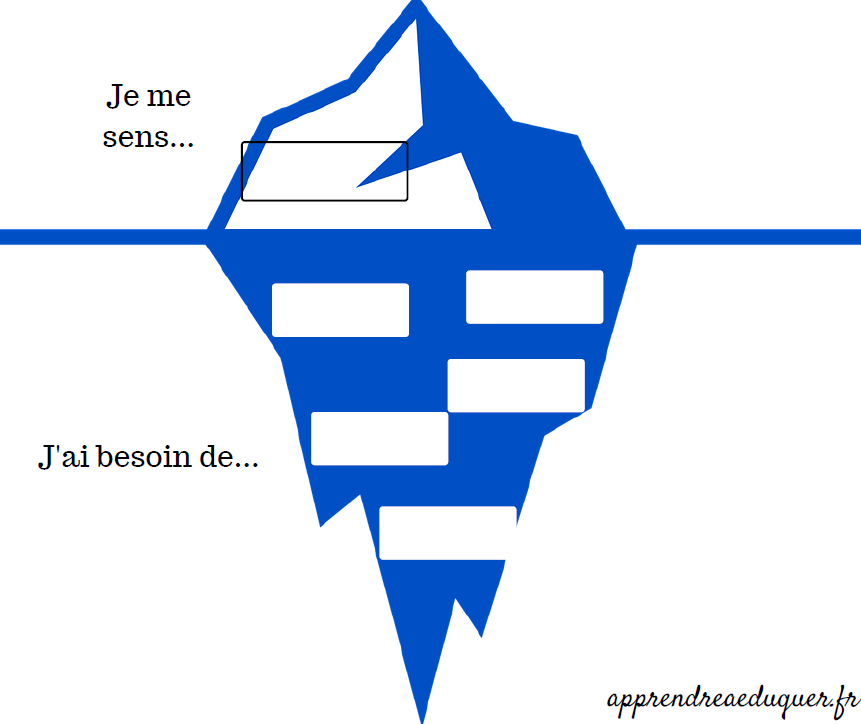
A simple exercise to practise naming feelings
The tool works best as regular practice rather than a one-off lesson. The idea is to train yourself to name an emotion felt recently and then look for the need behind it, using two sentence starters: “I felt…” and “I needed…”.
This exercise is useful for decoding strong and painful emotions such as anger, fear, sadness or shame. But it is just as important to understand that pleasant emotions, such as joy, optimism, gratitude, enthusiasm, confidence, love, calm and serenity, are also linked to needs and deserve to be welcomed just as much as the difficult ones. Keeping your parental authority intact makes this naming feel safe and steady for your child.
Children who struggle to bounce back after a setback often benefit from this kind of naming, which pairs well with learning helping children disappointment without rushing to fix the feeling. If you are preparing for motherhood, these movies about real motherhood can offer useful perspective.

| Feeling | What may be underneath | A question to try |
|---|---|---|
| Sadness | A need for comfort or connection | What would help you feel less alone? |
| Fear | A need for safety or predictability | What would make this feel safer? |
| Anger | A need for respect or fairness | What did you need in that moment? |
| Shame | A need for acceptance | What would help you feel accepted? |
| Joy | A need for play or shared meaning | What made this feel so good? |
Using the iceberg during conflicts
In moments of conflict, it helps to remind the child of the system in plain words: “Remember, when you feel an emotion, there are needs underneath, like the hidden part of the iceberg. Tell me what you need, what is under your emotion?”
This question shifts the conversation away from blame and towards understanding. Instead of asking a child to stop crying or shouting, you invite them to look under the surface with you.
The same patient decoding is useful in other tense moments of family life, such as the days after a trip when everyone is tired, and children jet lag turns small frustrations into big ones.

Examples for sadness, fear, anger, shame and joy
The tool includes examples with sadness, fear, anger, shame and joy so families can see how the iceberg works in practice. These examples are not models of what you should say or do; they are simply footholds that illustrate the mechanism.
For instance, sadness might sit above a need for comfort or connection, while anger often covers a need for respect or fairness. Shame can point to a need for acceptance, and joy to a need for play, meaning or shared delight.
Seeing a positive feeling treated the same way as a hard one is reassuring for children. It shows that all emotions carry information, and that naming a need is a skill that can be learned, much like any other, whether the child is playing with toddler toys or talking at the dinner table. This steady practice also helps with your first night away and with maintaining children's enthusiasm over the festive season.

Who can use this tool, and from what age
The iceberg of emotions can be offered to children from around seven years old, and it is also useful for adults. Younger children can still benefit from the vocabulary, even if they need more help putting the sentences together.
Adults often find the exercise revealing too. Naming a strong reaction at the end of a long day and asking what need was underneath can change how the evening unfolds, and it models the very skill we are teaching.
Printing the tool and keeping it visible makes it easier to return to in calm moments rather than only in the middle of a crisis, which is when new habits are actually built.
My hands-on take
I started using the iceberg with my own child after a run of evening arguments that seemed to come out of nowhere. Instead of asking him to calm down, I began asking what was under the anger. The first few times he just shrugged, but eventually he said he was worried about not finishing something at school. That answer changed the whole tone of the conversation.
What surprised me most was how often the need was something simple: rest, food, or a few minutes of my full attention. I now try to use the two prompts myself when I feel a sharp reaction rising, and I have noticed it slows me down enough to respond rather than react. It is not a cure, but it is a small, practical habit that has made our evenings calmer.
Frequently asked questions
What age is the iceberg of emotions suitable for?
It can be offered to children from around seven years old, when they can connect a feeling with a need using the two sentence starters. Younger children can still hear the vocabulary and join in with adult support.
Should I use it only when my child is upset?
No. It works best as regular practice in calm moments, so the habit exists before a crisis. You can then remind the child of the system during conflicts.
Does it apply to happy feelings too?
Yes. Joy, gratitude, calm and confidence are also linked to needs, and welcoming them in the same way teaches children that all emotions carry useful information.
Is this tool only for children?
Not at all. Adults can use the same two prompts to decode their own strong reactions, and doing so models the skill for children.
Product Reviews
 Best Toys for Dogs With High Prey Drive |
Best Outdoor Toys for 3-4 Year Olds |
Best Outdoor Toys for 6 Year Olds |
Best Harness for Poodle |
Best LEGO Sets for Adults |
Best Travel Toys for 4 Year Olds on Airplane |
Best Toy Stores in Washington DC |
Best Potty Training Toys |
Best Toys for Tripod Dogs |
Maillot equipe de france







