


The Enormous Crocodile is one of the easiest Roald Dahl books to share with a young reader, and it is packed with jokes, rhymes and gloriously over-the-top vocabulary. The story follows a boastful crocodile who announces to the whole jungle that he is hunting for a plump, juicy child to eat.
Fortunately, the other animals are horrified and do everything they can to foil his plans. What makes the book special is not only the silly plot but the language: the crocodile speaks in verse, the animals answer with a parade of vivid insults, and the whole tale is told in the simple past.

Quick takeaways
- A short, heavily illustrated Dahl title suited to readers of about seven or eight.
- The crocodile speaks in rhyme, which builds prediction and reading confidence.
- The animals answer with a rich parade of vivid, varied insults.
- The whole story is told in the simple past, adding quiet grammatical exposure.
- The comic ending delivers a satisfying moral without preaching.
- Works brilliantly as a two-voice bedtime read over several evenings.
A boastful crocodile who cannot stop rhyming
The Enormous Crocodile believes he is terribly clever. He struts through the jungle declaring that he is off to find a child to crunch, and he does it in rhyme, which makes his threats sound ridiculous rather than frightening. Young listeners quickly pick up the rhythm and often join in.
His verses are the heart of the book's humour. Lines about listening for bones cracking or about a meal with fingers, nails, arms, legs and feet are gruesome in a cartoonish way, and children tend to giggle rather than worry. If your child enjoys silly voices and playful scares, this is a gentle place to start, much like the lighthearted fun in party favor toys that keeps a group of five-year-olds laughing.
Why the rhymes work so well
Rhyme helps new readers predict what comes next, which builds confidence. It also makes repeated readings enjoyable for the adult, since the text has a natural swing that carries you along.
A jungle chorus of wonderfully rich insults
Every animal the crocodile meets reacts with outrage, and each one reaches for a different, more colourful insult. He is called a greedy glutton, a dark brute, a foul and loathsome monster, a disgusting character. The repetition of the pattern gives children a structure to hang new words on.
This is where the book earns its reputation for linguistic richness. Instead of one word for "bad", Dahl offers a whole collection, and children absorb the differences without any formal lesson. It is the same principle behind encouraging creativity at home: exposure and play do more than drills. The animals also work as a team, which quietly reinforces the idea that a group can stand up to a bully. Much like the Three Kings afternoon ideas, the fun lies in shared, playful discovery.
Vocabulary you can borrow
After reading, try a game where your child invents a new insult for the crocodile using two adjectives. It stretches vocabulary and keeps the story alive long after the last page, much like this French school turns an everyday moment into a talking point.

| Situation | Best approach | What your child gains |
|---|---|---|
| Bedtime story | Read aloud in two voices | Listening stamina and humour |
| New independent reader | One short chapter per sitting | Confidence and completion |
| Reluctant reader | Adult reads crocodile, child reads animals | Low-pressure practice |
| After reading | Invent new insults together | Vocabulary and wordplay |
| Gift giving | Pair with another short Dahl title | A habit of reading |
Short chapters, big pictures, early independence
Compared with longer Dahl titles, this one is brief, and the illustrations take up far more space. That balance makes it a realistic choice for a child of seven or eight to read alone, while still working beautifully as a bedtime story read in two voices over several evenings.
Reading in turns is a lovely routine: the adult takes the crocodile's rhyming lines and the child reads the animals' replies. It gives a hesitant reader a break and keeps the pace lively. If your child is still building stamina, short sessions help, the same way small, manageable steps support fear of water or any new skill.
Pairing it with other books
Once your child knows this story, other Dahl titles become less intimidating. The confidence gained from finishing a whole book is worth a great deal.
The ending children remember
The crocodile's schemes collapse one after another, and the finale is a comic set piece that my daughter found hysterical: the poor villain ends up roasted like a sausage. It is absurd rather than cruel, and children delight in seeing the bully defeated.
The moral lands without a lecture. The jungle animals unite against the crocodile to stop him from doing harm, and justice is served with a punchline. That combination of mischief and fairness is exactly what makes the story satisfying, and it opens an easy conversation about why the animals acted together, similar to the teamwork you might encourage during fights between siblings.
Talking points after reading
Ask your child which animal had the best insult, or what they would have done in the animals' place. Simple questions turn a funny book into a real discussion.
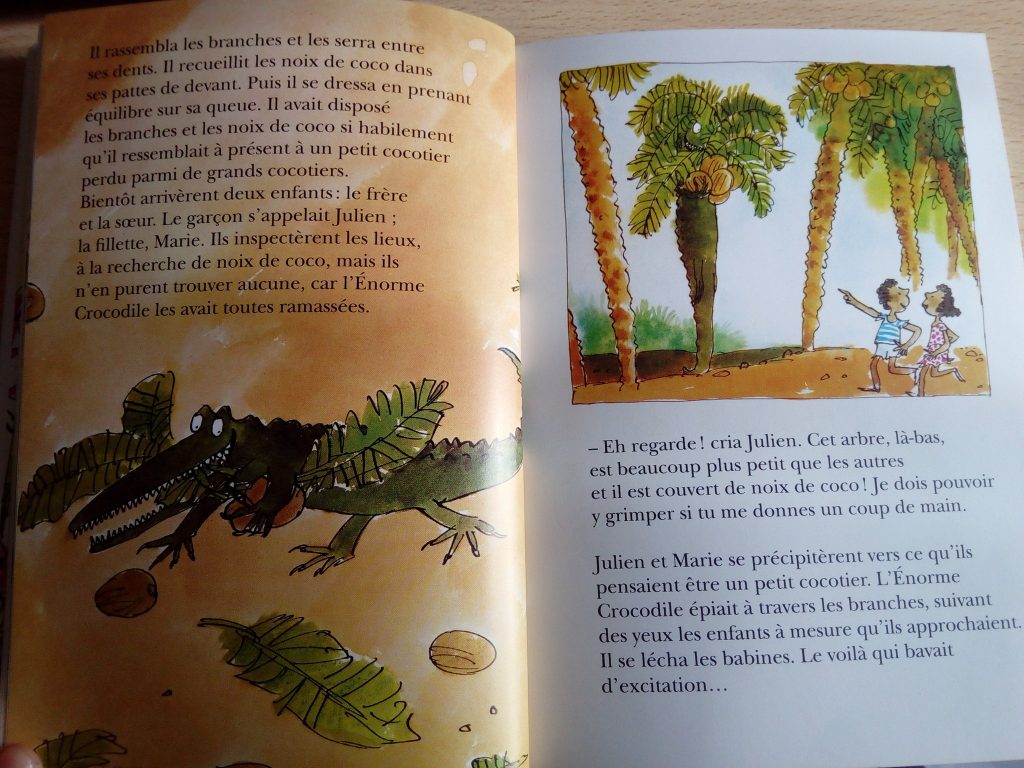
Where to find it and how to share it
The Enormous Crocodile is widely available in libraries, bookshops and online, so it is easy to borrow before committing to a purchase. If you are building a small home library, this is a strong, affordable addition that gets reread.
It also makes a dependable gift for a child who is just starting to read independently. For more ideas along those lines, browse Christmas gift ideas or outdoor toys if you want to balance screen-free activities with books. And if a rainy afternoon calls for something different, renting LEGO sets can be a fun complement to story time. Sharing a story works best when you keep adult authority gently in place.
A book worth revisiting
Children often return to this story on their own, quoting the rhymes and the insults. That is the surest sign a book has done its job.

My hands-on take
We came to this book after falling for Dahl's longer stories, and it turned out to be the perfect stepping stone. My seven-year-old and I read it over several evenings, splitting the parts: I took the crocodile's rhymes and she took the animals' outraged replies. She laughed hardest at the bird's ridiculous name and at the hippo, and she still repeats the insults weeks later.
What struck me most was how much she absorbed without any teaching. She started predicting the rhymes, then began inventing her own two-adjective insults for the crocodile, which turned into a game we played at dinner. If you want a gentle introduction to longer chapter books, this is a warm, funny place to begin.
Frequently asked questions
What age is The Enormous Crocodile suitable for?
It works well as a read-aloud for younger children and as an independent read from roughly seven or eight, thanks to its short length and plentiful illustrations.
Is the story too scary for sensitive children?
The threats are cartoonish and delivered in rhyme, and the villain is defeated comically, so most children find it funny rather than frightening.
What makes the language so valuable?
The rhymes, the simple past tense and the long list of colourful insults expose children to rich vocabulary in a playful, memorable way.
Can it be read in one sitting?
Yes, it is short enough for a single session, though many families prefer to spread it over a few evenings in two voices.
Product Reviews
 Best Toys for Dogs With High Prey Drive |
Best Outdoor Toys for 3-4 Year Olds |
Best Outdoor Toys for 6 Year Olds |
Best Harness for Poodle |
Best LEGO Sets for Adults |
Best Travel Toys for 4 Year Olds on Airplane |
Best Toy Stores in Washington DC |
Best Potty Training Toys |
Best Toys for Tripod Dogs |
Maillot equipe de france







