


Showing love to your child is not measured by what a parent feels and gives, but by what the child actually perceives. Many fathers love their children deeply yet find it harder than mothers to offer visible signs of affection, and this gap between felt love and shown love can shape a child's sense of security for years.
Children are not pre-equipped to decode the virtual messages parents believe they are sending. They need to see, hear, and feel love in their bodies. Understanding this difference is the first step toward closing the distance between what a father feels and what his child experiences.

Quick takeaways
- Love is measured by what the child perceives, not by what the parent feels.
- Fathers often show affection indirectly through presence, gifts, or shared activities.
- Socialization and childhood experience shape how men express emotion.
- Children who never hear love expressed may doubt their own worth.
- Affection travels through all five senses from birth onward.
- Teenagers still need understanding, support, and acceptance.
Why Fathers Love Differently
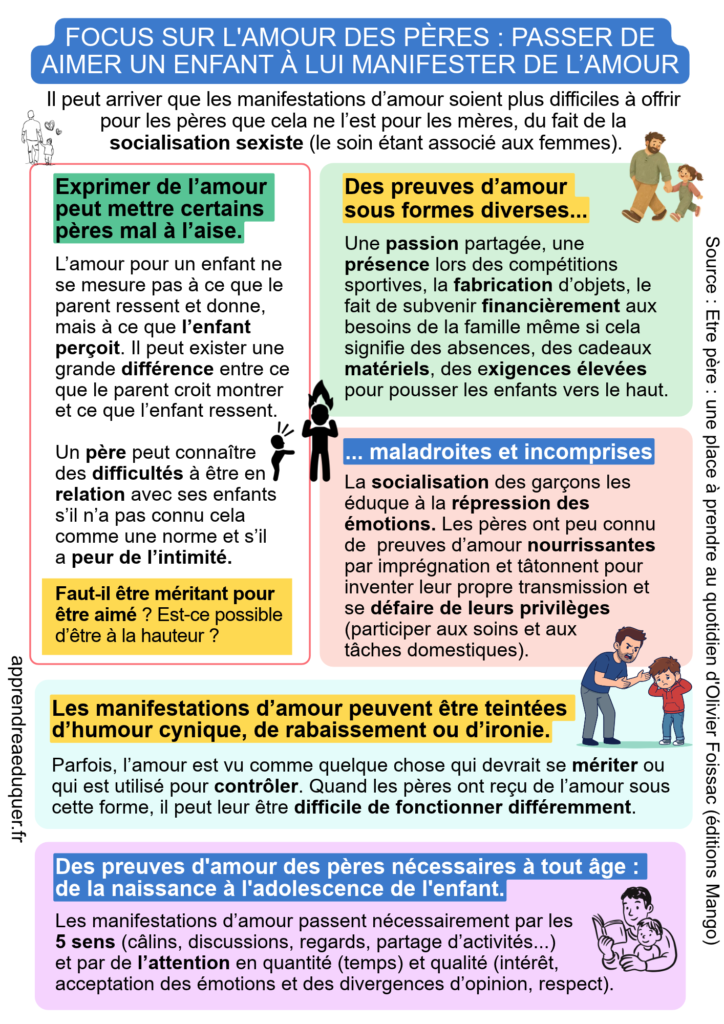
It can happen that fathers love their children while finding demonstrations of affection harder to offer than mothers do. Some fathers assume that a child who lacks for nothing is already receiving the proof of love they need. The problem is that love for a child is not measured by what the parent feels and gives, but by what the child perceives.
There can be a wide gap between what a parent believes they are showing and what the child actually lives and feels. A father may struggle to connect authentically with his children, to reach what it is like to be a child, or to offer physical affection such as cuddles and massages if he never experienced that as a norm and fears intimacy. The same holds for everyday physical care, which some fathers find easier to give than open tenderness.
Indirect Ways Love Shows Up
Expressing love can make some fathers uncomfortable. This does not mean they feel nothing; it means the way they communicate may be diverted. These diverted forms take many shapes: a shared passion, presence at sports competitions, making objects together, providing materially for the family even at the cost of frequent absences, material gifts, or high demands meant to push children upward. Much of this stems from how boys are socialized, with emotions repressed, and from what these men themselves received from their own fathers. Even planning future children can become one of these quiet, practical ways of caring.

The Gap Between Felt and Shown Love
If love can be obvious for the father, there is often a gap, even a gulf, between the love he feels, his way of transmitting it, and the perception his child will have of it. Signs of love can also be tinged with cynical humor, belittling, or irony. Sometimes love is seen as something that must be earned or is used to control. When fathers received love in that form, functioning differently can be difficult, not from malice but from habit and a lack of self-reflection.
This does not mean all mothers offer unconditional affection or that it is necessarily easy for women to be more explicit. Personal history, personality, and values all play a part for both sexes, but women are less socialized to repress emotions and limit affectionate touch. Parents who want to break the cycle can look at stronger sibling bonds as one place to practice warmth, and small everyday rituals matter more than grand gestures. Cozy moments like fun Christmas pajamas can help families connect, and questions such as does homeopathy work remind parents to reflect on their choices.
| Age stage | What the child needs | Practical example |
|---|---|---|
| Newborn | Warmth, voice, smell, gaze | Soft talk during feeding |
| Toddler | Play, encouragement, comfort | Shared games and cuddles |
| School age | Listening, verbal praise | Asking about their day |
| Teenager | Acceptance, support | Hearing their plans, playing sport together |
| Any age | Consistent presence | Undivided attention after work |
How Affection Builds Emotional Security
Assuming our children simply know we love them, so there is no need to say it, does not build their emotional security. A lack of demonstrations can lead children to existential questions that may persist into adulthood: must I be deserving to be loved, and when is it ever enough? Must I express love first to receive it back, without knowing whether a response will come? Must I give a great deal in the hope of receiving a little, even at the cost of sacrificing myself?
These questions are heavy to carry alone. When a child is left guessing, ordinary family moments can become tests of worth. Parents who notice a child withdrawing or over-pleasing may find managing parental stress helpful, since a calmer adult is better able to offer steady, reassuring affection rather than conditional approval.

Signs of Love Through the Senses
Demonstrations of love pass necessarily through the five senses. From birth, and even before, a baby perceives love when they hear soft voices, feel the warmth of skin, touch while nursing and kneading with their hands, taste with their mouth, smell their parents close by, and exchange tender looks. When the senses are awakened, the child is put in contact with a very strong feeling of protection and security that feeds fundamental emotional needs.
As children grow, they need other signs: cuddles, shared laughter, joys heard and shared, playtime, verbal and non-verbal encouragement, comfort, and listening. Even teenagers still have a vital need to be understood, supported, loved, and accepted, which can mean hearing about their life plans or simply playing sport with them. If a child seems anxious or restless, baby climbing stages and similar guides remind us that reassurance starts with presence. Understanding pregnancy cravings can also help parents tune into their child's sensory world from the very start, and choosing the best deal toys supports playful connection.

Adapting Affection to Every Age
What a newborn needs differs from what a teenager needs, but the underlying message stays the same: you are loved as you are. A father who shares a hobby, listens without judging, or offers a steady hug is transmitting that message in a form his child can receive. The concept of the five love languages, applied to children, can help parents notice which signs their child responds to most.
Everyday life offers countless openings. A shared game, a walk, or a few minutes of undivided attention after work all count. Parents juggling work and home can find balance by reading about work and birth decisions, and those raising several children can lean on sibling relationship tips to keep affection flowing between everyone. The goal is not perfection but consistency.
My hands-on take
I grew up in a home where love was never spoken, only assumed, and I carried those unspoken questions into adulthood. When my own child started asking whether I was proud of them after every small task, I recognized the pattern. I began saying it out loud, plainly, and offering a real hug instead of a nod from across the room.
What surprised me was how awkward it felt at first, and how quickly it became normal. I still share hobbies and fix things together, but I no longer let those stand in for the words. If you recognize yourself here, start small: one sentence, one moment of full attention, repeated until it feels natural.
Frequently asked questions
Why do some fathers struggle to show affection?
Many men were socialized to repress emotions and never experienced physical affection as a norm. Fear of intimacy and habit, rather than a lack of feeling, often explain the difficulty.
Does providing materially count as showing love?
It is one form of love, but it is indirect. Children still need visible, felt signs of affection to build emotional security, so material care works best alongside warmth and presence.
Can it be too late to start showing more affection?
No. Children of any age, including teenagers, still need to feel understood and accepted. Small consistent gestures can rebuild trust over time.
What if my child seems to doubt they are loved?
Say it plainly and show it through the senses: touch, attention, and listening. Naming your love out loud removes the guessing that can trouble children.
Product Reviews
 Best Toys for Dogs With High Prey Drive |
Best Outdoor Toys for 3-4 Year Olds |
Best Outdoor Toys for 6 Year Olds |
Best Harness for Poodle |
Best LEGO Sets for Adults |
Best Travel Toys for 4 Year Olds on Airplane |
Best Toy Stores in Washington DC |
Best Potty Training Toys |
Best Toys for Tripod Dogs |
Maillot equipe de france







