


Raising rebels does not mean raising children who argue about everything. It means helping them grow into people who can question a rule, weigh the reasons behind it and speak up when something feels unjust. This idea comes from the work of Alfie Kohn, who challenges the beliefs behind many of our everyday parenting habits.
Kohn invites us to imagine children who can stand up to a group of bullies, to an unfair law or to a family rule whose purpose nobody has explained. That kind of courage is not defiance for its own sake. It is a calm, considered habit of asking which rules are worth following, and why.

Quick takeaways
- Aim for reflective skepticism, not constant opposition to every rule.
- Distinguish rebellion from insolence, arrogance and cynicism.
- Praise questioning of rules, not just blind compliance.
- Welcome your child's arguments and resist the urge to win.
- Model the courage to admit you were wrong.
- Explain the reasons behind rules whenever you can.
Why Should We Raise Rebels?
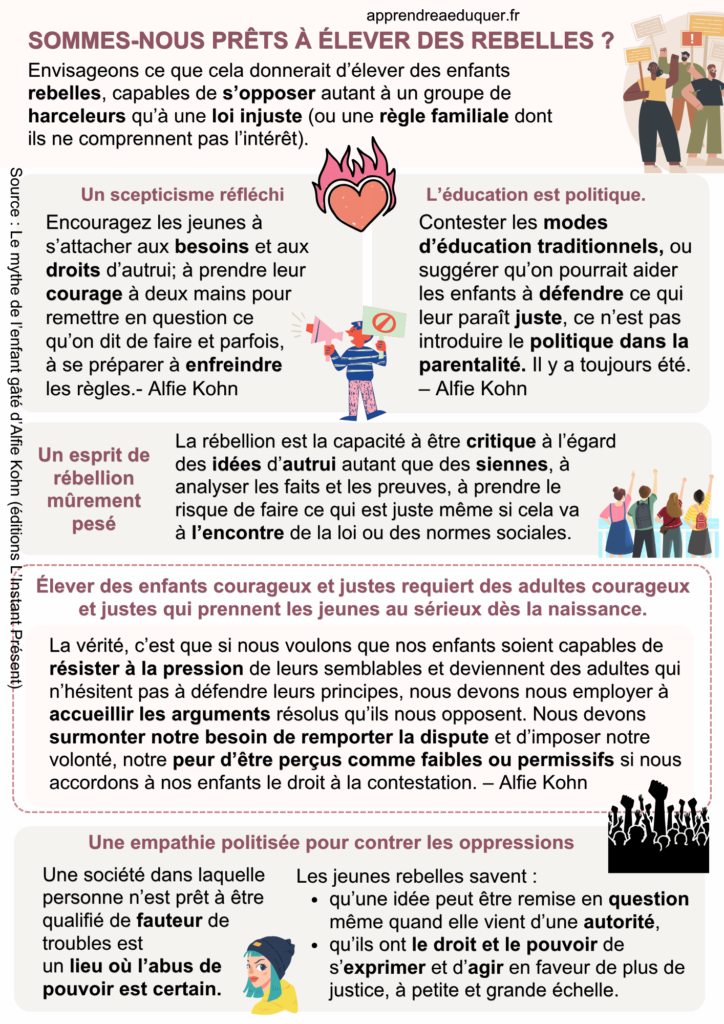
Kohn's argument is simple but demanding. He encourages adults to help young people care about the needs and rights of others, to study the practices and institutions that make life harder for people, and to find the courage to question what they are told to do. Sometimes that means being ready to break a rule.
This is not a call for constant opposition. Kohn speaks instead of "reflective skepticism" and a "weighed spirit of rebellion": the habit of asking which rules deserve our obedience and on what grounds. A child who learns to think this way is also learning to think about other people.
Education Is Always Political
Kohn points out that contesting traditional methods, or helping a child defend what seems fair to them, does not inject politics into parenting. It was always there. Every rule we set and every reward we offer carries a message about authority and obedience.
Insolence, Arrogance, Cynicism and Rebellion
Kohn asks us to tell these four attitudes apart, because they look similar from a distance but lead in very different directions. Insolence is resistance that offers no argument and shows no respect. Arrogance questions other people's ideas without ever questioning its own. Cynicism rejects anything that comes from outside, automatically and without thought.
Rebellion is different. It means being critical of other people's ideas and of your own, analysing facts and evidence, and taking the risk of doing what is right even when it goes against the law or social norms. As Kohn puts it, criticism aimed only at others risks pride and stagnation, while criticism aimed only inward risks timidity and indecision.
What This Looks Like Day to Day
In practice, a rebellious child might ask why bedtime is at eight, then accept the answer if it is a good one. A cynical child simply refuses. The difference lies in whether reasoning is welcome, which is why child motivation matters more than pressure when we want children to engage with rules.

| Attitude | What it looks like | What it builds |
|---|---|---|
| Insolence | Resistance with no argument, no respect | Conflict and distance |
| Arrogance | Questioning others, never oneself | Pride and stagnation |
| Cynicism | Automatic rejection of anything external | Isolation and distrust |
| Rebellion | Critical of others and oneself, weighs evidence | Moral courage and fairness |
| Compliance | Blind obedience, no questioning | Vulnerability to abuse of power |
The Trouble With Respectful Compliance
Kohn gives a name to the opposite of rebellion: "respectful compliance disorder." Its symptoms include unconditional faith in authority, blind obedience to rules, an inability to question the purpose of a rule or the ethics of a law, and paralysis in the face of injustice. It also includes an inability to debate ideas without a fight, or even the absence of any idea that debate is possible.
He notes, with some irony, that these symptoms are often praised as proof of successful socialisation. Schools say they want to form enlightened citizens with critical minds, yet they write internal rules without consulting pupils, rely on rewards and punishments, and label students who object as troublemakers without examining their arguments.
A society where nobody is willing to be called a troublemaker or a rebel, Kohn warns, is a place where abuse of power is certain. The same logic applies at home, where wanting to be small can sometimes hide a child's fear of disagreeing with us.
Welcoming Your Child's Arguments
If we want children who can resist peer pressure and grow into adults who defend their principles, we have to welcome the determined arguments they bring to us. That means overcoming our need to win the dispute, to impose our will, and our fear of looking weak or permissive when we grant a child the right to object.
This kind of parenting takes courage. Raising brave, fair children requires brave, fair adults. We all tend to find disobedience irritating and obedience far easier, whether because the daily battles over tooth-brushing exhaust us or because a disapproving social gaze breeds stress and doubt.
Questions Worth Asking Yourself
Kohn pushes us further with a few uncomfortable questions. Do we want our children to inspire others, or to spend their lives collecting marks of approval? Do we want them to think about others rather than only about personal benefit? Do we want them to question what feels oppressive, rather than doing something simply because it has always been done that way?
These questions connect to everyday health choices too, such as how we handle hidden sugar in foods or when to consult about homeopathy for children — moments when explaining our reasoning teaches more than issuing orders.
Three Ingredients for Raising Rebels
Three ingredients help children realise that an idea can be questioned even when it comes from authority, that they have the right and even the duty to speak, and that they have the power to act for more justice and less suffering, at home and beyond.
The first is modelling. Children learn skepticism by watching us question our own habits and admit when we were wrong. The second is genuine consultation: asking their opinion on rules that affect them, and changing those rules when their arguments are good. The third is safety to disagree, so that speaking up never costs a child affection or respect.
Making Room for Their Voice
Practical routines help. Family meetings where anyone can raise a complaint, explanations for rules instead of "because I said so," and honest conversations about fairness all build the habit. A child who feels heard at home is more likely to speak up for someone else at school.
Even play supports this. Building and rebuilding with construction toys, or choosing toys for toddlers together, gives children small daily experience of deciding, explaining and negotiating. For older children, a toddler bed transition or a first bunk bed becomes a chance to plan together and hear their worries.
Everyday Moments That Build Moral Courage
Moral courage grows in ordinary situations, not grand speeches. When a child comes home upset about something unfair at school, the first response matters: listening and asking what they think should happen teaches more than a quick instruction to obey the teacher.
Family life offers constant practice. Deciding together how to handle screen time, chores or child sleep routines gives children a real stake in the rules. So does letting them help plan outings, pack for a trip or choose toys for flights, where their preferences can genuinely shape the plan.
None of this means abandoning boundaries. Adults still decide what is safe and non-negotiable. The difference is that we explain our reasons, invite a response and treat disagreement as information rather than as an attack. Over time, that habit becomes the child's own inner compass.


My hands-on take
I tried this approach after a long stretch of exhausting bedtime battles. Instead of announcing the rule, I started asking my child why they thought a certain bedtime existed, and then explained my own reasoning about sleep and mornings. The first few conversations were messy, but something shifted: the arguments became shorter because they were actually conversations.
What helped most was admitting out loud when my child made a good point. Saying "you're right, that rule doesn't make sense" felt risky at first, as if I were losing authority. In practice, it did the opposite. My child now questions things more, but also listens more, and I have stopped treating every disagreement as a challenge to my authority.
Frequently asked questions
Does raising rebels mean letting children do whatever they want?
No. It means explaining rules, inviting disagreement and taking their arguments seriously, while adults keep responsibility for safety and clear boundaries. The goal is thoughtful questioning, not constant opposition.
How do I respond when my child argues about a rule?
Listen first and ask what they think should change and why. If their reasoning is sound, adjust the rule; if not, explain your reasons calmly. Either way, the child learns that debate is possible and respected.
Is this approach compatible with school rules?
Yes, but it may require nuance. You can support the school while teaching your child to raise concerns respectfully and to understand that some rules exist for good reasons and others may deserve questioning.
Product Reviews
 Best Toys for Dogs With High Prey Drive |
Best Outdoor Toys for 3-4 Year Olds |
Best Outdoor Toys for 6 Year Olds |
Best Harness for Poodle |
Best LEGO Sets for Adults |
Best Travel Toys for 4 Year Olds on Airplane |
Best Toy Stores in Washington DC |
Best Potty Training Toys |
Best Toys for Tripod Dogs |
Maillot equipe de france







