


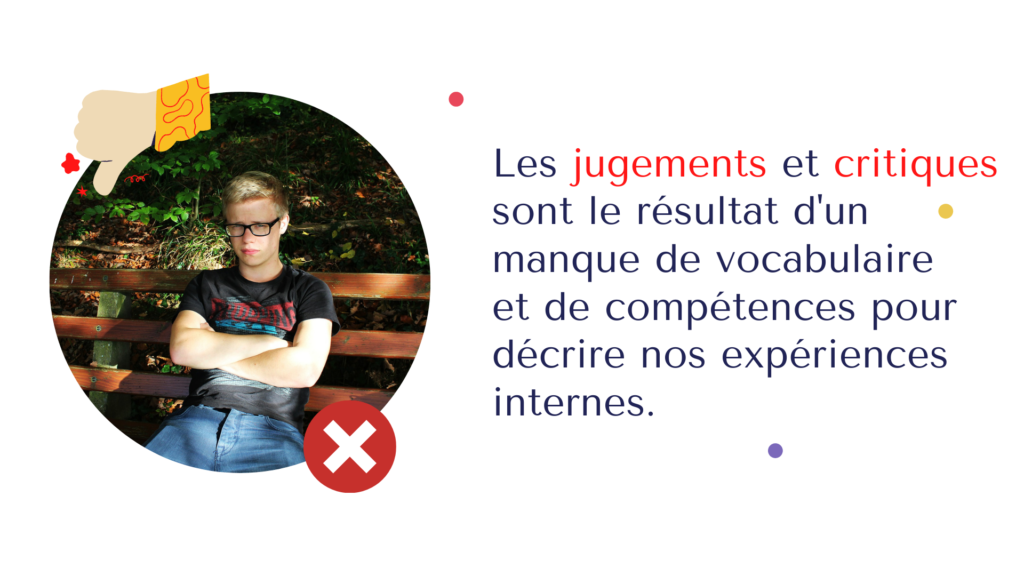
Judgments and criticism are the result of a lack of vocabulary and skills to describe our inner experiences. We judge ourselves, our partners and our children all day long, and each judgment is a poor substitute for a clearer description of what is really going on inside us.
Nonviolent Communication offers a different path: instead of blaming, we learn to name the emotions and needs underneath. This article walks through that approach step by step, with practical wording you can use today.

Quick takeaways
- Judgments are misleading descriptions of an inner experience we struggle to name.
- Every criticism points to one or more unmet needs, in ourselves or the other person.
- A "no" signals a need asking to be included, not a rejection of you.
- Thank people for the vulnerability of sharing their needs, and repeat back what you heard.
- Offer solutions only after both sides feel understood.
- Practice with a written exercise: judgments, emotions, then needs.
Judgments Are Misleading Descriptions
Yoram Mosenzon, a mediator and Nonviolent Communication trainer, considers judgments to be tragic descriptions of a certain inner experience we are having. The problem is not that we feel something, but that we lack the skills and vocabulary to describe that experience inside us. Judgments and criticism are everywhere: we judge ourselves and others all day long.
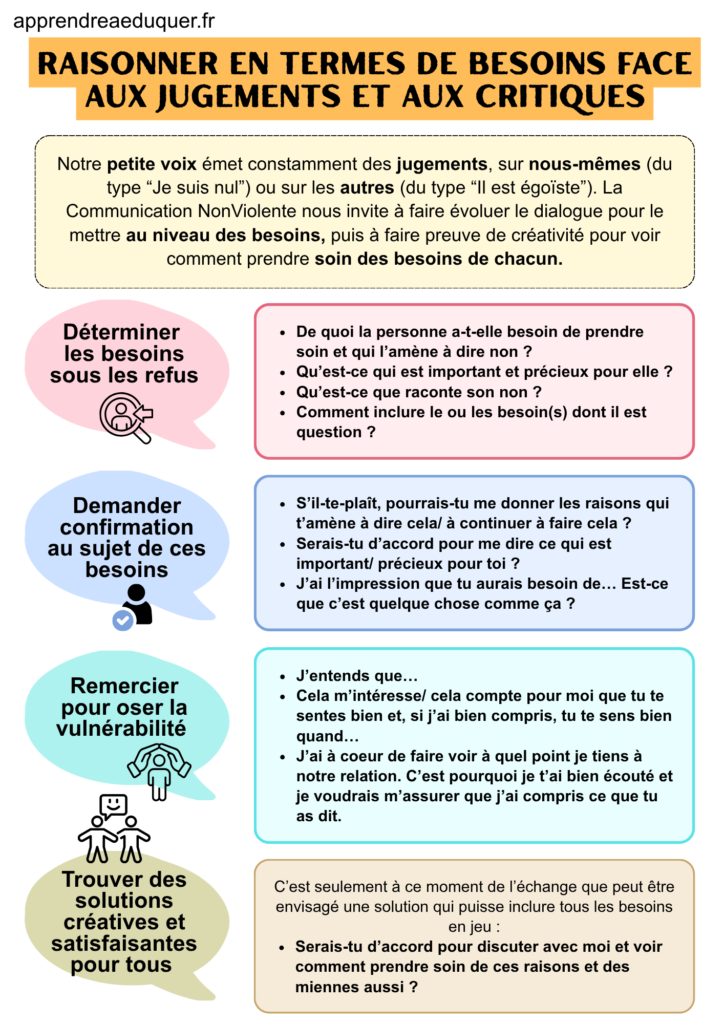
Whenever a person judges us, it has nothing to do with us and everything to do with their needs. Whenever we judge someone, we are talking about one or more of our own unmet needs. Nonviolent Communication invites us to shift the dialogue to the level of needs, then to get creative about how to care for everyone's needs.
As Marshall Rosenberg, the creator of Nonviolent Communication, put it: every judgment is the tragic expression of a magnificent need. Keeping that phrase in mind changes how we hear blame, whether it comes from a child or from ourselves. It also pairs well with the calm, respectful tone encouraged in the Waldorf method approach to daily family life.
Our Head Is a Battlefield
Mosenzon believes one of the most ignored battlefields is the one inside our head: our little voice constantly issues judgments, about ourselves ("I'm useless") or about others ("He's selfish"). We talk to ourselves in judgments, and these judgments prepare the ground for violence.
For example, calling someone selfish because they prefer going to the gym rather than spending the evening as a couple may really mean that we love them, that we miss them, and that we want more time together. If saying we are useless while preparing a public talk probably means we really want to create something meaningful for the audience and are deeply invested in that presentation.
Listening for the need behind the words
Once you notice the judgment, pause and ask what feeling and need sit underneath it. This simple habit is especially valuable on demanding days, much like the patience needed during rainy days indoors with children. It also helps when a child is struggling with nerves before a performance, a situation close to the test anxiety many teens face.
| What you hear | Possible feeling | Need to explore |
|---|---|---|
| "You're selfish" | Missing someone, love | Closeness, time together |
| "I'm useless" | Fear, self-doubt | Meaning, contribution |
| "No, I won't" | Reluctance, care | Autonomy, inclusion |
| "You never listen" | Frustration, loneliness | Understanding, respect |
| "He's mean" (child) | Hurt, injustice | Fairness, turn-taking |
Finding the Needs Behind a No
When someone says no, it means one of their needs wants to be included. We can try to guess what that need might be: what does this person need to take care of that leads them to say no? What is important and precious to them? What is their no telling us? And how can we include the need or needs at stake?
It is also possible to simply ask the person what their reasons are. Try: "Could you tell me the reasons that lead you to say that or to keep doing that?" or "Would you agree to tell me what is important and precious to you?" You can also offer a gentle guess: "I have the impression you would need… Is it something like that?"
This works just as well with relatives as with partners, and it can smooth over the small frictions of a visit or a shared holiday, such as a few days at the grandparents' house. The key is curiosity rather than persuasion.

Thanking the Vulnerability
We can then thank the other person for entrusting us with their unmet needs, because doing so is an act of vulnerability and trust. Acknowledging what they said by repeating it back shows that we listened and understood: "I hear that…" or "It matters to me that you feel good, and if I understood correctly, you feel good when…"
You might add: "I care about showing you how much our relationship matters to me. That is why I listened carefully and want to make sure I understood what you said." This step is easy to skip, yet it is often what makes the other person feel truly heard.
Receiving a child's frustration this way is a skill that grows with practice, and it echoes the respectful, unhurried attitude found in the Marie Kondo approach to family life. It also helps when a child is unwell or irritable, as with the discomfort of scarlet fever or the worry of losing hair.

Creative Solutions for Everyone
Only at this point in the exchange can a solution be considered that includes all the needs in play. You might ask: "Would you agree to talk with me and see how to take care of these reasons and mine too?" This sequencing matters, because a solution offered too early feels like a dismissal.
When both sides feel understood, creative options appear that nobody had considered at the start. The same spirit of shared problem-solving shows up in practical planning, from choosing warmest coats for the season to finding room with these space ideas for a crowded car.
A short exercise to practice
Think of a situation where someone said or did something you disliked. Write down all your judgments about that person, without censoring yourself, insults included. Then describe the emotions that led to those judgments and are fed by them, and connect with the need or needs hidden behind each one.

Practicing at Home With Children
Children offer constant opportunities to practice this shift. When a toy is snatched or a game ends in tears, the judgment ("He's mean") is a doorway to a need ("I wanted a turn"). Naming feelings out loud gives children the vocabulary they are missing.
Keep a short list of feelings and needs somewhere visible and use it in everyday moments, whether during outdoor toys play or while putting away the 10 Best Learning Toys at the end of the day. Over time, children borrow this language and start describing their experience instead of blaming.
Why This Matters for Parents
Parents judge themselves harshly, and those self-judgments drain the energy needed for patient care. Replacing "I'm a bad parent" with "I'm exhausted and need support" is not indulgence; it is an accurate description that points toward a solution.
This reframing supports the gentle routines many families build, from the Perfect books read at bedtime to the small rituals that make a Fun ideas feel calm. The goal is not perfect language but a habit of looking for the need.
My hands-on take
I started using this at home after one too many evenings that ended in slammed doors. The first time my daughter shouted that her brother was "the worst," I almost jumped in with a lecture. Instead I tried the pause: "It sounds like you felt really hurt when he took your thing." She looked at me, surprised, and then told me the whole story.
What struck me most was how often my own judgments were hiding something simple. "Nobody helps around here" usually means I am tired and want a bit of support. Saying that out loud feels far more exposed than complaining, but it also gets a real answer. I still slip back into blame regularly, but now I notice it sooner, and the repair is quicker.
Frequently asked questions
What is the main idea behind this approach?
Judgments and criticism are tragic descriptions of an inner experience we lack the vocabulary to express. Shifting to feelings and needs gives a clearer, kinder way to communicate.
How do I respond when someone says no?
Treat the no as information about a need that wants to be included. Ask what is important to them, or offer a gentle guess and check whether it fits.
Why thank someone for sharing their needs?
Sharing unmet needs takes vulnerability and trust. Acknowledging it shows you listened and helps the other person feel understood before solutions are discussed.
Can this work with children?
Yes. Naming feelings and needs out loud gives children the vocabulary they are missing, and they gradually borrow that language instead of blaming.
Product Reviews
 Best Toys for Dogs With High Prey Drive |
Best Outdoor Toys for 3-4 Year Olds |
Best Outdoor Toys for 6 Year Olds |
Best Harness for Poodle |
Best LEGO Sets for Adults |
Best Travel Toys for 4 Year Olds on Airplane |
Best Toy Stores in Washington DC |
Best Potty Training Toys |
Best Toys for Tripod Dogs |
Maillot equipe de france







