


Child insolence is one of the behaviours parents and educators find hardest to handle, partly because it feels personal. The behaviours grouped under this label include answering back, showing ingratitude, sighing, rolling eyes, dragging feet, ignoring adult requests, using irony and "provoking" or "testing" adults.
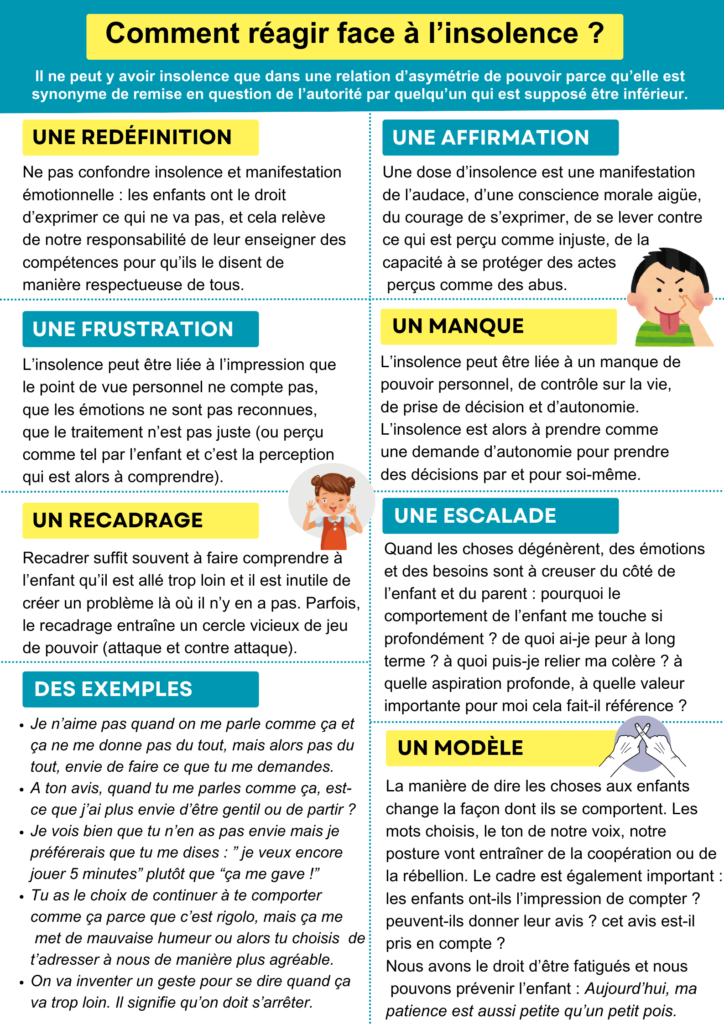
But what if we looked at insolence differently? Could it be self-assertion from children and teenagers who have not yet learned to express things in a socially appropriate way? Could it be the result of a dysfunction in the relationship or the system rather than a flaw in the child?

Quick takeaways
- Treat insolence as clumsy self-assertion, not a personal attack
- Check your own tone before blaming the child
- Name the feeling and the limit separately
- Teach polite phrases for disagreement in calm moments
- Repair quickly after a sharp exchange
- Keep boundaries brief and free of humiliation
Why child insolence deserves a fresh look
Before reacting, it helps to ask what the behaviour is doing. Child insolence may be a clumsy form of self-assertion from a young person who lacks the words or the calm to say things appropriately. It may also signal a dysfunction in the relationship or in the family system, rather than a simple discipline problem.
It is also worth examining the adult's posture. When a child faces an order barked without any respect, does he really have another choice than insolence to protect his dignity and integrity? And when adults routinely use threats, blackmail, punishment, humiliation or shouting, children learn that disrespect is the normal way to speak. Insolence can then become an expression, socially inappropriate but learned, of that everyday disrespect.
Redefining insolence before you respond
Rather than asking how to stamp out insolence, we gain from redefining it and changing perspective. The same eye-roll can mean "I feel powerless", "I am overwhelmed" or "I do not know how to disagree politely". Reading it as a message first, and as an offence second, changes the tone of your reply.
This shift does not mean accepting rudeness. It means separating the feeling behind it from the form it takes, then addressing both. A child who feels heard is far less likely to keep escalating. If you want to build calm, shared rituals at home, books with flaps and other interactive reads give you a relaxed moment to reconnect after a tense exchange.
| Behaviour | Possible meaning | Suggested response |
|---|---|---|
| Answering back | Wants to be heard | Listen briefly, restate the limit |
| Eye-rolling or sighing | Feels powerless | Stay calm, avoid a power struggle |
| Ignoring requests | Overwhelmed or tired | Simplify, check rest and routine |
| Irony or provocation | Testing the bond | Remove the audience, stay warm |
| Dragging feet | Needs transition time | Give a warning and a clear choice |
Check your own posture first
Ask yourself honestly what tone you used just before the insolence appeared. A shouted instruction, a sarcastic remark or a threat invites a defensive answer. Children mirror what they receive, and they protect their dignity when they feel cornered.
Practical adult moves
Lower your voice instead of raising it, state the rule once, and name the feeling you see without endorsing the behaviour. Give a short pause before answering, so you respond rather than react. These small adjustments remove the audience a provocation needs and keep the exchange from turning into a power struggle.
Fatigue and disrupted routines also lower everyone's tolerance. When a child is out of sorts after a change of schedule, the guidance on managing child fatigue is a useful reminder that behaviour often improves once rest does. If you are preparing a long journey, the tips on baby sleep travel help you plan ahead so tiredness does not fuel conflict.
Teach the words that replace insolence
Children often lack the vocabulary for polite disagreement. Offer phrases they can use: "I don't agree", "I need a minute", "Can I explain?" Practising these in calm moments gives them a socially appropriate alternative when frustration rises.
Model the same courtesy when you speak to them, and repair quickly after a sharp exchange. A brief apology from an adult teaches more about respect than any lecture. For younger children, simple playful tools support this learning; the ideas in educational children's apps and the activities in six month old toys show how repetition through play builds skills without pressure.
Older children respond well to shared projects that let them contribute and feel competent. Building something together, guided by LEGO Technic colours or a family time capsule, creates cooperation and gives a sense of purpose that reduces the need to provoke.

Respond in the moment without escalating
When insolence happens, keep it short. Name the behaviour, state the limit and move on, without humiliation or a long sermon. A calm, brief boundary protects the relationship and still makes the rule clear.
Later, once everyone is calm, revisit what happened and ask what the child needed. This is where real learning happens. If your child tends to throw things when frustrated, the explanations in why children throw help you read the trigger rather than only the mess.
Keep perspective too: a single rude answer is not a verdict on your parenting. Consistency, warmth and repaired moments matter far more than any one difficult evening, and small daily routines, such as the ones in the 18 month baby guide, keep the household rhythm steady as children grow.

My hands-on take
I remember a phase when every request I made was met with a sigh and a rolled eye. My first instinct was to tighten the rules, and it only made things worse. What changed was slowing down: I started stating the rule once, quietly, and then leaving the room instead of waiting for a reaction. The audience was gone, and so was most of the performance.
I also began asking, later and calmly, what had been going on. Sometimes the answer was simply tiredness; sometimes it was that I had spoken sharply first. Naming my own part in it did more for our relationship than any consequence. It is not a quick fix, but it is steady, and the tense evenings have become far less frequent.
Frequently asked questions
Is insolence always a discipline problem?
No. It can reflect a relationship difficulty, fatigue, or a child who has not yet learned appropriate words. Looking for the cause first usually leads to a more effective response.
Should I punish a rude answer?
A brief, calm limit is usually enough. Humiliation or shouting tends to increase defensiveness, while a short boundary followed by a calm conversation later teaches more.
How do I teach my child to disagree politely?
Offer simple phrases and practise them when everyone is calm. Model the same courtesy yourself and repair quickly after a sharp exchange.
What if the rudeness continues?
Stay consistent with warm but firm limits and look at routines, rest and connection. Persistent patterns are worth discussing with a professional who knows your family.
Product Reviews
 Best Toys for Dogs With High Prey Drive |
Best Outdoor Toys for 3-4 Year Olds |
Best Outdoor Toys for 6 Year Olds |
Best Harness for Poodle |
Best LEGO Sets for Adults |
Best Travel Toys for 4 Year Olds on Airplane |
Best Toy Stores in Washington DC |
Best Potty Training Toys |
Best Toys for Tripod Dogs |
Maillot equipe de france







