


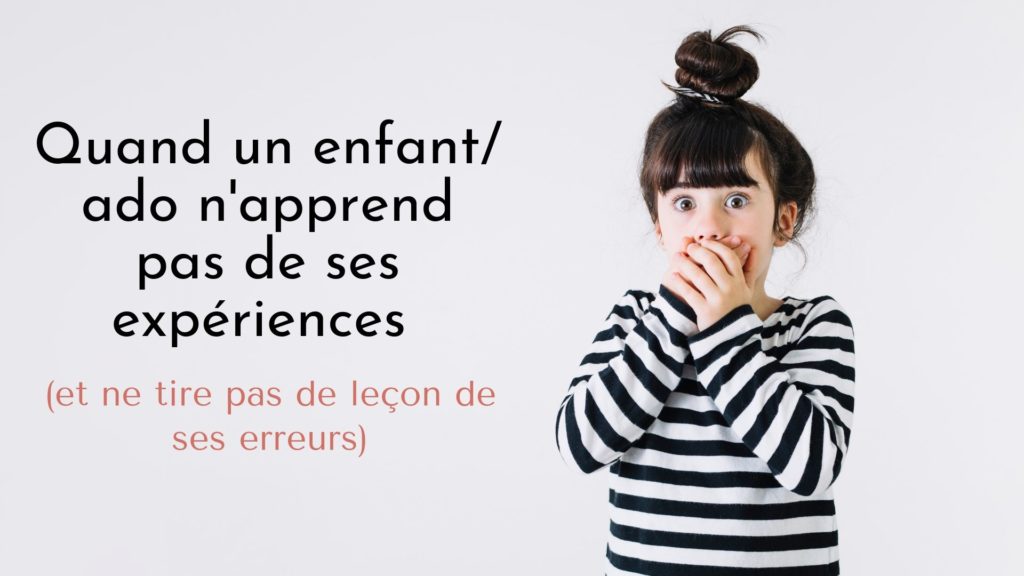
Helping a child who does not learn from mistakes is less about punishment and more about how we respond in the moment. When a child or teen never seems to learn from mistakes, the problem is often not the mistake itself but the way adults step in around it.
Errors, failures, small accidents and careless moments are genuine learning opportunities, for teenagers as much as for younger children. Yet a child cannot draw a lesson from an experience if we do everything for them, refuse to let them search for solutions, or bury them in reproaches and long moral speeches.

Quick takeaways
- Mistakes are learning opportunities, not proof of failure.
- Doing it for them removes the lesson.
- Reproaches and moral speeches shut down reflection.
- Name the feeling before discussing the behavior.
- Ask what they learned and how they will handle it.
- Offer help only as a last, optional proposal.
Why some children never seem to learn
A child who does not learn from mistakes is usually not careless or lazy by nature. Learning from experience requires a certain amount of room to think, try and repair, and that room disappears when an adult takes over. If we fix the clumsiness or apologize on their behalf, the child never feels the natural consequence of the act.
Reproaches close the door too. Phrases like "I told you so" or "there you go again" turn a useful moment into a humiliation, and a humiliated child defends rather than reflects. The same goes for a long moralizing speech, which children stop listening to after the first sentence.
What children actually need
They need to feel understood first, then to be trusted with the next step. That order matters, and it is the backbone of the three alternatives below, which come from a well-known illustrated guide to teenagers in crisis.
Start by welcoming the feeling
Before any lesson can land, the emotion has to be acknowledged. If your child has broken something, failed a test or upset a friend, begin with the feeling rather than the fact. You might say: "It's frustrating when that happens", "You would have preferred…", "You feel ashamed", or "That's really embarrassing, you wish you could disappear".
Name the anger too: "You were so angry that… and now you regret it." A hug or a quiet moment of comfort is often enough. This is not about excusing the behavior; it is about making the child calm enough to think.
This emotional first step echoes the respectful approach many parents use when a child refuses physical affection, as with these greeting alternatives that protect the child's sense of safety.
| Adult response | What the child learns | Better alternative |
|---|---|---|
| Fixing it for them | Someone else is responsible | Ask how they plan to repair it |
| "I told you so" | Shame and defensiveness | "What can you learn from this?" |
| Long moral speech | Tune out | One short open question |
| Ignoring the feeling | Emotions are not allowed | Name and validate the emotion |
| Imposing a plan | Compliance without ownership | Offer a plan as a starting point |
Then redirect toward solutions
Once the emotional connection is established, move to redirection. Ask open questions that hand the thinking back to the child: "What can you learn from this experience?", "What could you do so it doesn't happen again?", "What do you imagine now?", "How do you plan to go about it?"
With younger children, make it concrete by looking for three solutions together. This works well after a spilled drink, a lost toy or a broken promise, and it builds the same habit of responsibility you encourage when helping a child read to baby and follow simple routines.
Keep the questions short
One question at a time is enough. Silence is fine; it gives the child space to find an answer instead of receiving one.
Offer help as a last resort
Only when emotions have been validated and the child or teen is genuinely stuck should you offer proposals. Ask: "Do you need my help?", "How can I help you?", "Is there something I can do for you?" Then suggest a plan of action as a starting point, not a demand, something they can adapt.
This keeps the ownership with the child. It also models the kind of support that helps in harder situations, such as knowing help a teenager when a friend dies, where presence matters more than instructions.
Offering help without taking over is a skill worth practicing early, much like the gentle guidance described in toys for 1 year old that lets a toddler explore safely.

Set the home up for repair, not blame
Some families find it useful to agree in advance on a simple repair routine: acknowledge the feeling, ask what happened, decide together what would help. Written down and kept calm, it removes the heat from the moment and makes the response predictable.
A calm environment supports this. Predictable routines, including baby sleep tips on trips, reduce the exhaustion that fuels careless mistakes in the first place.
Older children can also be given small responsibilities that build accountability over time, in the same spirit as the everyday habits behind toys for 4 year olds that encourage independent play.
What to avoid and what to say instead
Three habits block learning: doing it for them, lecturing, and shaming. Replace "I told you so" with "What can you learn from this?" Replace a long speech with one question. Replace fixing it yourself with "How do you plan to handle it?"
When a child is struggling socially, the same respectful stance applies, as in these ideas on popular at school pressures. And when relatives overstep, the calm boundary-setting in family interferes follows the same logic of respect before redirection.
Finally, remember that a child who feels capable is a child who tries again. Encouraging small independent choices, like the ones behind toys for 4 month old, builds that confidence from the very start.

My hands-on take
I remember the first time I tried this with my own child after a spilled glass of juice. My instinct was to sigh and say something sharp, but I paused, said "that's frustrating, you wanted to carry it yourself", and then asked what he could do next. He fetched a cloth without being told. It was a small moment, but it changed how I saw the whole thing.
Since then, I try to keep one rule: feelings first, questions second, help last. It does not always go smoothly, and some days I still hear "I told you so" forming in my mouth. But when I manage to hold back, the conversation is shorter and my child walks away thinking rather than defending.
Frequently asked questions
Why does my child keep repeating the same mistake?
Often because the lesson was delivered as blame rather than reflection. When a child is shamed, the focus shifts to defending themselves instead of understanding what happened. Calm questions about what they learned tend to work better over time.
Should I comfort my child after a mistake?
Yes, acknowledging the feeling first is not the same as excusing the behavior. A calm, understood child is far more able to think about solutions than an embarrassed or angry one.
What if my teenager refuses to talk?
Keep it brief and leave the door open. A single question, or an offer of help later, is often more effective than pressing for an answer in the moment.
Does this approach work with younger children?
Yes, with simpler language. Instead of abstract questions, look for three concrete solutions together, which makes the reasoning visible and manageable.
Product Reviews
 Best Toys for Dogs With High Prey Drive |
Best Outdoor Toys for 3-4 Year Olds |
Best Outdoor Toys for 6 Year Olds |
Best Harness for Poodle |
Best LEGO Sets for Adults |
Best Travel Toys for 4 Year Olds on Airplane |
Best Toy Stores in Washington DC |
Best Potty Training Toys |
Best Toys for Tripod Dogs |
Maillot equipe de france







