


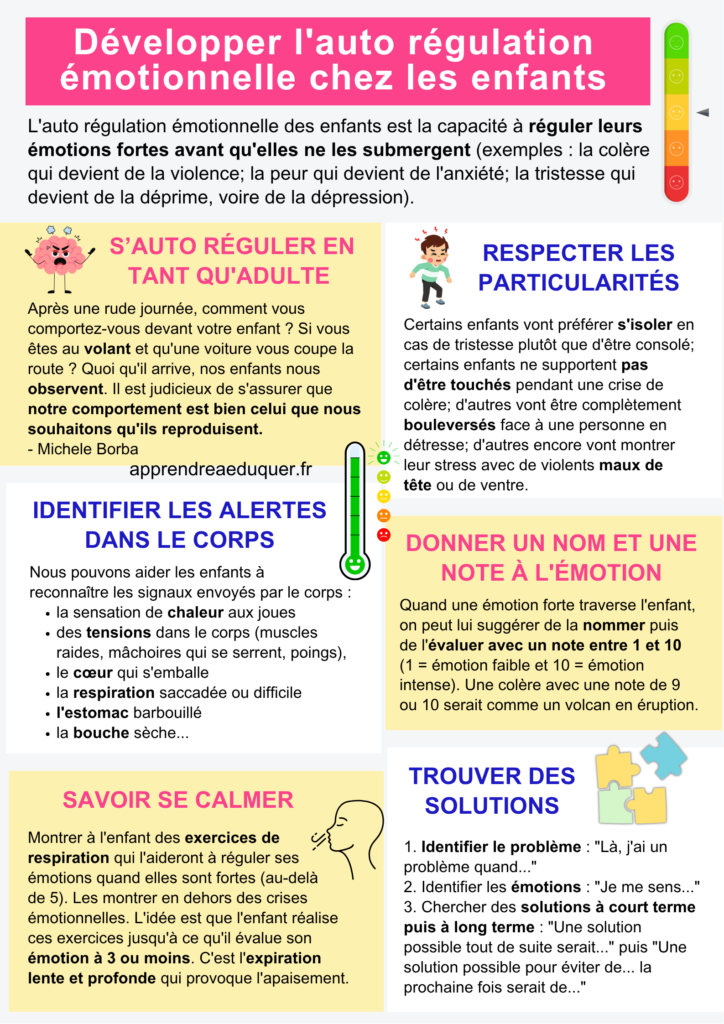
Emotional self-regulation in children is the ability they can develop to steady their strong emotions before those emotions overwhelm them — for example, anger that turns into violence, fear that grows into anxiety, or sadness that slides toward low mood.
Self-regulation is also a condition for resolving conflicts without violence. When a child is no longer fused with the emotion but notices that they feel it, they can think clearly again. Once the strong feeling is settled, a child or teenager can name their needs, communicate them, consider the other people involved and look for solutions that work for everyone.

Quick takeaways
- Your own calm recovery is the strongest lesson your child will copy.
- Watch each child's individual signals instead of applying a ready-made fix.
- Teach body clues: warm cheeks, tight jaw, racing heart, dry mouth.
- Name emotions precisely and rate them from 1 to 10.
- Practise breathing exercises when calm, not mid-crisis.
- Slow, deep exhalation is what actually brings the calming effect.
Model self-regulation yourself
To teach a child how to regulate emotions, the most powerful lesson is your own example. Think about how you behave in front of your child after a hard day, when a car cuts you off at the wheel, or when the bank announces an overdraft. Whatever happens, children are watching, so it is worth checking that your behaviour matches what you hope they will copy.
This does not mean performing constant calm. It means letting your child see the process: noticing the tension, saying it out loud and choosing a way to settle. A short phrase such as "I'm frustrated, I'm going to breathe for a minute" does more than a lecture on self-control. If you are raising children alongside other adults, agreeing on these small habits helps everyone stay consistent, much like the conversations in grandparents parenting rules.
Respect each child's particularities
Some children prefer to withdraw when they are sad rather than be comforted; some cannot bear to be touched during a tantrum; others are completely overwhelmed by the sight of someone in distress; and some show stress through violent headaches or stomach aches. There is no one-size-fits-all solution, so it is important to tune in to the particular child in front of you rather than imposing a ready-made fix.
Observing these particular needs makes you more empathetic toward that child, and therefore more effective. A child who needs space before a hug is not rejecting you; they are regulating in their own way. The same principle applies to how we read children's bodies and habits in general, from foods rich to everyday routines, because small physical factors often shape behaviour more than we expect. Just as motherhood reshapes priorities, so too does attentive observation reshape how we respond.

| Signal in the body | What it may mean | A simple response |
|---|---|---|
| Warm cheeks, clenched jaw | Anger building | Pause, name it, breathe out slowly |
| Racing heart, choppy breath | Stress rising | Side-by-side or balloon breathing |
| Queasy stomach, dry mouth | Fear or worry | Name the feeling, rate it 1-10 |
| Tight muscles, curled fists | Tension needs release | Space first, then talk it through |
| Withdrawal or tears | Sadness needing comfort | Offer presence, ask what helps |
Spot the warning signs in the body
We can explain to children that everyone has physical signals that alert us to rising tension and tell us we need to release it before we explode. Help them recognise the signs: warm cheeks, tight muscles, clenched jaws, fists that curl, a racing heart, choppy or difficult breathing, a queasy stomach, a dry mouth.
During an emotional storm, reflect back what you see in their body: "I can see you're clenching your fists. I get the impression anger is building up. Is that right?" The earlier children become aware of their stress, the better they self-regulate. Building a rich vocabulary around physical sensations supports this, and so does paying attention to health details such as bronchiolitis in children when a child seems unwell rather than simply upset.
Give the emotion a precise name and a score
Giving children precise words for what they feel increases their awareness of the emotion. Start with the four basic emotions — fear, anger, sadness, joy — then build the vocabulary: "I get the impression you're very annoyed; we could say you're exasperated" or "You look worried, are you preoccupied?" Words for secondary emotions such as shame, confidence, jealousy or betrayal can complete the picture.
When a strong emotion runs through the child, suggest naming it and then rating it from 1 to 10, where 1 is a faint emotion and 10 an intense one. An anger rated 9 or 10 is like a volcano erupting. This simple scale helps a child see that feelings rise and fall, and it gives you both a shared language — useful at home and in school settings, from test anxiety to playground disputes.
Know how to stop and calm down
Show the child a few breathing exercises that help regulate emotions when they are strong, for example above 5 on their scale. Practise them outside moments of crisis so the child knows them well enough to use them when needed. The aim is for the child to keep going until they rate the emotion at 3 or less; it is slow, deep exhalation that brings the calming effect.
Four exercises to try
Side-by-side breathing: sit back to back with arms linked at the elbows and breathe together, so the child feels your deep breath and slows theirs to match. Balloon breathing: lying on the back with a soft toy on the belly, breathe in to inflate the belly and feel the object rise, then fall on the out-breath. Candle breathing: imagine a candle and make the flame dance without blowing it out, breathing out long and gently. Bubble breathing: with younger children, pretend to blow bubbles from an imaginary bottle.
Build the skills around daily life
Self-regulation grows through repetition, not through a single perfect conversation. Keep practising the naming and breathing when everyone is calm, keep modelling your own recovery, and keep respecting your child's individual style. Over time these small habits become the child's own toolkit.
It also helps to look at the wider context: sleep, food and screen time all influence how easily a child settles. Practical guides on everyday topics, from healthy snack ideas to imaginative play toys, can support the routines that make regulation easier. And when emotions run high around shared activities, choosing open ended toys that invite calm, focused play gives children regular low-stakes practice at managing frustration and waiting. For sensitive topics, knowing how to talk calmly can also support everyday regulation.


My hands-on take
In my own home, the biggest shift came when I stopped trying to talk my child out of a feeling and started describing what I saw instead. Saying "your fists are tight, something is building up" landed far better than "calm down". I also had to admit that my own reactions at the wheel were being copied, which was uncomfortable but useful.
We practised balloon breathing at bedtime, when nobody was upset, and it became our default when things got heated. It did not work every time, and some days I got it wrong. But over months, my child began to notice the tension earlier and say so, which felt like the real win.
Frequently asked questions
At what age can children start learning self-regulation?
The foundations begin in early childhood through co-regulation, where an adult lends calm. The vocabulary and breathing exercises described here can be adapted for preschoolers and refined through the teenage years.
What if my child refuses to breathe or talk during a crisis?
That is normal, because the thinking brain is offline in the heat of the moment. Stay nearby, keep your own breathing slow, and save the exercises and conversation for afterwards.
Does rating an emotion from 1 to 10 really help?
It gives children a shared language and shows them that feelings rise and fall. It also helps you both decide when a calming exercise is worth trying.
How long does it take to see progress?
It varies from child to child and depends on consistent practice. Progress usually shows up as earlier awareness of body signals rather than fewer emotions.
Product Reviews
 Best Toys for Dogs With High Prey Drive |
Best Outdoor Toys for 3-4 Year Olds |
Best Outdoor Toys for 6 Year Olds |
Best Harness for Poodle |
Best LEGO Sets for Adults |
Best Travel Toys for 4 Year Olds on Airplane |
Best Toy Stores in Washington DC |
Best Potty Training Toys |
Best Toys for Tripod Dogs |
Maillot equipe de france







