


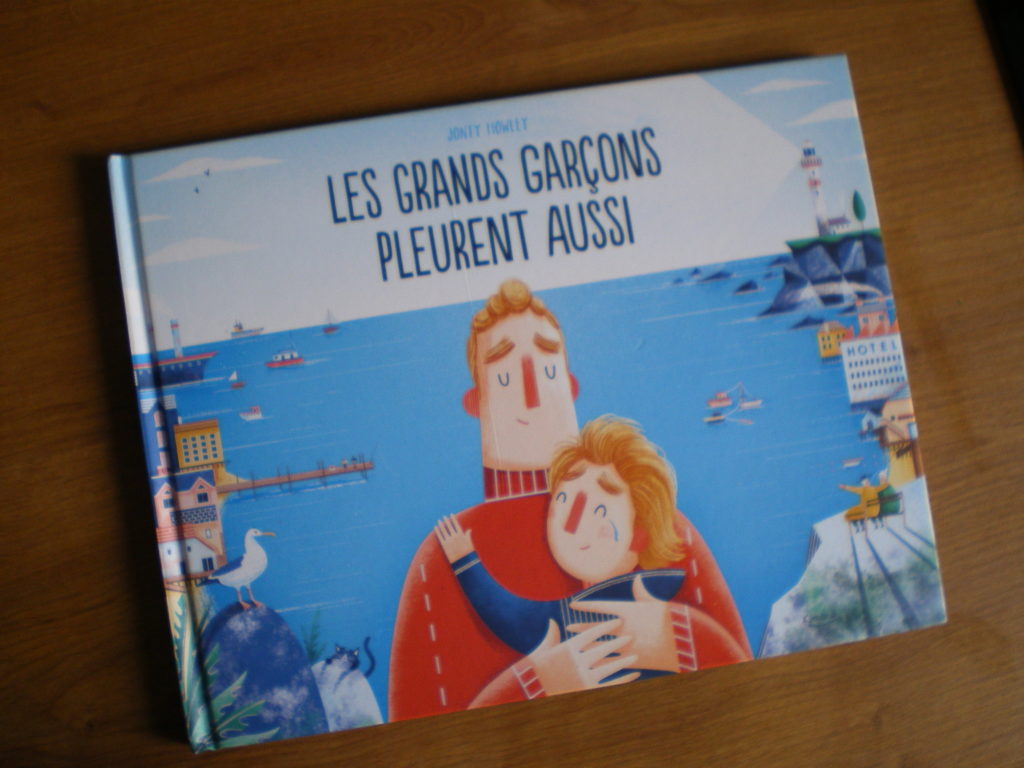
Boys are allowed to cry, and this picture book makes that clear from the very first page. It tells the story of Tom, a small boy facing his first day at a new school, and of the clumsy sentence his father uses to reassure him.
Along the way, the story quietly dismantles the old rule that "big boys don't cry" by showing the child a reality full of men who do. It is a simple, warm tool for talking about emotions with sons and daughters alike.

Quick takeaways
- The book tells the story of Tom, scared on his first day at a new school
- His father says "big boys don't cry", and the child believes him at first
- On the way, Tom meets fishermen, musicians and poets who are all crying
- In the evening, his father admits he cried too, out of worry
- The story questions tear censorship and supports acceptance of emotions
- It works as a read-aloud tool for talking about feelings with children
The Story of Tom's First Day
The book opens on a morning full of fear: it is Tom's first day at a new school and he is scared. His father does not know how to comfort him, so he says, awkwardly, that big boys do not cry. Tom decides not to cry, but the illustration shows him with a bent back, lost and unsure.
On the way to school he meets several grown men who are crying: a fisherman weeping at the thought of a long time at sea, a harp player moved by the music he plays, and passionate poets. Tom grows more and more confused, since he believed that big boys never cried.
A Father Who Also Cries
In the evening, coming home from school, Tom finds his father with tears in his eyes. He asks why, and his father answers that he was afraid for his son's first day. So big boys really do cry, and that is exactly how it should be.
Why This Book Challenges Tear Censorship
The subtlety of the story lies in how the father's claim is first accepted by the child, despite his own intuition, and then gradually questioned through observation of the real world. The boy does not argue; he simply watches, and what he sees contradicts what he was told.
Men cry in the facts: tough guys, rich and poor, soldiers, retired people, young parents. The ending insists on the unconditional acceptance of emotions in boys, big and small, and reminds us that boys have the right to cry.
The book tackles the acceptance of emotions and tears, and questions the censorship of crying, in boys and beyond. If you want more stories that open conversations at bedtime, a great books collection is a good place to start.

| Moment | What happens | What to talk about |
|---|---|---|
| Morning | Tom is afraid of his new school | Naming fear before it grows |
| The father's words | "Big boys don't cry" | Why adults say things they do not quite mean |
| The journey | Men are seen crying for different reasons | Emotions have many causes |
| The evening | The father cries too | Adults feel worry and love |
| The message | Everyone has the right to cry | Accepting emotions without condition |
Talking About Emotions With Children
Reading this book aloud is an easy way to name feelings without lecturing. Stop on the fisherman page and ask your child what the man might be feeling, then let them guess. Children often answer with surprising precision when they are given the space.
Keep the conversation open at home too: a parent who says out loud "I was worried today" gives a child permission to do the same. For families raising several children, a sibling bonds approach to feelings helps each child feel heard rather than compared.
For younger children who do not yet have the words, a baby sign language routine can reduce frustration before tears even start. And if a child is anxious about a new classroom, a nursery school choice conversation may be worth having before the first morning.

Books, Toys and Play That Support Emotional Learning
Picture books do part of the work, but play does the rest. Pretend play lets a child act out fear, anger and relief in a safe space, and open-ended toys are especially good at this because they can become anything. Our guide to open ended toys explains why simple materials often beat noisy gadgets.
For four-year-olds, who are right in the middle of learning to name emotions, a shelf of Montessori toys can support calm, focused play after a big day. Bath time is another good moment for relaxed talk, and a few well-chosen bath toys can turn it into a daily ritual.
Travel is a classic trigger for big feelings, so packing a small bag of travel toys can head off a meltdown on the plane. If you are preparing a long trip, it is also worth checking where to buy last-minute gifts, whether in Austin toy stores or San Diego toy stores.

My hands-on take
I read this one with my son during a week when he was nervous about starting a new activity, and the timing was almost too good. He kept pointing at the crying fisherman and asking why the man was sad, and that question turned into a long talk about missing people and being worried.
What I liked most is that the book never scolds the father. He is not a villain, just a tired parent saying the wrong thing, and that made it easier for me to admit my own clumsy sentences. Since then, "big boys don't cry" has become a running joke in our house, and my son corrects me every time.
Frequently asked questions
What is the book about?
It follows Tom on his first day at a new school, where his father tells him that big boys do not cry. Along the way, Tom sees many grown men crying and learns that everyone has the right to tears.
What age is it suitable for?
Like most picture books, it works best as a shared read with young children, roughly from preschool age upward. The simple text and clear illustrations make it easy to pause and talk about what the characters feel.
Does it only concern boys?
No. The story focuses on boys because the "big boys don't cry" rule is aimed at them, but the message about accepting emotions applies to every child and to the adults reading aloud.
Product Reviews
 Best Toys for Dogs With High Prey Drive |
Best Outdoor Toys for 3-4 Year Olds |
Best Outdoor Toys for 6 Year Olds |
Best Harness for Poodle |
Best LEGO Sets for Adults |
Best Travel Toys for 4 Year Olds on Airplane |
Best Toy Stores in Washington DC |
Best Potty Training Toys |
Best Toys for Tripod Dogs |
Maillot equipe de france







