


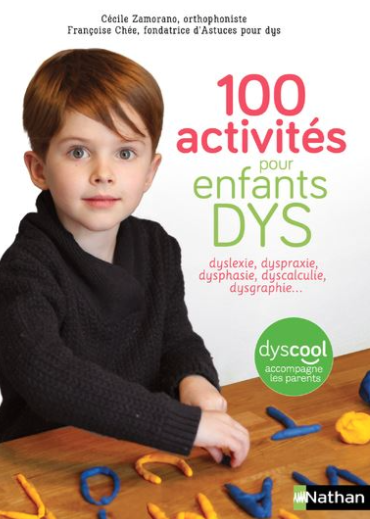
100 Activities for Dys Children is a book designed to help parents and teachers accompany a child with dys-type difficulties through everyday learning, from nursery school to the early secondary years.
The term covers a range of specific cognitive disorders and the learning difficulties they bring with them. Some affect early skills such as language or movement, while others touch school skills more directly, including reading, handwriting, spelling, calculation and geometry.

Written by a speech therapist and a mother of dys children, the guide offers a bank of activities to improve daily life both in class and at home.
Quick takeaways
- The book gathers 100 activities for all dys profiles, from nursery to early secondary.
- Activities are chosen by need, not by age, because each child progresses at their own pace.
- Six categories cover confidence, reading, writing, expression, logic and practical life.
- Concrete sound, motor and number games suit children around 5 to 12 years old.
- Older pupils get tools for spelling, grammar, proofreading and vocabulary.
- Practical advice covers organisation, font choice, computer use and extra time.
What the book covers and who it is for
This is a complete guide aimed at all types of dys difficulties, including dysphasia, dyscalculia, dyslexia and dysphrasia. Rather than treating one profile, it gathers activities that can be matched to the child in front of you. That flexibility matters, because no two children struggle in exactly the same way.
The authors are Cécile Zamorano, a speech therapist who has spent more than ten years supporting dys children and those with attention difficulties, and Françoise Chée, who shares her daily life as the mother of a dys child through her website and a Facebook page with close to 75,000 followers. Their combined professional and family perspective shapes the tone of the book.
If you are still exploring how support works in the early years, it helps to look at educational toys alongside structured activities, since play and guided practice often reinforce each other.

Why the activities are not sorted by age
Zamorano deliberately chose not to classify the activities by age or by level of acquisition, because every child progresses at their own pace. Instead, parents pick the activities that match the child's current needs and the difficulties actually encountered.
This approach respects the uneven profile many dys children show: strong in one area, fragile in another, and rarely moving forward in a straight line. A child may read fluently yet struggle to hold a pencil, or reason well with numbers while finding spelling exhausting.
The book is organised into six categories: self-confidence, reading, writing, oral and written expression, logic and mathematics, and practical life. In practice, the activities seem best suited to pupils roughly between 5 and 12 years old, particularly around the entry into reading and writing. For families who want to nurture a love of reading at home, these reading friendly stories can complement the book's suggestions.

| Area of difficulty | Example activity from the book | What it supports |
|---|---|---|
| Hearing sounds | Sound pots, rhyme boxes | Early reading and language |
| Hand control | Cutting, unscrewing, rough letters | Handwriting readiness |
| Numbers | Modelled digits, number boxes | Early maths and logic |
| Spelling and grammar | Common-word memory, proofreading sheet | Written accuracy |
| Daily organisation | Checklists, computer use, font choice | Independence and confidence |
When relatives interfere in the baby's care, it can undermine the calm routine these activities rely on, so it helps to know how to stop them gently.
Sounds, fine motor skills and early number work
Several activities focus on sounds, such as sound pots, rhyme boxes and moving sounds, which help children hear and manipulate the building blocks of language. These are playful, hands-on tasks rather than worksheets. For younger children, pairing them with language toys can make the practice feel less like a lesson.
Hands that learn by doing
Fine motor work appears throughout: cutting, unscrewing, tracing in textured material and rough letters. These build the control and coordination that handwriting depends on later. If you want more ideas in this direction, our selection of fine motor toys offers complementary options for four-year-olds.
Number work follows the same concrete logic, with modelled digits, number boxes and reading numbers. Movement-based games are a natural companion here, and psychomotor games at home can support this kind of learning without any special equipment. Families with pets may also enjoy our guide to child friendly dog breeds.

Spelling, grammar and reading for older children
For older pupils, the guide offers advice on spelling and grammar: a memory game with common words, a proofreading sheet, visual grammar and building a personal vocabulary notebook. These tools turn abstract rules into something the child can see and handle.
A proofreading sheet, for example, gives the child a fixed routine to check written work instead of relying on memory alone. A visual grammar approach uses colour and layout to make sentence structure visible. A vocabulary notebook encourages the child to collect words that matter to them.
Reading support runs through the whole book, and for children who need a gentler entry point, learning toys for two-year-olds can build early sound and word awareness long before formal reading begins.

Practical life: organisation, methods and tools
The final category focuses on daily life and on relieving the child's load. It covers organising oneself, a methodology for learning, choosing a suitable font, and using a computer, along with the extra time allowance some pupils receive in assessments.
These are the quiet supports that often make the biggest difference: a clear routine, a written checklist, a keyboard when handwriting is too costly. Each activity in the book is described, illustrated with a photo of children in action, and its purpose is explained by Chée, who is dys herself and the mother of dys children.
Building independence also means giving children room to practise daily tasks on their own, much as home childcare arrangements encourage routines and self-reliance in the early years.

How to use the book at home
Start from the difficulty you actually observe rather than from the table of contents. Choose one or two activities, try them for a couple of weeks, and keep what the child enjoys and returns to willingly.
Short, regular sessions work better than long ones, and stopping while the child is still engaged protects motivation. Keep the tone playful, praise effort rather than speed, and let the child handle the materials as much as possible.
Finally, share what works with the teacher so the same supports carry over into class. A consistent approach between home and school, including simple things like bedtime songs to close the day calmly, helps the child feel supported on every side.

My hands-on take
I have used activity books like this one with children who were exhausted by worksheets, and the change in mood was often immediate. What works for me is keeping the materials out on a low shelf so the child can choose an activity themselves; that small act of control seems to lower the resistance.
I also learned to stop a session while it is still going well. Ten focused minutes that end in success do more for confidence than half an hour that ends in tears, and the child comes back the next day without a fight.
Frequently asked questions
Who wrote the book?
It was written by Cécile Zamorano, a speech therapist with over ten years of experience supporting dys children, and Françoise Chée, a mother of a dys child who shares advice online. Their mix of professional and family experience shapes the guide.
Is the book organised by age?
No. The authors deliberately avoided sorting activities by age or level, so parents can choose what matches the child's current needs. This suits children whose skills develop unevenly.
Which difficulties does it address?
It is aimed at all dys profiles, including dyslexia, dysphasia, dysphrasia and dyscalculia. Activities span sounds, motor skills, numbers, spelling, grammar and daily organisation.
Where can I find it?
It is published by Nathan Dyscool and available in libraries, bookshops and online retailers. It can also be ordered through major online stores.
Product Reviews
 Best Toys for Dogs With High Prey Drive |
Best Outdoor Toys for 3-4 Year Olds |
Best Outdoor Toys for 6 Year Olds |
Best Harness for Poodle |
Best LEGO Sets for Adults |
Best Travel Toys for 4 Year Olds on Airplane |
Best Toy Stores in Washington DC |
Best Potty Training Toys |
Best Toys for Tripod Dogs |
Maillot equipe de france







