


Asking children for help is one of the simplest ways to build cooperation at home, yet many parents turn it into a daily battle. The goal is not to get perfect obedience but to invite children to contribute to family life in a way that respects both them and you.
Children gain self-esteem when they feel useful within their family. They need to belong to a group and to take part in reaching a common goal, and this can start as early as two or three years old. When their contribution matters and their presence is wanted, their need for belonging and importance is met.

Parents benefit too. Running a home is constant work, and asking for help is a way of protecting your own energy instead of exhausting yourself in endless struggles over cooperation.
Quick takeaways
- Children feel valued when their contribution truly matters.
- Start asking for small help from around age two or three.
- State your need honestly instead of pretending to be endlessly patient.
- Say what you want done, not what the child did wrong.
- Make requests specific and add a clear time frame.
- Use games, signals and funny voices to lighten chores.
Expressing Your Needs Honestly
Children can hear our emotions and needs, and they are especially sensitive to them when we are authentic. You do not have to be endlessly patient. Family therapist Jesper Juul offers simple examples of how this sounds in practice.
In one exchange, a parent says, “Solène, I need your help!” When the child replies that she has no time because she is going to play football, the parent can answer, “That’s fine, play football first, but I would like you to take care of the dishes afterwards.”
In another example, the parent asks the child to take old newspapers to the yellow bin today. The child protests that she doesn’t feel like it because she is watching television. The parent answers calmly: “No problem. You don’t have to feel like it. You are allowed to do it reluctantly. In any case, I don’t want to see these newspapers here today.”
This tone works because it states the need without attacking the child. It also helps to see the family as a team in which everyone, including children, has a full role, much like the small everyday lessons explored in high flying family plan.

Making Objective Requests Without Reproaches
Marshall Rosenberg, founder of Nonviolent Communication, recommends using positive action language: say what you want, not what you don’t want. Two clear questions help shape a request: what do we want the other person to do differently, and why do we want them to do it? The answer should describe a specific action.
So “I need help hanging the laundry!” only works if it is not paired with a disguised reproach, such as a list of everything you did alone or everything the child failed to do that day. Reproaches wear us down and kill our enthusiasm, as Catherine Dumonteil-Kremer puts it.
Keeping requests free of blame is a communication skill that pays off in many areas of family life, from mealtimes to the way we handle sensitive topics such as childhood hypersexualization concerns or the questions raised in family interference boundaries.

| Vague demand | Clear request | Added playful or time element |
|---|---|---|
| Tidy your room | Put toys in the chest, books on the shelf | Done before the meal |
| Deal with your laundry | Dirty clothes in the bathroom basket | Before tomorrow noon |
| Help me | Hang the laundry with me now | Race against the timer |
| Clear the table | Put the cutlery away | Done during one song |
Being Clear and Specific
Detailing what you expect helps a child understand the request. “Tidy your room!” is vague and means something different depending on the child’s age and point of view; hiding everything under the bed is, after all, one way of making the mess disappear.
“Tidy your room” could become “Tidying your room means picking up the toys and putting them in the toy chest, and the books and putting them on the shelf.” “Deal with your laundry” becomes “I’m asking you to pick up the dirty laundry and put it in the laundry basket in the bathroom.”
Adding a sense of time makes the request even more precise: “I would appreciate it if this were done by tomorrow noon, before the meal, or in ten minutes.” Clear expectations also support learning at home, in the same spirit as the playful discovery found in learning toys toddlers or the seasonal activities in autumn story ideas.
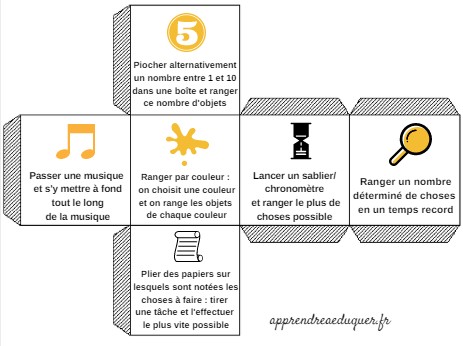
Adding a Playful Dimension
Playfulness lowers resistance. Write tasks on slips of paper, drop them in a shoebox, and let each family member draw one and complete it as fast as possible. Or turn tidying into a race against a timer, since challenges make chores feel less like a constraint.
Agree on a signal in advance, such as a special word or the clink of a glass, and when it sounds everyone puts away a set number of objects. The signal could also be a song: at the signal, everyone starts their previously agreed task, or tidies as much as possible while the song lasts.
Changing your voice or adopting a comic accent, like a robot voice or an unusual formal tone, can also get children moving in good humour. Playful routines fit naturally alongside screen-free fun such as screen free toys and the imaginative worlds of wooden playhouse dreams.

Keeping Reminders Brief
There is no need to drown children in explanations and reproaches. A simple reminder of expectations and household rules is usually enough, whether as a single word (“Zoé, the cutlery!” said warmly) or a short, informative sentence (“It’s time to set the table!”).
Short reminders respect the child’s attention and keep the atmosphere calm. They also model the kind of clear, kind communication we hope to see returned, whether the topic is chores, water float safety or the practical planning behind exercise during pregnancy.
My hands-on take
In our home, the biggest change came when I stopped announcing vague chores and started naming the exact action. “Tidy up” used to produce blank stares; “put the blocks in the blue box and the books on the low shelf” actually got things moving. I also learned to drop the little speech about everything I had already done that day, because it only made everyone tense.
The shoebox of task slips was an unexpected hit. My children started asking to draw one, and the timer turned tidying into a game they wanted to win. I still forget to keep reminders short, but when I manage a warm “the cutlery!” instead of a lecture, the table gets set far faster.
Frequently asked questions
At what age can I start asking my child for help?
You can begin around two or three years old with small, simple tasks. At that age the point is participation and belonging rather than perfect results.
What if my child says they don’t want to help?
You can acknowledge the feeling without giving up the request. Explain that they don’t have to enjoy it, but the task still needs doing today.
Why should I avoid reproaches?
Reproaches wear parents down and kill enthusiasm in children. A clear action request without blame is far more likely to get cooperation.
How do I make chores more appealing?
Add a game, a timer, a song or a funny voice. Playfulness makes tasks feel less like a constraint and more like shared fun.
Product Reviews
 Best Toys for Dogs With High Prey Drive |
Best Outdoor Toys for 3-4 Year Olds |
Best Outdoor Toys for 6 Year Olds |
Best Harness for Poodle |
Best LEGO Sets for Adults |
Best Travel Toys for 4 Year Olds on Airplane |
Best Toy Stores in Washington DC |
Best Potty Training Toys |
Best Toys for Tripod Dogs |
Maillot equipe de france







