


Classroom stress management is one of the most useful skills you can quietly build into a school day, because children cannot learn well when their bodies are flooded with worry. The good news is that most calming tools are simple, free and quick enough to fit between two lessons.
This guide gathers ten concrete strategies you can print, display and practise with students, from talking and counting to breathing, drawing and moving. Each one is short enough to use in the moment and easy to repeat until it becomes a habit.

Quick takeaways
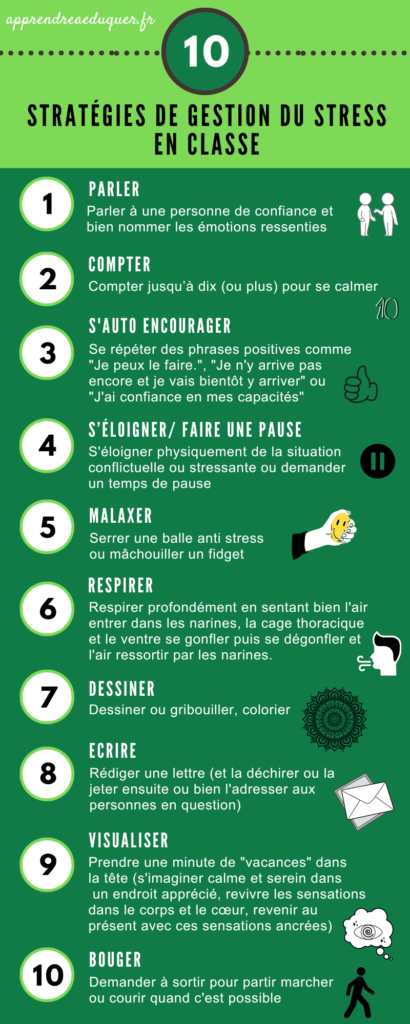
- Name the emotion out loud to a trusted person
- Count to ten or higher to slow the body down
- Repeat short, fair, positive phrases
- Step away or ask for a pause when needed
- Squeeze a stress ball or fidget to occupy the hands
- Breathe deeply, then draw, write, visualise or move
Why stress management belongs in the classroom
Stress is not a character flaw, and it is not something children should simply push through. A racing heart, tight chest or restless body makes it hard to listen, remember instructions or take part in group work. When a child learns a few reliable ways to calm down, the whole class benefits from a quieter, more focused atmosphere.
It helps to treat these strategies the way you treat any other routine skill, such as handwriting or reading aloud. You practise them when everyone is calm, so they are ready when someone actually needs them. Some children also find it useful to understand why easy things sometimes feel so difficult, which takes pressure off them when a task suddenly feels overwhelming. difficult tasks explained
You do not need a special room or a long session. A single minute, used consistently, can shift the mood of a child and of the room.
Talk, count and encourage yourself
The first three strategies are verbal and private, which makes them easy to use anywhere. Talking means naming the emotion out loud to a trusted person, because putting a feeling into words already loosens its grip. Counting to ten, or higher, gives the body a simple rhythm to hold on to while the wave passes.
Self-encouragement is the third tool: repeating short phrases such as “I can do this”, “I haven't managed yet and I will soon” or “I trust my abilities”. These sentences are not about pretending everything is fine; they are about giving a worried child a fairer inner voice. As Lucía's pediatric advice reminds us, parents are the mirror children reflect themselves in, so our own calm words matter.
Making it practical
You can display these three prompts on a small poster near a quiet corner, and model them yourself when something goes wrong in class. Children copy what adults do far more readily than what they are told. For more inspiration, these motherhood blogs offer plenty of everyday examples.

| Strategy | What the child does | Best moment to use |
|---|---|---|
| Talk | Names the emotion to someone trusted | During or just after a conflict |
| Count | Counts to ten or more | When feelings rise quickly |
| Self-encourage | Repeats positive phrases | Before a test or task |
| Step away | Takes distance or a pause | In a tense situation |
| Squeeze | Uses a stress ball or fidget | During quiet seat work |
| Breathe | Breathes deeply through the nose | Any time, especially before focus |
| Draw | Draws, scribbles or colours | When words are hard |
| Write | Writes a letter, then keeps or discards it | After an upset |
| Visualise | Takes a one-minute mental holiday | Before returning to work |
| Move | Walks or runs briefly | When the body is restless |
Step away, squeeze and breathe
Sometimes the best move is physical distance. Stepping away from a stressful or conflictual situation, or simply asking for a short pause, gives a child space to settle before returning. Pair this with something to squeeze, such as a stress ball or a small fidget to chew, and the hands get busy while the mind slows down.
Breathing is the anchor of the whole set. Ask students to breathe in deeply through the nostrils, feel the ribcage and belly expand, then let the air flow back out through the nose. Doing this slowly a few times is often enough to bring a child back into the room.
Younger children respond well to playful props, and the same calm-down habits you use at school can be echoed at home with the best toys for a four month old, which are designed for grabbing, mouthing and soothing. toys for babies
Draw, write and visualise
Not every child can talk about what is bothering them, and that is fine. Drawing, scribbling or colouring offers an outlet that needs no vocabulary at all. Writing works in a similar way: a child can compose a letter to the person or situation that upset them, then tear it up, throw it away or keep it.
Visualisation is the quietest strategy of all. Invite students to take a one-minute holiday in their head: picture a place they love, feel calm and peaceful there, notice the sensations in their body and heart, then come back to the present with those feelings still anchored.
These creative outlets are also a gentle way to improve self improvement and strengthen bonds between siblings at home, since drawing or writing side by side often opens a conversation that direct questions close. sibling bonds
Move the body to reset the mind
Movement is the final strategy and often the fastest. When it is possible, let a child leave the room to walk or run for a few minutes. A short burst of activity burns off some of the adrenaline that keeps a stressed body on edge.
You can build movement into the day before stress has a chance to build up. A calm, predictable start to the morning helps, and these tips to prepare your child for the school route show how a settled journey can set the tone for the hours that follow. school route
For children who find it hard to sit still during focused work, a short movement break between tasks is often more effective than a reminder to stay quiet. Try it before a test, after lunch or whenever the energy in the room starts to fray.
Building a calm routine that lasts
One strategy used once is a rescue; the same strategy used every week becomes a skill. Choose two or three from the list and practise them at fixed moments, such as the start of the day or after break. Keep the language neutral and the tone matter-of-fact, so no child feels singled out.
Some children need a little more support with focus and confidence, and approaches such as the Kumon method show how small, repeated steps can build a sense of competence over time. Kumon method You might also explore which movie character fits each pupil, or find science toys to spark curiosity.
Finally, remember that adults set the emotional weather. A teacher who pauses, breathes and names their own frustration calmly gives the class a living example of everything on this list.

My hands-on take
I have used these prompts with groups of children of different ages, and the pattern is always the same: the strategies that work best are the ones the children have already practised when nothing was wrong. Breathing in particular tends to fall flat the first time it is introduced during a crisis, because a stressed child finds slow breathing strange. Practising it for thirty seconds at the start of a session, as a game rather than a remedy, changes everything.
My own habit is to keep the list visible and to use it myself out loud. When I say “I'm going to count to ten before I answer that”, the room usually goes quiet and a few children count along. That small moment of shared regulation does more than any lecture about staying calm.
Frequently asked questions
How long should a calming strategy take?
Most of these tools work in one to three minutes. Counting, breathing and visualising are designed to be short enough to use between two activities without disrupting the lesson.
What if a child refuses to try any of them?
Offer choices rather than instructions, and let the child pick one from the list. Modelling the strategy yourself, without asking anything in return, often lowers resistance over time.
Can these strategies be used at home too?
Yes. The same prompts work at home, and consistency between school and family makes them more effective. A short poster on the fridge can be enough.
Do I need special equipment?
No. Only the squeeze strategy needs an object, and even that can be replaced by a piece of fabric or a simple toy. Everything else relies on words, breath, paper or movement.
Product Reviews
 Best Toys for Dogs With High Prey Drive |
Best Outdoor Toys for 3-4 Year Olds |
Best Outdoor Toys for 6 Year Olds |
Best Harness for Poodle |
Best LEGO Sets for Adults |
Best Travel Toys for 4 Year Olds on Airplane |
Best Toy Stores in Washington DC |
Best Potty Training Toys |
Best Toys for Tripod Dogs |
Maillot equipe de france







