


Movement is a fundamental human need, and in children that need is even more intense. When kids cannot move as much as their bodies demand, many of them become overexcited, jump in every direction and simply cannot sit still.
It helps to see this behaviour not as misbehaviour but as a signal. Children need ways to spend their surplus energy without hurting themselves, hurting others or breaking things at home.

The good news is that everyday movement, a change of body position and a few playful activities can do a great deal to bring a wired child back to calm.
Quick takeaways
- Movement is a basic need, not misbehaviour.
- An immature prefrontal cortex means children act on impulse.
- Slow, steady spinning calms; fast, jerky spinning excites.
- Inversions stimulate the vestibular system and aid balance.
- Offer short movement breaks before restlessness builds.
- Avoid competition when a child is already wound up.
Movement is a basic need, especially for children
Child psychologist Héloïse Junier reminds us that young children are programmed to climb anything within reach. As she puts it, the child does not merely wish to climb, the child needs to climb and is literally programmed to do it.
Climbing, running, sliding, jumping and pulling themselves up all serve a positive purpose in development. To sharpen balance and refine motor skills, a child must test their body in situations that feel a little risky, lifting a leg higher or reaching further for a support.
On top of this, an immature prefrontal cortex does not yet let a child brake or inhibit impulses. The child lives in action and in the present moment, so blocking spontaneous exploration does not just slow the child, it slows the intelligence being built. When movement and fresh air are missing, children are physically in a state of need and show signs of tension. Giving them toys for toddlers and space to move freely meets that need.

Changing body position has a calming effect
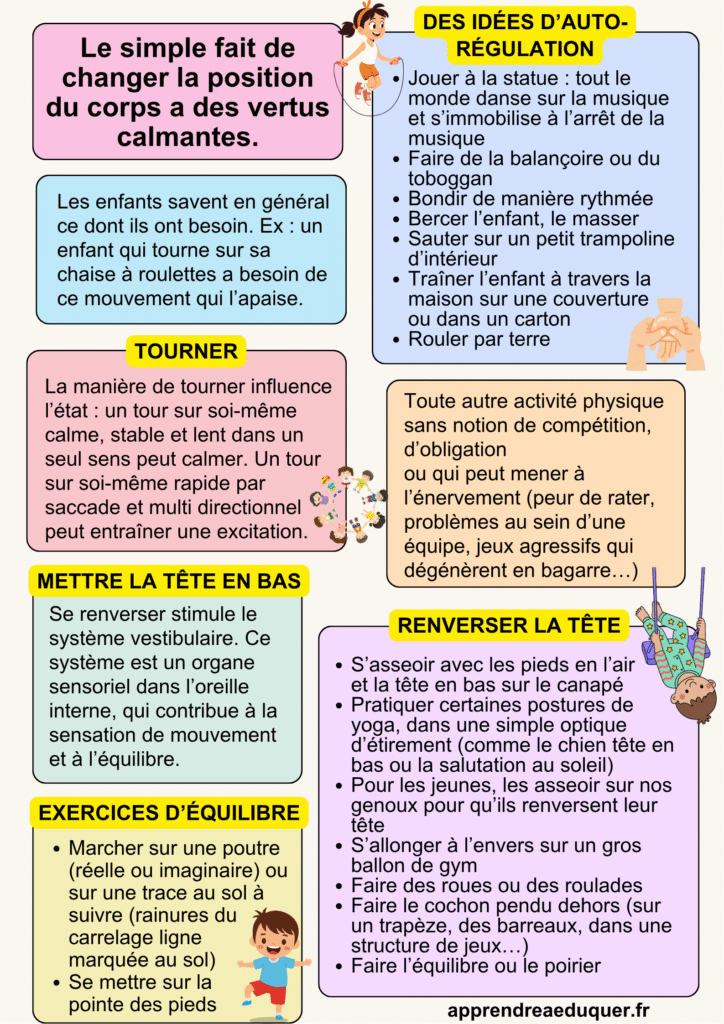
Children usually know what they need. A child who keeps spinning on a wheeled chair probably needs that movement because it soothes them. The more we move, the better we regulate emotions, and this holds for adults and children alike.
Simple activities can be offered as self-regulation techniques. Try a game of musical statues, where everyone dances and freezes when the music stops, or let children bounce rhythmically, swing, slide, rock in your arms or jump on a small indoor trampoline.
You can drag a child across the house on a blanket or in a cardboard box, hold hands in a circle, or run a short back-and-forth race. Walking along a real or imaginary beam, or following a line on the floor, works well too. Notice that slow, steady spinning in one direction calms, while fast, jerky, multi-directional spinning excites. Keep activities free of competition, obligation or anything that can lead to frustration, and consider bath toys for playful movement at home. As our pediatrician reminds us, we parents our children reflect every morning, so join in the movement yourself.

| Activity | Effect | Best moment |
|---|---|---|
| Slow rocking or swinging | Calming | Before bed or after excitement |
| Steady spinning in one direction | Calming | When tension builds |
| Fast, jerky multi-directional spinning | Exciting | Active outdoor play |
| Downward dog or head-down poses | Calming | Several short times a day |
| Musical statues | Calming focus | Indoor quiet transitions |
| Short back-and-forth races | Energising | Morning or after school |
Going upside down: an odd but effective idea
Putting the head below the body can help a child return to calm when emotions and the urge to move become overwhelming. Inverting the body stimulates the vestibular system, a sensory organ in the inner ear that contributes to the sense of movement and balance.
This system is responsible for our balance, our spatial orientation and the coordination of our movements. Specific inversion activities can be offered several times a day, for a few minutes, to children who tend to get restless or easily wound up.
Simple inversion ideas
Children can sit with feet up and head down on the sofa, practise gentle yoga stretches such as downward dog or sun salutation, or lie upside down over a large gym ball. They can do cartwheels or somersaults, hang from a bar or trapeze, or try a headstand. For younger children, sit them on your lap and let them tip their heads back. If you are curious about how sensory play develops early on, these toys for crawling are a natural starting point.
Building movement into the everyday routine
The most reliable way to prevent the overexcited spiral is to offer movement before the child is already desperate for it. Short bursts of physical play spread through the day work better than one long session, and they fit easily around meals, homework and quiet time.
Outdoor time matters as much as indoor play. A walk, a trip to the park or simply running around the garden gives children the fresh air their bodies crave. When you plan family outings, it helps to choose places where children can move freely, and these family hotels Spain show how much space and play areas can matter. Even a simple routine like balanced barbecue planning can become an active family moment. For more ideas on understanding your child's needs, these parenting TED Talks are worth watching.
Watch for the early signs of tension, such as fidgeting, chair spinning or restlessness, and respond with a quick movement break rather than a reprimand. A few minutes of jumping, rocking or balancing often prevents a much bigger meltdown later.

What to avoid and how to respond
Punishing a child for moving rarely solves the problem, because the need does not disappear when it is forbidden. Instead, redirect the energy toward safe outlets and set clear boundaries around what is not allowed, such as jumping on furniture or throwing hard objects.
Keep competitive games for moments when your child is already calm, since fear of losing or team friction can quickly turn excitement into anger. Choose cooperative movement instead, where everyone wins together.
If restlessness seems constant and intense, it is worth mentioning it to a health professional, who can help you look at sleep, screen time and other factors. For general questions about children's health, resources on topics like recurrent tonsillitis or whether homeopathy for children is useful can support your decisions. Above all, stay patient: movement is how children learn about their bodies and the world, and your calm response teaches them how to find calm themselves.

My hands-on take
In my own home, the biggest change came when I stopped treating jumping and climbing as a problem to fix and started treating it as information. When my child began spinning on the chair or bouncing off the sofa, I learned to pause and ask what the body was asking for. Often a few minutes of rocking, a short race down the hallway or a quick head-down stretch on the sofa was enough to reset the mood.
I also found that timing matters more than intensity. A short movement break before homework or before dinner prevented far more meltdowns than a long session later. Keeping a small indoor trampoline and a floor line made of tape nearby meant I could respond quickly without turning the moment into a power struggle.
Frequently asked questions
Why does my child jump and spin so much?
Children have a strong, developmentally programmed need to move, climb and test their balance. When that need is unmet, they often become overexcited and restless rather than calm.
Is going upside down really calming?
Inversions stimulate the vestibular system in the inner ear, which supports balance and spatial orientation. Short, gentle head-down activities several times a day can help a wired child settle.
What should I do when my child is already overexcited?
Offer a simple, non-competitive movement break such as rocking, slow spinning or a short race. Avoid competitive games until your child is calm again.
When should I worry about constant restlessness?
If the restlessness is intense and persistent, talk to a health professional. They can help you review sleep, routine and other factors behind the behaviour.
Product Reviews
 Best Toys for Dogs With High Prey Drive |
Best Outdoor Toys for 3-4 Year Olds |
Best Outdoor Toys for 6 Year Olds |
Best Harness for Poodle |
Best LEGO Sets for Adults |
Best Travel Toys for 4 Year Olds on Airplane |
Best Toy Stores in Washington DC |
Best Potty Training Toys |
Best Toys for Tripod Dogs |
Maillot equipe de france







