


Children's anger is one of the most misunderstood parts of parenting, and it is easy to jump to judgment when a child melts down in public. Onlookers often assume the child is spoiled or that the parents have lost control, and many of us quietly think we would handle it better. Yet every parent eventually faces a child who behaves in ways they never wanted.
The real question is not how to punish the outburst but how to read it. Once you understand what is happening inside a young child, the shouting and tears start to make sense, and your own reaction becomes something you can choose rather than something that erupts.

Quick takeaways
- Anger in children usually signals an immature brain, not manipulation
- The impulse-control area of the brain matures only from around age five
- Children often release stored stress with their main attachment figure
- Mirror neurons make them catch the emotions of adults around them
- Tenderness and a secure presence help the brain mature
- Calm boundaries work better once the crisis has passed
Why children behave in ways we judge as inappropriate
Young children cannot yet put words to what they feel. When an emotion overwhelms them, it comes out as screaming, crying or what looks like rage. A hungry child, for example, can become unbearable to be around because the physical need disrupts their hormonal balance and creates stress.
None of this is deliberate. Children are not plotting to make your morning difficult; they often cannot even form a plan. What many adults still fail to grasp is that the child's brain is immature, and the part that controls impulses only begins to mature from around age five. Until then, children are in direct contact with their emotions, without the filter of reason. This is also why labeling children so easily backfires: a child who hears "you're the difficult one" starts to believe it.
When tension builds up elsewhere
Many meltdowns are disproportionate reactions, stress discharging from a saturated and disoriented brain. A child who has held in a layer cake of emotions all day at school or nursery often keeps them bottled up. When the main attachment figure reappears, usually the mother, the child feels safe enough to release everything.
These are exactly the moments when parents feel most helpless. Words do not work, because stress makes the thinking brain switch off, and the child's reasoning capacities are in any case less developed than an adult's. Punishing a child mid-crisis means blaming them for a brain they cannot control. Staying close and offering a secure presence does the opposite: it supports the slow work of infant development and emotional growth. The same steady, responsive approach also underpins Montessori play choices that respect a child's pace.
What to do in the moment
The emergency response to stress is tenderness. Ideally a hug, but even an attentive, empathetic look can begin to calm a child. A warm attitude, gentle gestures and a soothing voice all help the brain mature, as pediatrician Catherine Gueguen explains. For related guidance on safe sleep, see tummy sleep safety.

| What you see | What may be happening | A helpful response |
|---|---|---|
| Sudden meltdown after nursery | Stored stress released with a safe adult | Stay close, lower your voice |
| Screaming when hungry | Physiological stress from an unmet need | Offer food calmly, avoid lectures |
| Copying your shouting | Mirror neurons echoing your emotion | Regulate yourself first |
| Acting out after family tension | Child carrying the family's stress | Reassure, name feelings gently |
| Withdrawn or defiant behavior | Inverted cooperation with adult emotion | Look at what you are modeling |
The family emotional barometer
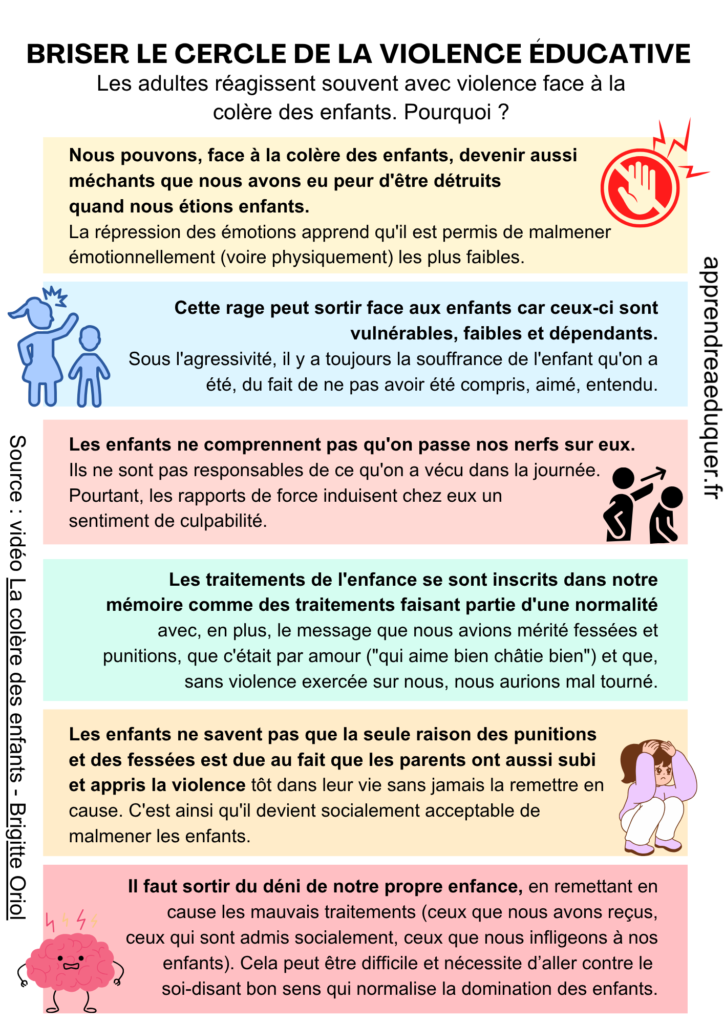
Children's mirror neurons pick up the emotions of those around them. Gueguen describes these neurons as a kind of sixth sense that makes emotions contagious, so when adults shout and lose their temper, the child feels that same anger. Tantrums can also be a way of externalizing family tension, with the child carrying it so the parents can release it.
The Danish family therapist Jesper Juul sees cooperation as central to childhood. For him, cooperating means copying, imitating or adapting, and children do it in two ways. Directly, they behave like their parents and become near-copies of their outward attitude. Inversely, they invert and distort adult behavior, as with a mother who hides her grief while one child withdraws and another acts out. Recognizing this pattern helps you read the Montessori climbing toys style of hands-on, self-directed play as another place where children process emotion.
Rethinking punishment and rewards
If anger is a signal rather than an offense, the old reflex of punishment loses its logic. A child in crisis needs co-regulation, not a consequence. That does not mean abandoning boundaries; it means setting them calmly once the storm has passed, when the thinking brain is back online.
This is also why so-called rewards for good behavior can confuse things, turning connection into a transaction. A calmer approach is to name feelings, offer comfort and model the regulation you want to see. The same patience pays off in daily routines, whether you are choosing quiet toys for a restless afternoon, helping your baby sleeps well on warm nights, or preparing for children sleep after an emotional day. Staying alert to childhood flu complications matters too, since illness can unsettle rest and mood.
Practical habits that lower the temperature
Prevention does a lot of quiet work. Regular meals and rest reduce the physiological stress that sparks outbursts, and a predictable rhythm gives children a sense of safety. Naming emotions aloud throughout the day, even happy ones, builds the vocabulary they lack.
Parents also need to look after their own state, since children absorb it so readily. A short pause before reacting, a calmer voice and a moment to breathe are not luxuries but part of the job. If you are expecting another baby, the same principles apply from the start, and postpartum care basics can help you stay grounded while everyone adjusts.

My hands-on take
I learned this the hard way with my own daughter, who would fall apart the moment I picked her up from nursery. For months I read it as defiance and answered with a sharper voice, which only made things worse. One evening I simply sat on the floor, said nothing and held her while she cried. The storm passed far faster than any lecture ever managed.
Since then I have tried to treat her anger as information rather than an attack. I still lose my patience sometimes, and I say so out loud, which seems to help her see that feelings are manageable. The change in our house has been slow but real, and it started the day I stopped taking the tantrums personally.
Frequently asked questions
Is my child's anger a sign of bad parenting?
Not necessarily. Anger is often a normal expression of an immature brain and stored stress. What matters most is how you respond in the moment and afterward.
Why does my child melt down right after school or nursery?
Children often hold emotions in all day and release them when they feel safe with their main attachment figure. It is a sign of trust rather than defiance.
Should I punish a tantrum?
Punishing a child mid-crisis blames them for something they cannot yet control. Calm boundaries set after the storm are more effective and kinder.
Can my own stress affect my child?
Yes. Children pick up emotions through mirror neurons, so your shouting or tension can be transmitted. Regulating yourself is part of helping them.
Product Reviews
 Best Toys for Dogs With High Prey Drive |
Best Outdoor Toys for 3-4 Year Olds |
Best Outdoor Toys for 6 Year Olds |
Best Harness for Poodle |
Best LEGO Sets for Adults |
Best Travel Toys for 4 Year Olds on Airplane |
Best Toy Stores in Washington DC |
Best Potty Training Toys |
Best Toys for Tripod Dogs |
Maillot equipe de france







