


Violence against a child, whether a smack, a shove, a humiliating remark or a shouted threat, leaves a mark that no apology erases by itself. Yet what happens afterwards matters enormously: the way a parent returns to calm, names what went wrong and repairs the relationship can turn a painful moment into a lesson in accountability.
This article walks through that process step by step, from understanding the mechanisms that push us past our convictions to the concrete words that rebuild trust. It is not about becoming a perfectly serene parent, but about refusing violence as an educational method and owning the moments we fall short.

Quick takeaways
- Violence often comes from our own childhood wounds, not from the child's behaviour.
- Anger is healthy and informative; violence is a choice we can refuse.
- Name your state, take a real pause, and say where you are going.
- Commit out loud to non-violence, using simple words children can grasp.
- Apologise, acknowledge the hurt, and ask whether a hug is welcome.
- Accept the child's anger without defending yourself with “but”.
Understanding what pushes parents toward violence
Most slaps and spankings children receive have less to do with any misbehaviour than with the wounds their parents carry from childhood. That is an uncomfortable idea, close to pop psychology at first glance, but working on your personal history is anything but incidental. Many of us are governed by traumatic memory the moment education is at stake, and revisiting the past is the only real way to free ourselves from it.
None of this means becoming an impassive monk who has deleted anger from the emotional register. Anger is a healthy emotion: it alerts us that our personal boundaries have been crossed and that we are entitled to feel it. Anger is not the same as violence; it is a signal that a need is going unmet, and learning to read that signal is part of learning from children as much as teaching them.
Accepting vulnerability as an antidote
What we can do is accept showing vulnerability in front of our children, because vulnerability works as an antidote to violence. A sentence as simple as “When things go like this between us, I don't know what to do. I feel myself getting very, very angry and I'd rather we took a pause. I need it to calm down” changes the whole scene.
That pause can take any form, but it must never turn into a punishment in the child's eyes. Sending a child away to calm down, or announcing that you cannot stand them any more, is not a pause. Isolating yourself for a few moments to lower the anger is fine, provided you say where you are going so the child is not frightened. Even the smallest children notice tension, and a calm explanation protects them, much as you would protect a baby's wellbeing when thinking about sitting the baby safely at the family table. The same care applies to contraceptives after childbirth and to requesting schedule changes without reducing your hours.

| Step | What it sounds like | Why it matters |
|---|---|---|
| Calm down first | Long exhales, a glass of water | You cannot repair while still flooded |
| Apologise clearly | “This was not acceptable, I apologise” | Shows the adult owns the act |
| Acknowledge the hurt | “I must have frightened you” | The child feels seen, not blamed |
| Offer contact | “Would a hug help?” | Respects the child's own timing |
| Receive their anger | Listen without “but” | Anger expressed is anger released |
| Keep the promise | Pause early next time | Consistency builds trust |
Coming back to calm as a parent
Several techniques help you return to calm before you can work out what has been touched inside you: taking long, ample breaths with slow exhales, drinking a glass of water, thinking back to your child as a baby, calling your partner or a friend or relative, handing over for a while if possible, stroking the dog or cat or a soft fabric, or breathing in a pleasant scent.
This quiet time is necessary to step back and start an emotional investigation. What happened? What was the trigger, the thing said, seen or heard? What is my anger telling me, what would I have needed, which important value of mine was touched? And now, what do I need, and how can I put it into words for my child? Writing it down helps, and so does borrowing the reflective habit behind the family book, where feelings and stories are given a place.
Committing to non-violence out loud
It takes courage to explain calmly to a child: “Whatever you do, whatever you say, nobody has the right to hit you, speak badly to you or disrespect you, not even your mum and dad.” Saying this does not dump responsibility for your outburst on the child; it acknowledges before them that you cannot commit such acts.
With children old enough to follow rational speech, which is not before six or seven, you can add examples and share your aspirations: “We both know it is forbidden to hurt those smaller than us. We must look after them, protect them, help them. There is always a respectful way to solve a conflict, and I commit to it.” A child who is learning to read and write is also learning to name feelings, which is why helping a child write their emotions can support this work.
Repairing the relationship: taking adult responsibility
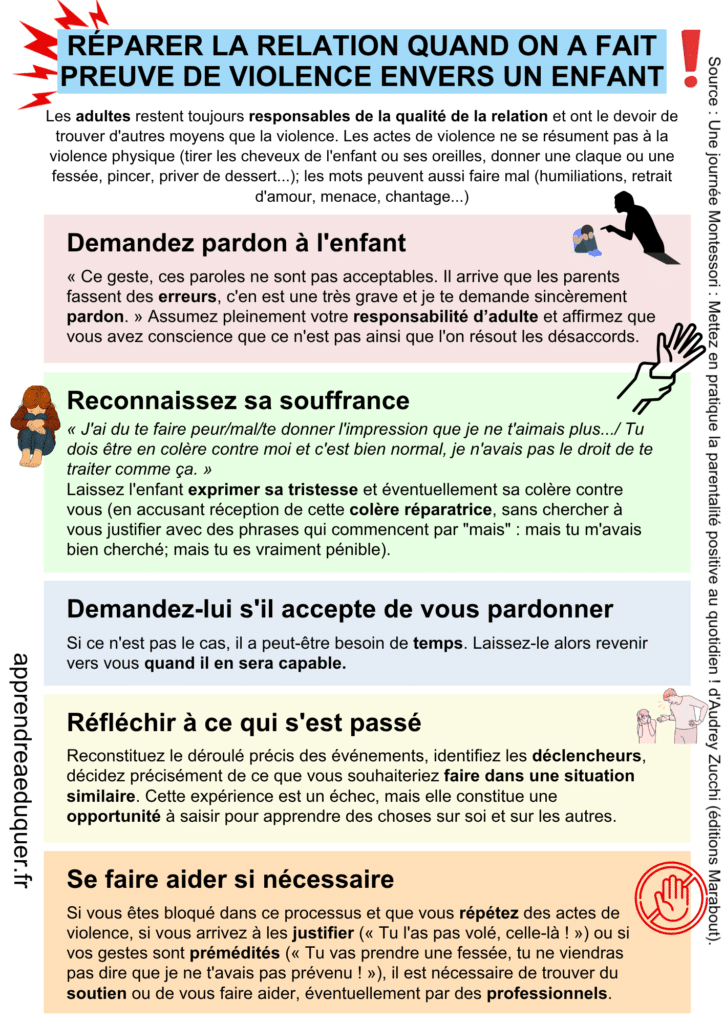
Whatever the child said or did, adults remain responsible for the quality of the relationship and must find means other than violence. Violence is not only physical, such as pulling hair or ears, slapping, spanking, pinching or withholding dessert. Words can hurt as much as blows: insults, humiliation, silence, withdrawal of love, threats, blackmail and ultimatums all count, and these are among the behaviors to avoid.
Concrete steps after a violent act
Ask the child for forgiveness: “This gesture, these words, are not acceptable. Parents make mistakes, this is a very serious one, and I sincerely apologise.” Acknowledge their physical or psychological suffering: “I must have frightened you, hurt you, made you feel I no longer loved you. You must be angry with me, and that is normal.” Affirm that you know this is not how conflicts are resolved.
Then ask whether they accept your apology and a return of physical contact, a hug or a hand on the shoulder. If not, they may need time; let them come back when they can. Allow sadness and anger to be expressed, receiving it without justifying yourself with sentences starting in “but”. Play can help children process what they cannot yet say, which is one reason toys for imaginative play earn their place in the home, and it also offers a gentle way to reuse old toys.
Rebuilding trust over the following days
Repair is not a single conversation but a climate you build afterwards. Keep the commitments you made, name your anger early when you feel it rising, and use the pause before words escape. Children forgive readily, but they also remember consistency, so the days after an incident are when your good intentions are tested.
For younger children, the same principles apply with simpler words and more physical reassurance. A calm routine around meals and rest reduces friction, and the guidance on toys for newborns reminds us how much environment shapes behaviour even in the earliest months. Older children benefit from hearing that respect is mutual, and that the adults in their life are working on themselves too.

My hands-on take
I remember a evening when I snapped over a spilled drink and heard my own voice come out far too loud. What stayed with me was not the spill but my son's face, and the fact that I had promised myself this would not happen. The next morning I sat down beside him and said, plainly, that my reaction had been wrong and that nobody, including me, had the right to speak to him that way.
He was quiet, then asked whether I was still angry. We agreed on a word he could use when my voice starts rising, and honestly, that small signal has done more for our household than any resolution I made alone. I still lose my temper sometimes. The difference is that I now know the way back.
Frequently asked questions
Is it too late to repair if I shouted at my child yesterday?
No. Children respond well to a sincere, calm conversation even a day later. What matters is that you name the act, take responsibility and avoid repeating it.
Should I force my child to hug me after an argument?
No. Offer contact and let them decide. If they refuse, they may need time, and you should let them come back when they are ready.
At what age can I explain that nobody has the right to hit?
You can say it simply from the start, but rational explanations with examples land better from around six or seven. Younger children understand tone and reassurance more than reasoning.
Product Reviews
 Best Toys for Dogs With High Prey Drive |
Best Outdoor Toys for 3-4 Year Olds |
Best Outdoor Toys for 6 Year Olds |
Best Harness for Poodle |
Best LEGO Sets for Adults |
Best Travel Toys for 4 Year Olds on Airplane |
Best Toy Stores in Washington DC |
Best Potty Training Toys |
Best Toys for Tripod Dogs |
Maillot equipe de france







