


Setting limits for children works best when we first change how we look at childhood itself. Many babies arrive already wired for empathy, and our job is to protect that capacity rather than drill morality into them through lectures or a punishment-and-reward system.
It is not easy to drop the belief that children manipulate us, test us and must obey at any cost. Yet reflecting on a few simple questions can shift both our outlook and our daily practice toward a more caring style of education.

Quick takeaways
- Clarify your values before enforcing rules; love and fear do not mix well.
- Treat emotions as messengers pointing to unmet physical, emotional or autonomy needs.
- Name the need even when you cannot meet it, to preserve connection.
- Punishment and permissiveness both mask the cause instead of addressing it.
- Set firm, non-violent limits on what harms people, property or safety.
- Expect skills to develop slowly, with occasional steps backwards.
Start With Values, Not Obedience
Before we try to educate children, it helps to clarify the values we want to guide our relationship with them. Ask yourself whether you truly want your child to follow every order regardless of its ethical worth, or whether you would sacrifice their emotional and relational skills just to have a quiet day.
Consider whether your relationship rests on fear or on love, since the two sit very poorly together. Think too about the model you offer: a child who sees that the strongest person may use violence learns to adopt that law of the strongest. Finally, try adjusting your vocabulary, speaking of clumsiness rather than mischief, of a puzzle to solve rather than a tantrum, and of cooperation rather than obedience.
Children Are Wired for Fairness
It is our responsibility to recognise and nourish the child's loving, fair nature. Humans are predisposed to resonate with others and to act ethically, which lets us live together in a degree of harmony. Adults therefore do not need to manufacture empathy or altruism; they need to support the growth of qualities that are already there. Because children learn the behaviour they see, a child raised with violence learns violence, while Montessori housework shows how everyday participation builds competence gently.
Match Expectations to Development
Knowing the stages of child development helps us hold appropriate expectations and adapt our instructions. It is pointless to expect a child under five to master frustration or eat without spilling. Reasonable goals prevent a great deal of conflict.
Play itself is a powerful teacher here. A simple cardboard box can absorb a toddler for ages, and choosing toys for toddlers that match the child's real stage avoids setting them up to fail. For older children, foam block toys support learning through building rather than through instruction.
Emotions Point to Needs
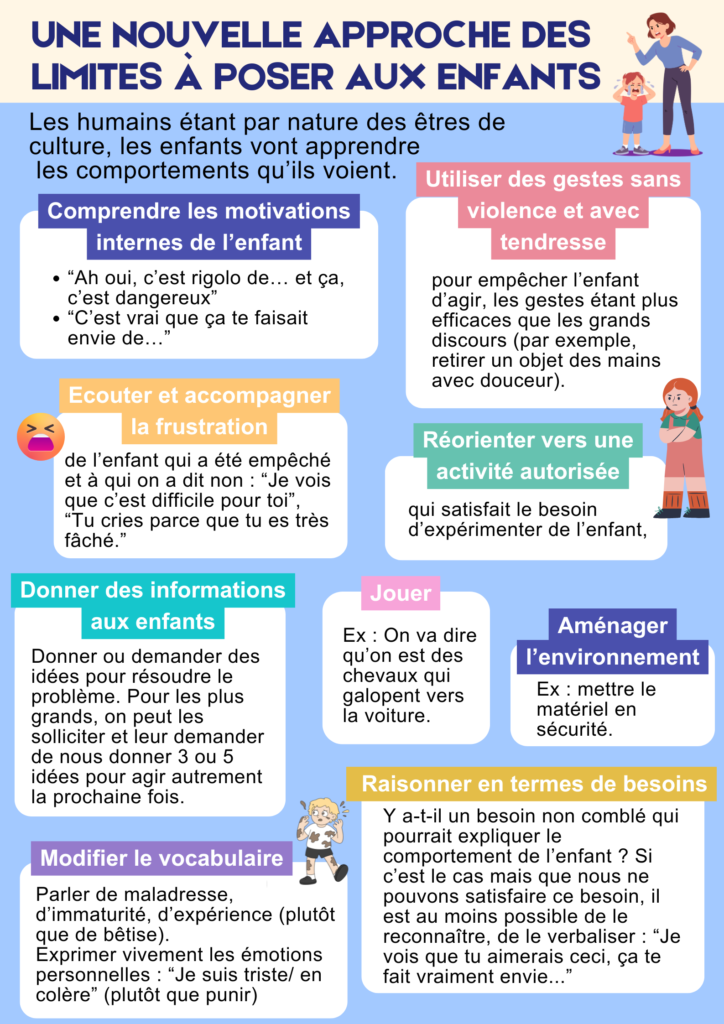
Emotions carry no moral value in themselves; they are messengers drawing attention to unmet needs. When a child has a meltdown, one of their needs is probably unsatisfied. These needs may be physiological (food, sleep, drink, the toilet), emotional (attention, affection, presence, empathy), or related to movement (jumping, playing, running, creating).
There is also the need to learn (exploring, understanding, experimenting with water, food or earth) and the need for autonomy (doing it alone, making choices). Until we identify the positive motivation behind a behaviour, there is little chance the child will change it. Thinking in terms of needs rather than limits is far more useful: is something unmet explaining this behaviour? If we cannot meet the need, we can at least name it and acknowledge it, creating an empathic connection that fills the child's emotional tank. Sensory play, such as games to stimulate senses, often meets several of these needs at once.
| What we often say | What may be happening | A more helpful response |
|---|---|---|
| "Stop being naughty" | Clumsiness or a missing skill | "Let's try again together" |
| "You're having a tantrum" | An emotional release or unmet need | Stay close, name the feeling |
| "Do as I say" | A need for autonomy | Offer two acceptable choices |
| "That's dangerous, no!" | Curiosity plus real risk | "That's fun, and this part is dangerous" |
| "You'll get a reward if..." | Compliance bought with prizes | Notice and describe the effort |
When the Milk Boils Over, Turn Down the Gas
Shouting, punishing, smacking, sending a child to the corner, but also tolerating unacceptable behaviour or granting every request, all amount to putting a lid on boiling milk. These reactions never address the cause, the gas beneath the pan. There is no point stopping the milk from spilling if you do not turn down the heat.
Limits and learning go hand in hand: to learn, a child needs to feel emotionally and physically safe. That means encouragement and empathic understanding alongside rules and a safe environment. Skills are acquired gradually, and progress sometimes slips backwards.
Firm Limits Without Violence
At the same time, we are responsible for limiting experiences that damage the environment or materials, harm others, or create danger. Such limits can be set without violence while acknowledging the child's inner motivation: "Yes, that's funny to do, and that part is dangerous," or "I can see you really wanted to." With younger children, gentle physical gestures stop the action far more effectively than long speeches. Calm, consistent responses also shape how children handle music and rhythm and other stimulating activities, where excitement can quickly tip into overwhelm.

Build a Home That Makes Limits Easier
Many conflicts disappear when the environment does some of the work. A child who has their own space to retreat to is less likely to melt down in shared rooms, and simple routines reduce the number of daily negotiations. You can read more on why babies need space of their own.
Reward systems deserve a rethink too. Rather than dangling prizes for compliance, notice effort and cooperation, and save small treats for genuine celebrations. Seasonal ideas such as back to school rewards work best when they mark a moment rather than buy behaviour. Shared humour also defuses tension: a well-timed silly joke, drawn from jokes for kids, can reset a difficult moment faster than any lecture.
Finally, remember that parents are people too. Protecting your own rest and support network keeps your patience available when limits really matter.
My hands-on take
In my own home, the biggest shift came from swapping "what rule is being broken?" for "what is going on underneath?". When my youngest started flinging food off the table, my first instinct was to scold. Instead I watched for a week and noticed it happened mostly before lunch, when hunger and tiredness collided. Moving the meal earlier and offering a job at the table changed almost everything.
I have also learned to use my hands more than my voice with little ones. A gentle hand guiding a toy away from a socket works far better than a speech they cannot follow yet. And when I do lose my temper, I try to repair it afterwards rather than pretend it did not happen. That repair, I find, teaches more about limits than any punishment ever did.
Frequently asked questions
Does this approach mean children never hear the word no?
No. Limits remain essential, especially around safety, property and other people. The difference is that limits are set calmly and with an understanding of the child's motivation, rather than through punishment or shouting.
How do I respond when I cannot meet the need behind a behaviour?
Acknowledge it out loud. Naming the wish, such as "you really wanted that," shows the child you understand and keeps the connection intact, even when the answer stays no.
Is a meltdown always a sign of bad parenting?
Not at all. Crying and raging can be a normal physiological release of accumulated tension. It is uncomfortable for adults, but it serves a healthy function.
Product Reviews
 Best Toys for Dogs With High Prey Drive |
Best Outdoor Toys for 3-4 Year Olds |
Best Outdoor Toys for 6 Year Olds |
Best Harness for Poodle |
Best LEGO Sets for Adults |
Best Travel Toys for 4 Year Olds on Airplane |
Best Toy Stores in Washington DC |
Best Potty Training Toys |
Best Toys for Tripod Dogs |
Maillot equipe de france







