


Your inner child is the part of you that still carries the emotions, memories, and unmet needs of the child you once were. Recognizing this part of yourself is the first step toward understanding adultism, the systemic domination of children by adults.
Because every human being passes from childhood to adulthood, everyone has experienced this domination in some form. Yet many adults deny their own childhood pain, and that denial can make it harder to treat children with the dignity they deserve.

This article explores how reconnecting with your inner child can become a powerful ally in breaking that cycle and building a more respectful relationship with the youngest among us.
Quick takeaways
- Adultism is the domination of children by adults, and everyone has experienced it.
- Your inner child carries unmet needs that still shape your adult emotions.
- Phrases that justify childhood violence hide a contradiction between feeling and belief.
- Repression of children's emotions conditions them to obey authority uncritically.
- Reconnecting with your inner child begins with small, honest moments of attention.
- Respecting children means believing their emotions while still holding gentle boundaries.
What Adultism Really Means
Adultism describes the domination of children by adults, and it is unique among oppressions because every adult was once a child. We all move from the dominated group to the dominant one, which means everyone has been touched by it. When we talk about our childhood, it is our inner child speaking, and that voice lives within our body and brain.
This inner child can act as a guide, helping us recognize unmet needs that still influence our emotions and reactions as adults. Ignoring that voice does not make it disappear. It simply goes underground, shaping our behavior in ways we rarely notice.
Understanding adultism starts with honest self-reflection. The way we respond to a child's distress often mirrors how our own distress was handled, whether with patience or dismissal.
When We Silence Our Own Inner Child
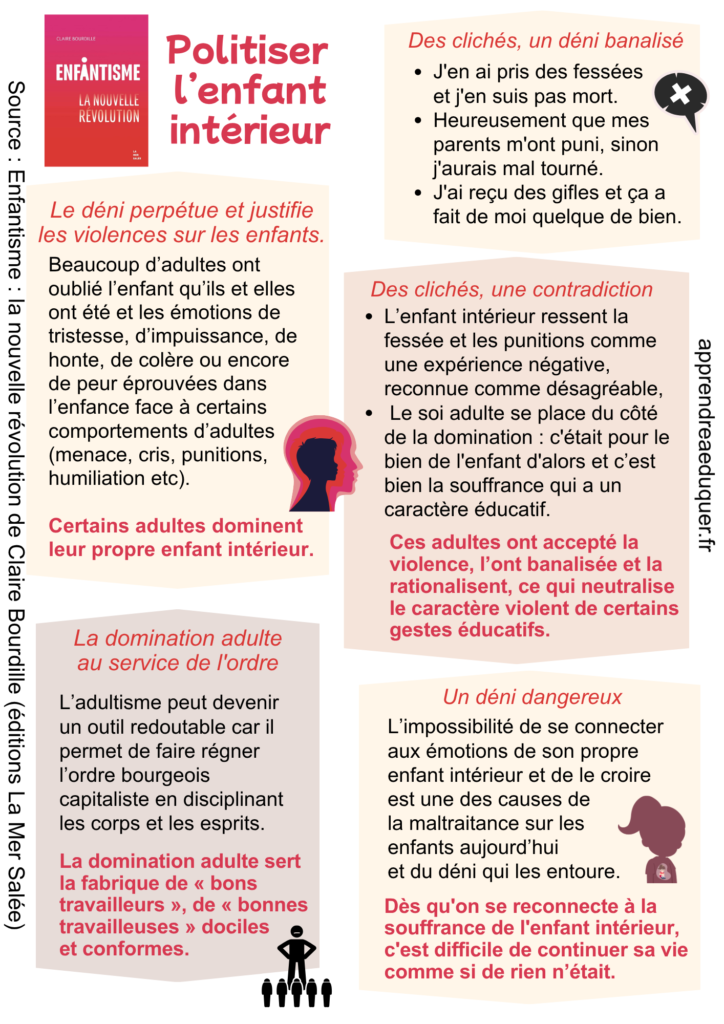
Many adults have forgotten the child they once were, along with the sadness, helplessness, shame, anger, and fear they felt when facing threats, shouting, punishment, or humiliation. In this sense, some adults dominate their own inner child. This shows up in familiar phrases like "I got spanked and I turned out fine" or "my parents punished me, otherwise I would have gone wrong."
These clichés hide a contradiction: the inner child experienced the act as unpleasant, while the adult self sides with the domination and justifies the violence. The violence gets rationalized and neutralized, sometimes even redeemed by later social success, much like the saying that one must suffer to be beautiful. Yet children come our lives, not to be broken into compliance.
But is someone truly "good" when they defend violence against the most vulnerable? The inability to connect with, hear, and believe our own inner child places us in a dangerous denial that fuels mistreatment and the silence around it. Reconnecting with play, as with the best outdoor toys, can help adults recover that lost connection.
| Reaction to a child's distress | What it signals | A more respectful response |
|---|---|---|
| "You're overreacting" | Dismissing your own inner child | "I see you're upset; tell me more" |
| "I got spanked and turned out fine" | Justifying past violence | Acknowledge the pain you felt then |
| "It's for their own good" | Rationalizing control | Explain the boundary calmly |
| Rushing to fix the feeling | Discomfort with emotion | Sit with the child quietly |
| Punishing the outburst | Fear-based discipline | Address the need behind it |
Adultism and the Discipline of Bodies and Minds
Adultism can become a powerful tool because it helps maintain a disciplined social order by controlling bodies and minds. Physical, verbal, and psychological violence against children suppresses emotions, spontaneity, vulnerability, and creativity from an early age, everything that makes us deeply human.
This socialization through repression conditions children to obey the teacher, then the employer, and every authority figure, while weakening critical thinking. Adult domination thus serves the making of docile, conforming workers who rarely question the system around them.
The difficulty for those who advocate for children's rights is that conditioned adults cling to the established order, even when it only serves the interests of the powerful. Speaking up for children means refusing to preserve relationships where their suffering can be denied, minimized, or justified.
Why Reconnection Is Uncomfortable
Once you reconnect with the suffering of your inner child, it becomes hard to carry on as if nothing happened. That discomfort is not a flaw; it is the beginning of change. Our inner children are political, and they carry the hope of a fairer, more equal society that respects the dignity of the youngest.
Everyday Ways to Listen to Your Inner Child
Reconnecting does not require grand gestures. It begins with small moments of honesty, noticing when a child's cry or a parenting decision stirs something in you. That stir is information, not weakness. Naming the feeling quietly to yourself is often enough to interrupt an automatic reaction.
Practical steps help too. Pause before responding to a child's distress and ask what your younger self needed in a similar moment. Speak to children the way you wish someone had spoken to you. When you catch yourself repeating a phrase that dismisses pain, stop and rephrase it.
Parenting routines offer daily practice. Even simple caregiving moments, like newborn hospital registration or planning nap schedules around a child's real needs, become chances to respect rather than control. A family getaway can offer this same practice in a new setting. Play is another doorway: choosing open ended toys or toys for 6 year olds lets children lead, and letting them lead teaches adults to listen.

Building a More Respectful Relationship with Children
A respectful relationship with children rests on believing their emotions rather than minimizing them. When a child is upset, the goal is not to talk them out of it but to sit with them in it. This mirrors what we would offer our own inner child, and it gradually rewires the habit of dismissal.
This same spirit can shape family life beyond discipline. Planning family escape rooms or child-friendly attractions around what genuinely delights children, rather than what adults assume is good for them, puts their perspective at the center. Even choosing toy stores together becomes a small act of respect when the child's preferences matter.
None of this means abandoning boundaries. Children still need guidance and safety. The difference is that guidance can come from connection rather than fear, and boundaries can be explained rather than imposed. Over time, these small shifts build trust and show children their voice has value.
My hands-on take
When I first read about the inner child, I thought it sounded abstract. Then I noticed something small: whenever a child near me cried loudly, my first instinct was irritation, a quick urge to make it stop. One day I paused and asked myself where that irritation came from. The answer surprised me. As a child, I had learned that crying was inconvenient, so I had buried the impulse entirely. Since then, I have tried a simple practice. When a child's distress triggers me, I take one breath and silently ask my younger self what he needed in that moment. Usually the answer is something plain, like being believed or simply being held. Offering that to the child in front of me feels less like technique and more like repair. It has not made me a perfect parent or caregiver, but it has made me slower to dismiss, and that alone has changed how the children around me respond to me.Frequently asked questions
What exactly is adultism?
Adultism is the systemic domination of children by adults. It is unique because every adult was once a child, so everyone has experienced it from the dominated side before moving to the dominant one.
How do I know if I am silencing my inner child?
Watch for phrases that justify harsh treatment you received as a child, such as insisting punishment did you good. These statements often reveal a gap between what your inner child felt and what your adult self now believes.
Is reconnecting with my inner child the same as blaming my parents?
No. It is about understanding your own emotional history, not assigning blame. The goal is to recognize unmet needs so they stop shaping your reactions unconsciously.
Can I respect children's emotions and still set limits?
Yes. Boundaries and respect are not opposites. You can hold a firm limit while acknowledging and believing the child's feelings about it.
Product Reviews
 Best Toys for Dogs With High Prey Drive |
Best Outdoor Toys for 3-4 Year Olds |
Best Outdoor Toys for 6 Year Olds |
Best Harness for Poodle |
Best LEGO Sets for Adults |
Best Travel Toys for 4 Year Olds on Airplane |
Best Toy Stores in Washington DC |
Best Potty Training Toys |
Best Toys for Tripod Dogs |
Maillot equipe de france







