


Parents at the end of their rope need something gentler than another list of rules, and that is exactly what these four messages of hope offer. Every parent knows those difficult moments when a child is overwhelmed, when we are overwhelmed, and when nothing we try seems to work.
These ideas come from the work of Daniel Siegel and Tina Payne on how children's brains grow through connection, rupture and repair. They do not promise a magic wand. They promise something more durable: presence, honesty, and the possibility of starting again.

Read them slowly, keep the ones that speak to you, and return to them on the hard days.
Quick takeaways
- There is no magic wand: sometimes presence is the only thing you can offer.
- Your failures teach your child how to handle difficulty and repair harm.
- Ruptures are normal; restoring connection is the parent's responsibility.
- Apologies, invitations to talk and humor are simple repair tools.
- The brain keeps changing at any age, for parents and children alike.
- Small, repeated choices matter more than one perfect reaction.
There Is No Magic Wand for Parents at the End of Their Rope
Sometimes there is simply nothing we can do to fix a problem while our children are moving through inner turbulence that is too violent to reason with. We can stay calm and loving, be fully present, and improvise with real creativity, and still the situation will not improve in that exact moment.
What we have to offer is our presence, helping our children cross their own zone of turbulence. When a child asks to be left alone, respect the need that seems most appropriate for their return to calm. If reconnection or reframing fails, say something simple: “This is not the right moment to talk about it. You are furious and so am I, so we listen to a song for now.”
What presence looks like in practice
Presence is not a technique, it is an attitude: staying close without forcing words, lowering your voice, and accepting that the storm has its own timing. This is the same patience we need when speech development takes its own slow path, or when we are simply guiding our children through a day that keeps unraveling.
Even Our Failures Have a Positive Influence
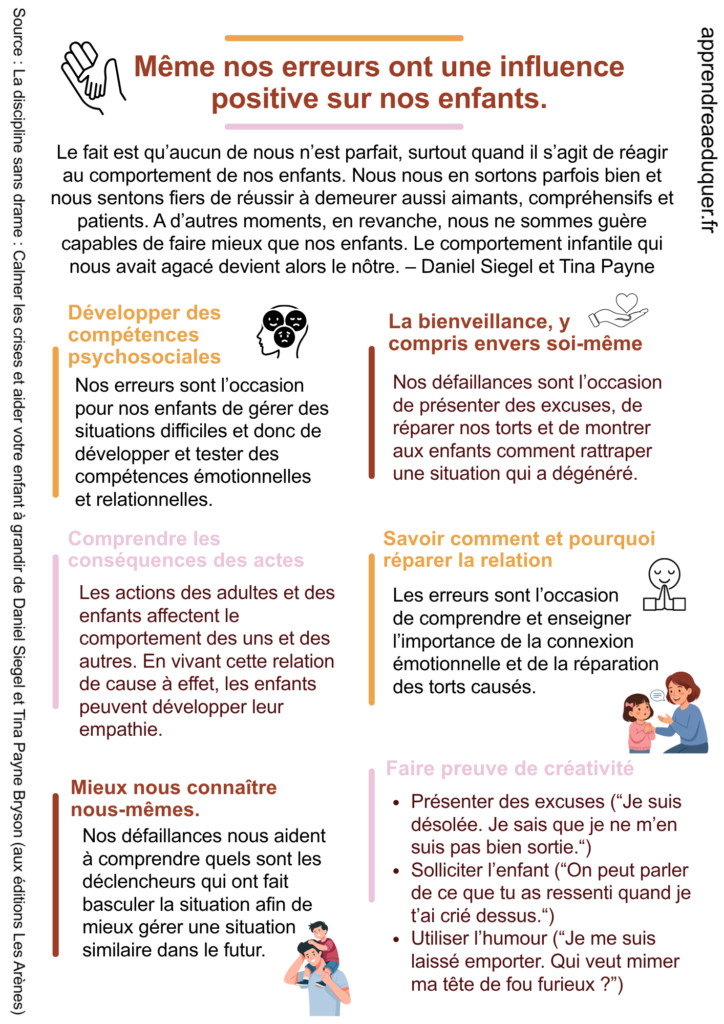
None of us is perfect, especially when it comes to reacting to our children's behavior. Sometimes we do well and feel proud of staying loving, understanding and patient. At other times we are barely able to do better than our children, and the childish behavior that annoyed us becomes our own.
Those moments are not wasted. They are an opportunity for our children to manage difficult situations and test emotional and relational skills. They let us apologize and repair, showing by example how to recover a situation that has gone wrong. They help children see that their actions affect other people, which feeds empathy, and they teach the importance of emotional connection and repair.
What we learn about ourselves
Failures also show us which triggers tipped the situation over, so we can handle a similar moment better next time. They help us know ourselves and practice kindness, including toward ourselves. A parent who is mentally preparing for a demanding season can hold this perspective more easily.

| Situation | What to say or do | Why it helps |
|---|---|---|
| You shouted and regret it | Apologize plainly and name your tiredness | Models accountability |
| Your child is furious | “This is not the moment to talk; let's listen to a song” | Lowers the temperature |
| Your child asks for space | Respect the need to be alone | Supports return to calm |
| The fracture went unmentioned | Invite the child to share what they felt | Restores connection |
| You keep losing your temper | Note the trigger and plan one small change | Builds new habits |
We Can Always Restore the Connection
In most adult relationships, when we fail we eventually acknowledge it or confront it, and we know how to repair. Many parents, with their own child, prefer to ignore the fracture entirely and never face it. That attitude can be deeply hurtful and disorienting for a child, exactly as it would be for an adult.
Ruptures leave parents and children disconnected, and restoring connection is our responsibility as the parent. Siegel and Payne suggest several ways to do it: apologize and ask for forgiveness (“I am sorry. I think I just reacted because I am exhausted today. I know I did not handle that well”), invite the child to talk (“We can talk about what you felt when I shouted at you”), or use humor (“I completely lost it. Who wants to imitate my furious face?”).
Small repairs, big effect
Repair does not need a long speech. A short, sincere sentence close to the child often does more than an elaborate explanation. The same instinct to reconnect matters when breastfeeding gets painful or when a family is figuring out shared expenses and needs calm conversations.
It Is Never Too Late for Positive Change
Brain neuroplasticity has shown the human brain's capacity for transformation and adaptation throughout life. We can adopt a new parenting philosophy at any age, at any age of the parents, because the brain can learn and create new neural connections all life long, and at any age of the children.
You can decide that you will try, as often as possible, to connect and to use kind redirection rather than punishment. This is not about becoming a different person overnight. It is about repeating small choices until they become habits, and trusting that the brain keeps its ability to change.
Practical ways to support the shift
Keep a simple routine that lowers tension, such as indoor activities on difficult afternoons, and notice what helps your child settle. If you are expecting another baby, preparing for birth calmly can make the whole household steadier, and toys for crawling keep a little one happily occupied while you breathe.
Turning These Messages Into Everyday Habits
Hope becomes useful when it turns into something concrete. Choose one repair phrase you can say almost automatically, and one calming ritual you can reach for when the tension rises. Keep them small enough to survive a bad day.
It also helps to look at the environment around the meltdown: a quieter corner, a familiar object, a song. The point is not to prevent every storm but to shorten it and to end it connected rather than apart.

My hands-on take
I remember a evening when nothing I said reached my son and I could feel my own patience snapping. Instead of launching into another explanation, I sat on the floor nearby and said quietly that I was tired and sorry for shouting. He did not answer, but a few minutes later he leaned against my shoulder, and that small gesture told me the connection was still there.
Since then I keep one repair sentence ready and one calming ritual, a song we both like. It does not prevent every hard moment, but it shortens them, and it reminds me that being present is often enough.
Frequently asked questions
Does apologizing to my child undermine my authority?
No. A sincere apology shows that mistakes can be named and repaired, which is a skill your child will need. It strengthens trust rather than weakening your role.
What if my child refuses to talk after a rupture?
Offer the invitation without pressure and stay nearby. Sometimes a shared activity or a bit of humor opens the door better than a direct question.
Is it really possible to change my reactions now?
The brain keeps its ability to learn and form new connections throughout life. Change comes from small, repeated choices rather than one dramatic decision.
How do I stay calm when nothing works?
Accept that some moments cannot be fixed and aim only for presence. Lowering your voice and shortening the storm is already a success.
Product Reviews
 Best Toys for Dogs With High Prey Drive |
Best Outdoor Toys for 3-4 Year Olds |
Best Outdoor Toys for 6 Year Olds |
Best Harness for Poodle |
Best LEGO Sets for Adults |
Best Travel Toys for 4 Year Olds on Airplane |
Best Toy Stores in Washington DC |
Best Potty Training Toys |
Best Toys for Tripod Dogs |
Maillot equipe de france







