


The roots of hatred are rarely innate: they are grown, often quietly, in ordinary educational violence that adults dismiss as harmless discipline. Alice Miller asks a fundamental question: why do we search so eagerly for "innate" evil in the genes, when so much of the harm we fear is made at home, hour after hour?
Most of us, she suggests, have suffered some form of ordinary educational violence: spankings, slaps, verbal humiliation, emotional repression, blackmail, threats, withdrawal of love and isolation. As children we learned to suppress the pain these caused, because the adults around us insisted that hurting children was normal and for their own good.

Yet the memory of those emotional wounds stays stored in the brain and the body. This article looks at how that stored pain can turn into hatred, and what parents can do to break the cycle.
Quick takeaways
- Ordinary educational violence includes spankings, shaming, threats and withdrawal of love.
- Repressed childhood pain stays stored in the brain and body and can resurface as hatred.
- Humiliation tends to breed more humiliation, feeding a spiral of violence.
- Facing the truth about your own history is the way out of the cycle.
- Allow children to express emotions, including anger, from an early age.
- Be a helpful witness: anyone can offer an abused child empathy and support.
The birth of hatred
Miller questions our habit of hunting for evil in the genes rather than in childhood experience. She argues that many of us carry the effects of ordinary educational violence and secretly fear the awakening of old humiliations we were taught to bury. Children learn to repress suffering because adult messages said it was normal to hurt them "for their good".
The memories do not disappear. They remain stored in the brain and the body, shaping reactions long after the event. Many adults still believe that blows and emotional violence do good, that they are educational and stop children from going "wrong". Plenty of parents say it is neither desirable nor possible to raise children without hitting or punishing them.
That belief is worth examining closely, because it decides how we respond when a child tests our patience. If you have ever wondered why you want to be small again, part of the answer may lie in the safety childhood should have offered.

Violence is never educational
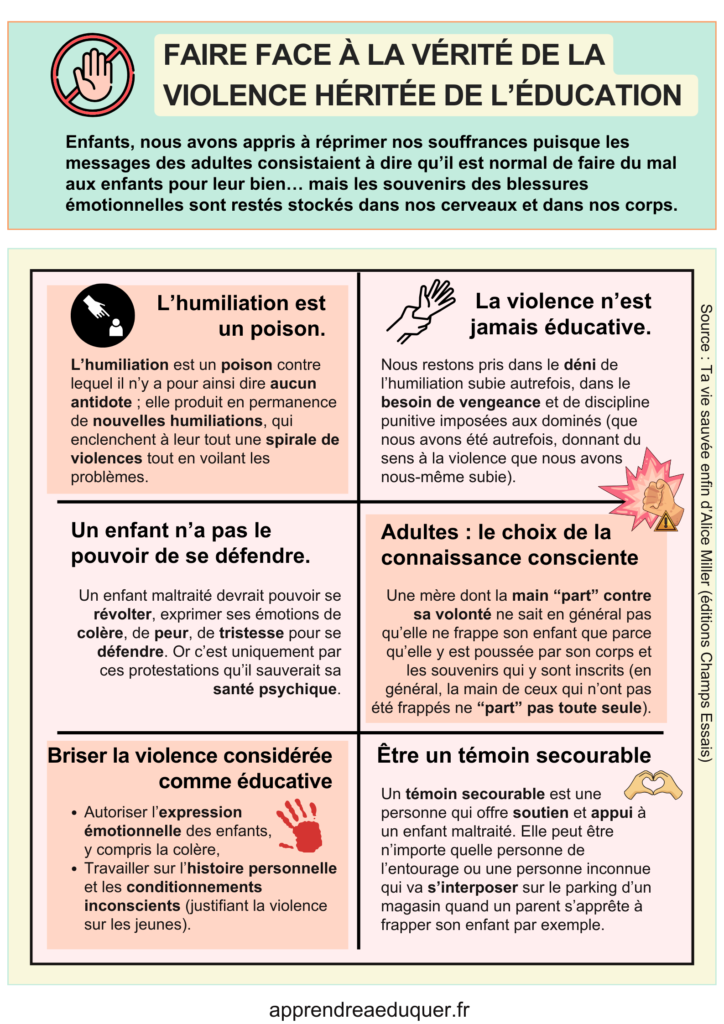
Miller regrets that we stay caught in the cycle of violence and denial, in the need for revenge, retaliation and punishment. She writes that emotions repressed in childhood turn, in adulthood, into a murderous hatred that ethnic or religious groups dress up in ideology. Humiliation, she says, is a poison with practically no antidote: it produces ever new humiliations, which in turn set off a spiral of violence while hiding the real problems.
According to Miller, the only way to break the circle of inherited violence is to face the truth. As adults we can choose conscious knowledge instead of being led only by unconscious emotional knowledge inscribed in the body, which keeps us afraid of the truth. Facing uncomfortable truths also means resisting dark phenomena such as the Blue Whale challenge.
A mother whose hand "goes" against her will usually does not know that she strikes only because her body and its stored memories push her to it. If she knows this, she can manage the situation better, control herself better and spare grief to her child and to herself. Knowing the body's signals matters in many situations, as explained in this guide.
| Common practice | What it teaches the child | Conscious alternative |
|---|---|---|
| Spanking or slapping | Pain is part of love | Step away, breathe, name your feeling |
| Verbal humiliation | You are not worthy of respect | Describe the behaviour, not the child |
| Threats and blackmail | Obedience through fear | Offer clear, calm choices |
| Withdrawal of love | Love is conditional | Keep connection while setting limits |
| Forbidding anger | Emotions must be hidden | Allow anger and help name it |
Why repression happens
Miller explains repression as a place where contradictions live comfortably and where the point is not truth but escape from old suffering. A child who is despised, hit or emotionally abused is not allowed to defend himself. A child whose integrity and dignity are trampled should be able to revolt, to express anger, fear and sadness in order to protect himself and recover.
Only through these protests and emotional expressions would he safeguard his psychological health and his capacity to become a conscious, responsible human being. When those protests are forbidden, the feelings do not vanish; they wait.
This is why a child's emotional life deserves the same attention as his physical health. Just as you would watch for signs of illness and know when your child is sick, you can learn to notice when emotions are being silenced.

Breaking the circle of so-called educational violence
Because of this mechanism, Miller stresses the importance of doing everything possible to end educational violence, whether or not it is called "ordinary". First, allow children's emotional expression from the earliest age, including anger. Second, work on yourself and your own story to free yourself from unconscious conditioning.
Third, be a helpful witness for children who need one. Miller defines helpful witnesses as people who assist an abused child and offer support. This role can be taken by anyone close to the child, or even by a stranger who steps in when a parent is about to hit a child. A helpful witness brings a little empathy, and through him the child learns that something like unconditional, non-violent love exists in the world. Even small gestures, like playing simple games, can offer a child comfort.
Building a calm home atmosphere supports this work, much as the Montessori method encourages respect for the child's pace. Parents who are separating can still protect children from conflict, as these keys after divorce show. Respectful communication also matters in everyday moments, as when a school handles lateness without humiliation.

Learning to love life instead of fearing it
Miller is convinced that wars can be avoided by teaching children to love life through non-violent, conscious education. We must admit the truth: evil exists but is not innate. It is created by society, daily, every hour, without interruption, worldwide. This happens through birthing methods as much as through the education of small children, who may later become criminals against themselves or others if they meet no helpful witness.
What a baby feels in the womb and in the first moments of life already matters, which is why what the baby feels deserves our attention. Birth itself can be early and unexpected, so knowing why childbirth comes early helps parents prepare emotionally.
None of this requires perfection. It requires honesty about our own history and a willingness to choose differently, one ordinary moment at a time.
My hands-on take
I remember the first time I felt my own hand tense before a slap I did not want to give. Nothing dramatic had happened; my child had simply spilled something for the third time. What struck me was how familiar the impulse felt, as if my body remembered a script I had never chosen. I stepped back, breathed, and said out loud that I was angry but would not hit. It felt clumsy and strange, and it worked.
Since then I have tried to notice those moments rather than judge them. I let my children be angry without punishing the anger itself, and I apologise when I get it wrong. I am not a therapist and I have no special training, just a willingness to look at my own story honestly. What helps me most is remembering that the goal is not perfect parenting but a child who knows his feelings are allowed.
Frequently asked questions
Is ordinary educational violence really harmful if it is mild?
Miller argues that even mild forms such as slaps, shaming and threats leave emotional wounds that children must repress. Those stored memories can shape adult reactions in ways we do not consciously choose.
Does this mean parents who spank are bad people?
No. Miller's point is that many parents act from unconscious memories in the body rather than from cruelty. Becoming aware of that pressure is what allows a parent to pause and respond differently.
What is a helpful witness?
A helpful witness is anyone who supports an abused child and offers empathy, whether a relative, a neighbour or a stranger who intervenes. Through that person the child learns that non-violent love exists.
Can non-violent education really prevent violence later?
Miller is convinced that teaching children to love life through conscious, non-violent education can help avoid wars. It is not a guarantee for any single family, but it changes what children learn about conflict.
Product Reviews
 Best Toys for Dogs With High Prey Drive |
Best Outdoor Toys for 3-4 Year Olds |
Best Outdoor Toys for 6 Year Olds |
Best Harness for Poodle |
Best LEGO Sets for Adults |
Best Travel Toys for 4 Year Olds on Airplane |
Best Toy Stores in Washington DC |
Best Potty Training Toys |
Best Toys for Tripod Dogs |
Maillot equipe de france







