


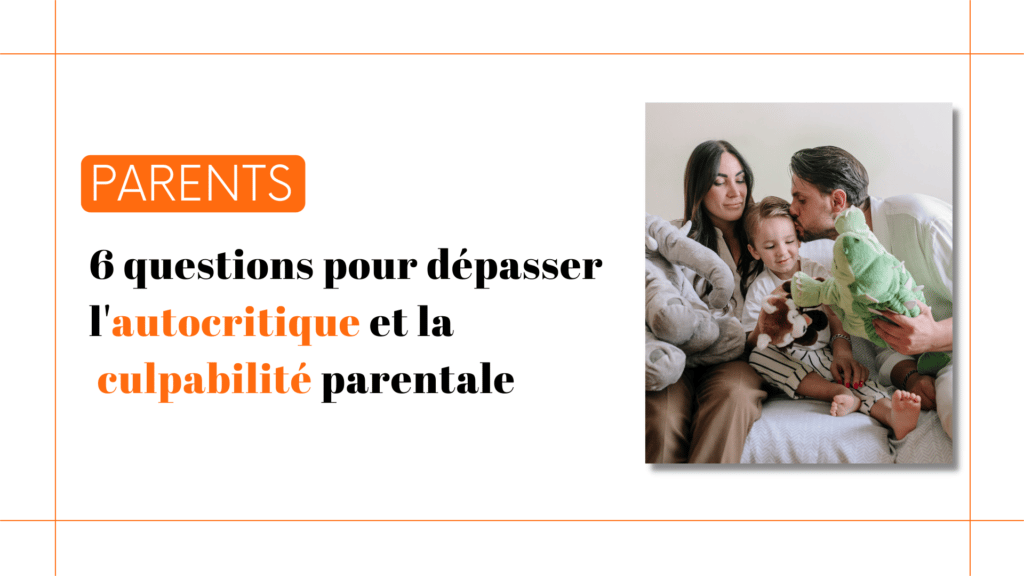
Parental guilt shows up fast, often when something happens that clashes with what matters to you, or when a moment simply does not go as planned. That uncomfortable feeling is like an alarm: it tells you something is off between your values and your actions, and it is hard to welcome.
This article walks through six questions that help you slow down instead of drowning in self-criticism. You will look at the situation, the needs behind it, the emotions involved, and what repair can look like. The goal is not to feel guilty forever, but to turn that guilt into something useful.

Quick takeaways
- Guilt is an alarm pointing to a gap between values and actions.
- Check expectations, circumstances and skills before judging yourself.
- Name the unmet needs and the emotions behind the reaction.
- Let sadness replace harsh self-criticism to unlock learning.
- Repair by talking honestly about your emotions and needs.
- Ask children how it feels to hear you, and listen fully.
Guilt and self-criticism are closely tied to perfectionism and to the difficulty of accepting what happens inside us. It often appears when you break a promise you made to yourself, like shouting after vowing not to, or when something just does not work. To understand it, name the incident that led to the choice you now regret. Then check three things: are your expectations realistic or too high, do the circumstances make family life harder, and do you have the skills to act more in line with your hopes? If not, ask where you could build them. This is the same patient work behind [L11|children self-improvement], which starts with the adult modelling honesty rather than perfection.
Which needs went unmet behind that choice?
Guilt works like an alarm: it signals that you are cut off from important values and points to unsatisfied needs, lost aspirations, or a misalignment between your goals and your actions. When you feel guilty, two parts of you clash, the one that acted and the one checking whether that act respected your values.
The tension comes from sensing the gap between your deep aspirations and what you did. What releases parental guilt is a kind of grieving for those unmet needs, and that grieving needs time to reconnect with yourself, your painful emotions and what could not be satisfied at that moment.
Two parts, one conversation
Rather than silencing the critical part, let both sides speak. Acknowledging that you tried to meet a need, even clumsily, softens the harshness. It is a similar shift to the one described in unconditional parental love, where honesty matters more than a flawless image. As with home science experiments, curiosity matters more than a perfect result.

| Step | Question to ask yourself | What it produces |
|---|---|---|
| Situation | What incident triggered the guilt? | Clarity about the moment |
| Expectations | Were my standards realistic? | Less perfectionism |
| Needs | What need went unmet? | Understanding, not blame |
| Emotions | What did I feel just before? | A nameable message |
| Repair | How can I talk about it? | Connection and learning |
Which emotions were tied to needs to fill?
Emotions are common to all humans and each has a useful function; our emotional system serves the unconscious goal of preserving life. Recognising and naming what you feel lets you address the message it carries. You cannot deal with something you do not let exist, or that you name badly, or not at all.
So when you replay a difficult moment, ask what you felt just before you reacted. Was it exhaustion, fear, frustration? Naming it precisely, rather than vaguely, changes how you respond next time.
Naming opens the door
Naming is not indulgence, it is information. If a child’s aggression triggers your own fear, that insight matters; the guidance in control his aggression works better when you first understand your own reaction. The same applies to puzzling behaviour like a toddler who keeps throwing things on the floor: naming your irritation helps you respond calmly instead of snapping. This awareness also supports self improvement, and it echoes the questions raised by extreme cases such as The Blue Whale.

What do I feel as I look at my needs?
When you listen to all your needs, both the unmet ones and those you tried to satisfy, an inner shift often happens. Instead of stopping at self-critical judgments like “I really should be more understanding”, you feel sadness: “it makes me sad to think I called my son lazy.”
Allowing that sadness, alongside awareness of your own needs, often makes an inner reconciliation possible: “I tried to act on what matters to me. Next time I will look for a way that meets more of the needs that drive me.”
From judgment to grief
This is the pivot point. Judgment keeps you stuck in the past, while sadness moves you toward learning. It is a gentler path than the pressure many parents carry, and it pairs well with the reminder that time spent together shapes memory more than any single imperfect moment. If you find yourself weighing controversial parenting issues, this shift can help, and it also supports your baby's sleep on trips.

How can I repair once the sadness is recognised?
When you think you made a mistake, at heart you favoured some needs at the expense of others. Listening to those needs is the first step that turns a bad conscience into sadness, then into learning. A second step is putting words on that bad conscience: talk to your children about the emotions and needs that influenced the incident.
This is not a trick to dodge your own discomfort. It is about transforming self-criticism into sadness, then into learning that opens more ways to meet more needs. The same openness helps with everyday friction, whether it is a child who throws everything on the ground or the ordinary chaos of parenting twins where no routine survives perfectly.

What does it feel like for children to hear this?
This question matters as much as your willingness and availability to hear the answer. Admitting a mistake is not a shortcut around your own bad conscience; it is a way to turn self-criticism into sadness, then into learning that satisfies more needs. That is why you call on every channel of communication, words, body language, tone of voice and facial expression, to show children you are genuinely interested in their answer and ready to receive it with empathy.
Talking about your errors and struggles builds connection and sharing, and creates chances to learn from each other. Children like it when close adults show themselves as whole, real people who feel things, have needs and wants, rejoice and marvel, but can also be sad, doubtful, and simply doing their best, people they can identify with.
My hands-on take
I remember a evening when I snapped over a spilled glass and then lay awake replaying it. What helped was not another round of self-criticism but sitting down the next morning and saying, plainly, that I had been tired and had spoken too sharply. My child’s answer surprised me: a shrug and a simple “it’s okay”, followed by a hug.
Since then I try to run the six questions quickly in my head, especially the one about which need went unmet. Often it is sleep, or hunger, or a rushed morning. Naming it does not excuse the shouting, but it turns a vague cloud of guilt into something I can actually work with, and it makes the next repair conversation much easier to start.
Frequently asked questions
Is feeling guilty as a parent a bad thing?
Not necessarily. Guilt works as an alarm that shows a gap between your values and your actions, so it can point you toward what needs attention rather than being a verdict on you.
How do I stop being so self-critical?
Start by naming the situation, your expectations and the needs behind your reaction. Letting sadness in, instead of harsh judgment, usually opens the way to a more useful response.
Should I tell my child about my mistakes?
Yes, when you are genuinely ready to hear their answer. Speaking about your emotions and needs builds connection and shows children that adults are real people who are still learning.
What does repair actually look like?
Repair means acknowledging what happened, naming the needs involved, and looking for a way next time that meets more of the needs that drive you, rather than pretending nothing occurred.
Product Reviews
 Best Toys for Dogs With High Prey Drive |
Best Outdoor Toys for 3-4 Year Olds |
Best Outdoor Toys for 6 Year Olds |
Best Harness for Poodle |
Best LEGO Sets for Adults |
Best Travel Toys for 4 Year Olds on Airplane |
Best Toy Stores in Washington DC |
Best Potty Training Toys |
Best Toys for Tripod Dogs |
Maillot equipe de france







