


Gentle parenting is often mistaken for a permanent state of calm, as if a well-meaning parent should never raise their voice, never feel frustrated and never face a conflict. In reality, the approach described here is less about serenity and more about conscious work, a slow process of unlearning old reflexes.
Our fears and beliefs shape the way we parent far more than we usually admit. This article looks at where disproportionate reactions come from, which unrealistic beliefs keep us stuck, and why kindness is not the same as avoiding conflict.

Quick takeaways
- Gentle parenting is conscious work, not permanent calm.
- Fears from your own history can trigger oversized reactions.
- Stress pushes parents toward control or self-sacrifice.
- Unrealistic beliefs about perfect children fuel guilt.
- Kindness means facing conflict, not avoiding it.
- "Power with" replaces "power over" and "power under".
Our Fears and Beliefs Quietly Govern Our Parenting
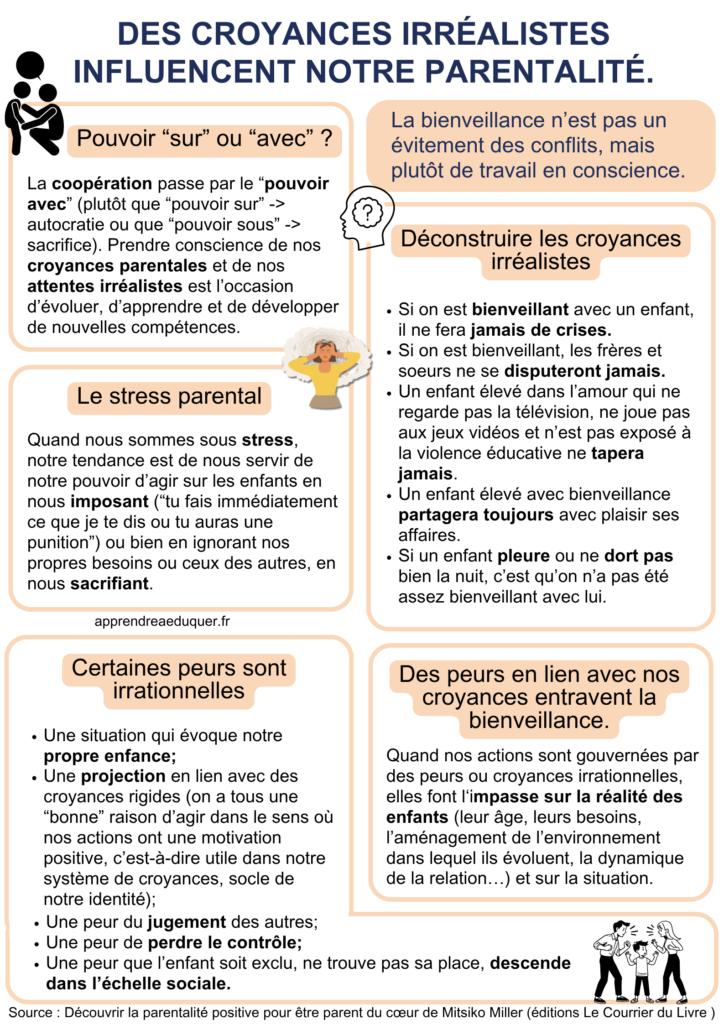
Every parent carries fears rooted in their own history, and those fears can produce reactions that are out of proportion to what is actually happening. A parent may see aggression in a simple wrestling game between siblings, or rejection in a child who wants space, and respond to the fear rather than to the child.
When our actions are driven by irrational fears or rigid beliefs, they skip over the reality of the situation: the child's age, their actual needs, the environment and the state of the relationship. These stress-mode interventions rely on reactive control, which leads almost inevitably to threats and guilt-tripping.
Why Good Intentions Are Not Enough
It helps to remember that every action has a positive motivation inside our own belief system, even when the result is unkind. Understanding that mechanism is the first step toward parental cooperation rather than a power struggle. The same calm awareness applies to everyday moments, whether you are choosing fun games or remembering to apply after sun care.

The Factors Behind Disproportionate Parental Reactions
Several triggers tend to sit behind these oversized interventions. A situation may echo our own childhood, or we may project personal fears and desires shaped by rigid beliefs. Fear of other people's judgment, fear of losing control, or fear that a child will be excluded and lose their place in the group all play a part.
Under stress, we usually lean one of two ways. We impose our power on the child ("do it now or there will be a punishment"), or we abandon our own needs and sacrifice ourselves. A parent might let children constantly interrupt adults, believing free expression matters, without noticing that the children now occupy all the space at everyone else's expense.
Neither extreme is sustainable, and both deserve honest attention rather than quiet resignation. Learning to respect the caregiver is part of the same balance, because a child who sees a rested adult learns cooperation more easily. The same patient, step-by-step approach helps when you help children learn English, and even small everyday choices, like understanding what toys cost, can ground our expectations in reality.
| Situation | Reactive response | Conscious response |
|---|---|---|
| Child wrestles with sibling | Stop it immediately, fear of aggression | Check safety, then observe the real need |
| Child interrupts adults | Ignore it or explode later | Set a limit calmly and kindly |
| Sibling argument | Assume gentle parenting failed | Treat it as normal practice for skills |
| Parent feels exhausted | Push through or shut down | Name the need and ask for support |
| Child cries at night | Blame your parenting | Look at age, routine and environment |
Is a Zen Education Really Possible? Unrealistic Beliefs to Dismantle
Many parents assume that kindness and calm are the same thing, and a handful of unrealistic beliefs keep that confusion alive. They expect that a gently raised child will never have a meltdown, that siblings will never argue, and that a child raised with love and without screens will never hit another child.
Others believe a child raised with kindness will always share happily, or that tears and poor sleep mean the parent simply was not gentle enough. These expectations set families up for disappointment, because they describe an imaginary child rather than a real one.
What Realistic Expectations Look Like
Children grow through friction, play and repair, and that includes messy moments. A practical environment supports this: toys that invite independent play give a child room to test ideas without an adult managing every second. Hands-on projects, like learning how to build an ornament, offer another calm, focused outlet.

Positive Parenting Is Not Zen, and Kindness Is Not Conflict Avoidance
For many parents it feels easier to put their own needs in brackets and stay silent than to make a parental intervention at all. This habit often lasts until exhaustion takes over, and then the parent either explodes into educational violence or implodes into burnout or depression.
This is the swinging movement: from neglecting your own limits and meeting only the children's desires, to neglecting the children's needs and meeting only your own. Many parents confuse positive parenting with conflict avoidance, when conscious kindness actually requires facing the conflict.
Cooperation grows from "power with" rather than "power over" or "power under". Seeing our beliefs clearly is a chance to learn new skills, and small shared rituals, such as a gingerbread recipe baked together, build that sense of working as a team.

Growing in Clarity Instead of Chasing Serenity
Positive parenting is not self-denial or self-forgetfulness. Step by step, we are invited to grow into the clarity of our essential values so we can consciously choose an environment where everyone can thrive. That path begins by shining a light on our reactive habits and understanding why we stay stuck in them more often than we would like.
This is the work of "unlearning", a deconstruction of our thought system rather than a new set of rules. It asks for patience with ourselves, honest reflection, and the willingness to repair after a difficult moment.
Small Practical Anchors
Notice your body before you speak, name the fear silently, and ask what the child actually needs right now. Keep routines predictable and the play space manageable, since a tidy room with LEGO storage makes transitions calmer for everyone. A shared plan between mom and dad prevents one adult from becoming the only enforcer.
My hands-on take
I remember a phase when my child's rough-and-tumble play with friends made me tense up instantly. I would step in, separate them and explain why fighting is wrong, and everyone ended up frustrated. It took me a while to see that I was reacting to my own fear, not to anything dangerous happening on the floor.
What helped was a simple pause: I started asking myself what I was actually afraid of before speaking. Sometimes the answer was embarrassing, and that honesty changed my tone. I still set limits, but now they come from the situation in front of me rather than from an old story in my head. It is slower work than chasing calm, and far more useful.
Frequently asked questions
Does gentle parenting mean never getting angry?
No. It means noticing your anger and choosing a response instead of reacting automatically. Repair after a difficult moment matters as much as the moment itself.
Why do I overreact to small things?
Small triggers often connect to your own childhood or to fears about judgment and control. Naming the fear helps you respond to the child rather than to the fear.
Is avoiding conflict a good strategy?
Not in the long run. Suppressing your needs usually leads to explosion or burnout. Clear, calm limits protect both the child and the adult.
Can I unlearn old parenting habits?
Yes, gradually. The work is a slow deconstruction of automatic reactions, built on reflection and small repeated changes rather than perfection.
Product Reviews
 Best Toys for Dogs With High Prey Drive |
Best Outdoor Toys for 3-4 Year Olds |
Best Outdoor Toys for 6 Year Olds |
Best Harness for Poodle |
Best LEGO Sets for Adults |
Best Travel Toys for 4 Year Olds on Airplane |
Best Toy Stores in Washington DC |
Best Potty Training Toys |
Best Toys for Tripod Dogs |
Maillot equipe de france







