


Every "no" from a child is a message, and learning to read it can transform family life. Behind each refusal hides a need, and children rarely express their needs in clear, concrete words. The same is true of most adults, which is why a parent who listens for the need rather than the defiance gains something precious: understanding.
This approach asks us to respect a child's will without abandoning our own needs as parents. It is not about giving in, and it is not about winning a battle. It is about finding a third path where both sides feel heard.

Quick takeaways
- Every "no" from a child hides a need, not just defiance.
- Reflect what you understood before responding or correcting.
- Your own needs matter too; a win-win arrangement respects both.
- Children cooperate more when they feel respected and understood.
- Resistance often signals a relationship that needs rebuilding.
- Attending to needs saves time rather than costing it.
What Is Really Hidden Behind a Child's "No"?
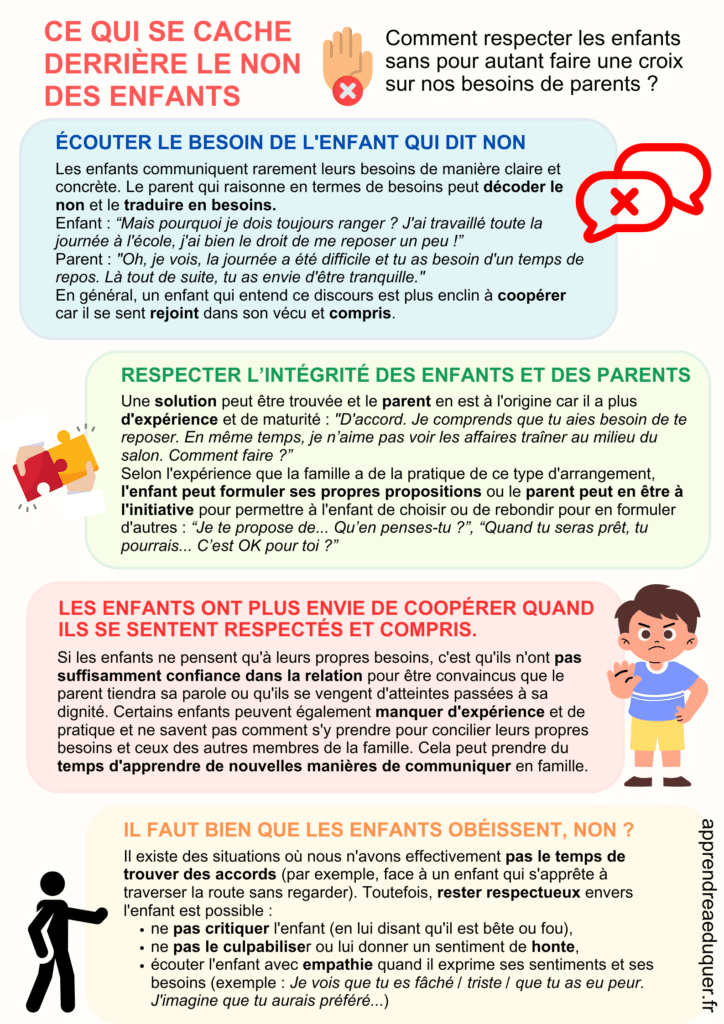
Behind every "no" there is a need, and this holds for adults just as much as for children. Children seldom communicate their needs clearly, so a simple statement of refusal is often the only tool they have. A parent who is ready to listen to the need behind the word can respond very differently.
Picture a child asked to tidy up who answers: "Why do I always have to tidy? I worked all day at school, I deserve a rest!" A parent thinking in terms of needs can translate this: "I see, you need some downtime. Right now you want to relax and be left alone." A child who hears this instead of criticism or threats usually relaxes, because he feels met and understood. This is the same attentive presence that helps children build confidence, as explored in children need gaze.
Reflecting before reacting
Once you have mirrored what you understood, two things can happen. Your own need may shift, because you realise your child's rest matters more to you than tidiness. Or your need stays a priority. Either way, nothing is decided by force.

Building a Win-Win Arrangement
A win-win solution can almost always be found, and the parent should take the lead, simply because they have more experience and emotional maturity. Try: "Okay. I understand you need to rest. At the same time, I care about the living room being tidy. How could we make sure we are both happy?" This kind of open question, phrased in your own authentic words, shows you want to respect your child's integrity as much as your own. There is no room for a power struggle.
Depending on how much practice a family has with this, the child may offer ideas or the parent may suggest some so the child can choose or bounce off them: "I could push all my things into a corner and you won't see them," or "I could tidy when my show is over." The idea is to proceed by trial and error, proposals and counter-proposals, until an arrangement suits both parties. Giving a child a genuine say also feeds the quiet confidence that shy children often need, a theme touched on in normal to be shy. The same respectful tone helps when you talk about masturbation, and it echoes the reflection on the perfect age to have children.
| What the child says | Possible hidden need | A helpful parent response |
|---|---|---|
| "I don't want to tidy up" | Rest, downtime after school | "You need to relax first. How can we both be happy?" |
| "I'm not hungry" | Trust in their own fullness | Respect the signal, offer food later without pressure |
| "Leave me alone" | Space, quiet, privacy | Give space, check in calmly afterwards |
| "That's not fair!" | Recognition, equal dignity | Listen, reflect, then look for a shared solution |
| "No!" to everything | Need to feel heard, or past hurt | Slow down, reconnect, rebuild trust over time |
"Children Only Think of Their Own Needs"
This is one of the most common objections: listen too much and you raise a tyrant. The author argues the opposite. Children want to cooperate when they feel respected and understood. If they seem to think only of themselves, it is usually because they do not yet trust the relationship enough to believe the parent will keep their word, or because they are getting even for past blows to their dignity.
Some children also simply lack practice and do not yet know how to reconcile their needs with those of other family members. Learning new ways of communicating takes time. Win-win arrangements can only emerge in relationships where everyone is treated as equally worthy of respect.
Look at the relationship as a whole
If resistance appears, parents remain responsible for the quality of the relationship. That may mean rebuilding it, including recognising past mistakes and offering sincere apologies. Ask yourself about mutual respect (do you respect your child's sense of fullness, or force them to eat?), about the sincere, unconditional interest you show beyond grades or obedience, about empathy for their emotions, about the quality of attachment, and about your language. Is it personal, authentic and vulnerable, or hidden behind "you must" and "that's just how it is"? A steady, predictable framework supports this, and routines are one way to build it, as these books about routines show. The same care applies to the toys you choose, and understanding what a LEGO set costs can help you decide what is truly worth bringing into the home.

"This Takes Too Much Time"
The time argument does not hold up. It is about taking the time to tell your child what matters to you and to be interested in what matters to them. If you feel you have no time for that, it is worth urgently reconsidering how you choose to spend your time.
Remember that attending to others' needs actually saves time. A child who feels respected, and certain that their needs will be taken into account, will most often choose to cooperate. They do not need to defend themselves or activate their instinct for counter-will. For parents, losing time often means gaining it in the end.
This is also why the home environment matters. A child with a calm, defined space of their own is less likely to fight every request, a point echoed in baby own space for younger siblings. And the way we speak carries weight from the very first days, as with the gentle care described in bathing little ones.

"But Children Still Have to Obey"
There are situations where we cannot simply negotiate, and the author acknowledges this. Safety, health and certain non-negotiable family rules are not open to bargaining. The difference is that these moments are the exception, not the everyday default.
When obedience is genuinely required, it lands far better in a relationship built on respect. A child who trusts that their needs usually count is more willing to accept a firm "no" when it truly matters. That trust is built in ordinary moments, from the way we handle everyday care to the way we respond when a child is unwell and we explain what is happening, much as we would when reading about something like antibiotics not prescribed or the careful monitoring described around newborn bilirubin levels.
In short, cooperation grows from connection. The parent who listens first rarely has to fight later.
My hands-on take
I remember the first time I tried this with my own child during the after-school tidy-up battle. Instead of repeating "put your things away," I said what I thought I saw: "You're tired and you want to switch off for a bit." The change was immediate. Not because the room got tidy, but because the argument disappeared and we could actually talk.
What helped me most was preparing a couple of open questions in advance, so I was not improvising while frustrated. I also learned to accept that some days my need for order simply won, and that was fine as long as I said so honestly. The trial-and-error part felt messy at first, but it gradually became our normal way of sorting things out.
Frequently asked questions
Does listening to my child's needs mean giving in to everything?
No. Listening means understanding the need behind the refusal. You can fully understand a need and still hold your own, then look for an arrangement that satisfies both sides.
What if my child rejects every proposal?
Resistance usually points to a relationship issue rather than a negotiation problem. Focus on rebuilding trust and mutual respect first, and revisit the arrangement later.
How do I start if we have never done this before?
Begin with one small, low-stakes situation. Reflect what you think your child needs, state your own need honestly, and invite them to suggest a solution.
Is this approach too slow for busy days?
It can feel slower at first, but a child who feels respected cooperates more readily, which saves time and conflict over the long run.
Product Reviews
 Best Toys for Dogs With High Prey Drive |
Best Outdoor Toys for 3-4 Year Olds |
Best Outdoor Toys for 6 Year Olds |
Best Harness for Poodle |
Best LEGO Sets for Adults |
Best Travel Toys for 4 Year Olds on Airplane |
Best Toy Stores in Washington DC |
Best Potty Training Toys |
Best Toys for Tripod Dogs |
Maillot equipe de france







