


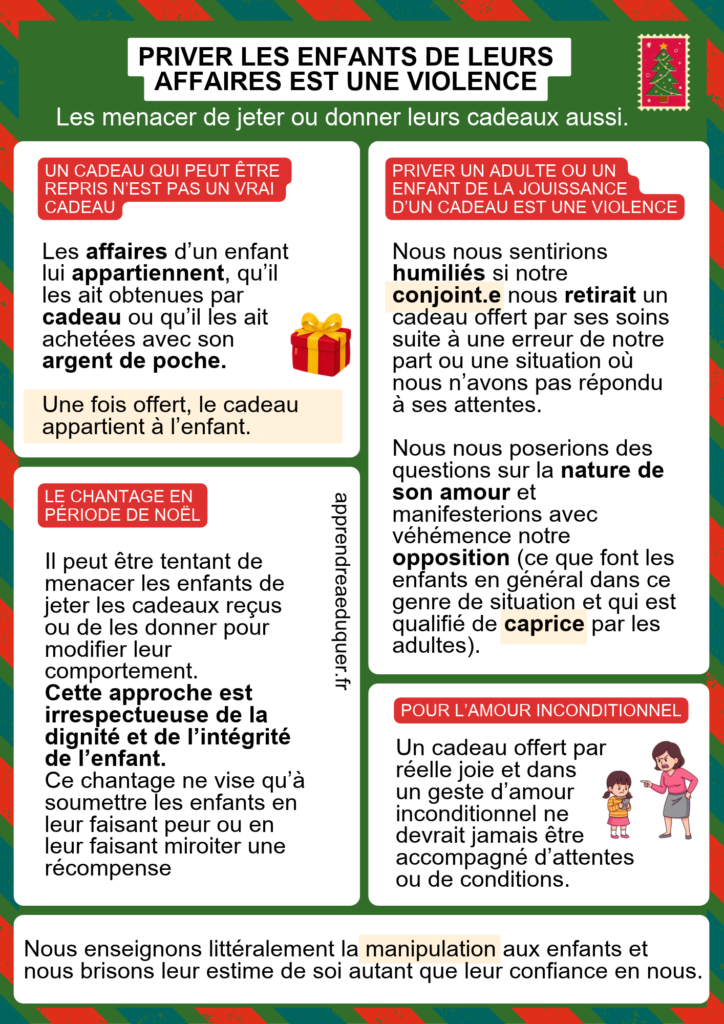
Taking away children's belongings is a form of violence, whether the item arrived as a gift or was bought with pocket money. A child's possessions belong to the child, and a gift that can be reclaimed was never really a gift at all.
Once something is offered, it belongs to the child, and denying them the enjoyment of it crosses a line. A present given from genuine joy and unconditional love should never come with expectations or conditions attached.

Around the holidays, this temptation grows stronger, so it helps to think carefully about what our discipline methods actually teach.
Quick takeaways
- A child's belongings belong to the child, whether gifted or bought with pocket money.
- A gift that can be withdrawn was never truly a gift.
- Threatening to throw away or donate presents teaches manipulation and erodes trust.
- Blackmail produces short-term obedience at the cost of self-esteem and connection.
- Replace threats with choices, natural consequences, and calm, clear limits.
- Repair after conflict matters more than winning the power struggle.
Why a Gift That Can Be Taken Back Is Not a Gift
Imagine the same situation in a marriage: we would feel humiliated if our partner removed a gift they had given us after we made a mistake or failed to meet their expectations. We would question the nature of their love and protest loudly, which is exactly what children do in these moments, though adults often label it a tantrum.
This comparison matters because it shifts our perspective. A gift offered freely and without strings becomes the child's property, full stop. When we later withdraw it as leverage, we are not teaching a lesson about responsibility; we are showing that our affection has conditions. Children absorb that message quickly, and it shapes how safe they feel with us. If you want to understand how deeply children read these signals, it helps to know children understand world differently than adults assume.
The Difference Between a Gift and a Loan
A loan has terms. A gift does not. Blurring the two turns every present into a bargaining chip, and children learn to treat generosity as something to distrust.
The Holiday Trap: Threats and Blackmail Around Presents
During the Christmas season, threatening to throw away or donate received gifts can look like an efficient disciplinary method for getting obedience. It is tempting precisely because it works in the short term. Yet this approach disrespects the child's dignity and integrity, and it aims only at submission through fear or the promise of reward.
Through this crude logic, we literally teach manipulation while damaging both self-esteem and trust in us. We cannot raise respectful children by disrespecting them, and reaching for blackmail is a sign that the relationship has broken down. Parents looking for calmer strategies often start by exploring classroom prize toys and reward systems, then rethink how rewards function at home too.
None of this means abandoning boundaries. It means finding ways to hold them without turning love into a transaction.

| Approach | What the child learns | Long-term effect |
|---|---|---|
| Threatening to throw gifts away | Fear and hiding mistakes | Distrust, damaged self-esteem |
| Threatening to donate belongings | Love is conditional | Withdrawal, conflict cycles |
| Offering a choice | Autonomy within limits | Cooperation and confidence |
| Natural consequences | Cause and effect | Responsibility without fear |
| Calm limits plus repair | Conflict is survivable | Trust and openness |
| Respecting ownership | Their things are safe | Security and generosity |
What Children Actually Learn From Confiscation
When belongings become collateral, children learn that their things are never truly theirs and that adults can revoke comfort at will. They also learn to hide mistakes, since admitting an error may cost them something they treasure. Over time, this erodes the openness that makes discipline possible in the first place.
The lesson lands hardest during sensitive developmental stages. A toddler clinging to a parent, or a baby working through baby care guide routines, is already navigating a lot of change, and stability in possessions offers real security. Older children are no different; the meaning of a favorite object does not fade with age.
Fear Produces Compliance, Not Character
Compliance born of fear disappears the moment the threat does. Genuine cooperation grows from trust, and trust is what confiscation spends.
Respectful Alternatives to Power Struggles
It is entirely possible to adopt respectful approaches instead of staying stuck in power games. The first step is naming the real problem: a child who will not tidy up is not attacking us, they are struggling with a task. Offer a choice, model the behavior, or make the job smaller and more concrete.
Natural consequences work far better than manufactured ones. If a toy is left outside, it may get wet, and that is the lesson, not a punishment we invent. For families managing big feelings, resources on friends family bonds and on helping nervous children sports can support the emotional regulation that makes cooperation easier.
When we remove blackmail from our toolkit, we have to replace it with something. Calm limits, clear explanations, and repair after conflict do that work far better than any threat.
Building a Home Where Belongings Are Safe
Children deserve the same basic respect we extend to adults: their possessions are theirs. That principle simplifies countless daily conflicts, because it removes an entire category of leverage from the table. Instead of threatening to remove something, we can address the behavior directly and separately.
This also applies to how we choose and give toys. Thoughtful selection reduces clutter and conflict, and guides like toys four year olds or toys five year olds can help match gifts to a child's real interests. For younger siblings, bath toys reviews and toys four month guides offer practical starting points, while fine motor toys support skill-building without turning play into a reward economy.
The goal is a home where things are given freely, kept safely, and never used as weapons.

My hands-on take
I remember the first time I heard myself say, "If you don't pick those up, they're going in the bin." It came out so easily, and my child's face changed instantly, not into obedience but into something closer to alarm. I did not follow through, but the damage was already visible, and I spent the rest of the evening thinking about why I had reached for that threat at all.
What helped me most was slowing down and separating the behavior from the object. Now when a room is a disaster, I name the task, offer a starting point, and tidy a little myself. It takes longer than a threat, but nobody ends up crying, and my child actually keeps the toys they love. That trade feels worth it every single time.
Frequently asked questions
Is taking away a toy ever acceptable discipline?
Removing an object that is being used to hurt someone, such as a stick swung at a sibling, is a safety measure rather than a punishment. The distinction is that you are stopping harm in the moment, not confiscating a gift to force obedience later.
What if my child refuses to tidy up their toys?
Make the task smaller and concrete, offer a choice about where to start, or tidy alongside them. The mess is a practical problem to solve together, not a reason to threaten their belongings.
Does this mean children should never face consequences?
No. Consequences are valuable when they are natural and connected to the behavior. The problem is manufactured blackmail, which teaches fear rather than responsibility.
How do I repair things if I have already used this threat?
Acknowledge it plainly, return the item, and explain that you were wrong to use it as leverage. Children respond well to genuine repair, and it models the accountability we want them to learn.
Product Reviews
 Best Toys for Dogs With High Prey Drive |
Best Outdoor Toys for 3-4 Year Olds |
Best Outdoor Toys for 6 Year Olds |
Best Harness for Poodle |
Best LEGO Sets for Adults |
Best Travel Toys for 4 Year Olds on Airplane |
Best Toy Stores in Washington DC |
Best Potty Training Toys |
Best Toys for Tripod Dogs |
Maillot equipe de france







