


Descriptive praise is a simple, proactive tool for gentle parenting: instead of judging your child with “good job” or “well done,” you describe exactly what you see them doing well. The approach is closely associated with Noël Janis-Norton’s book on raising children with kindness, even when it is hard, and it has been discussed in interviews with Marlène Martin, who translated the work.
Janis-Norton argues that physical and verbal punishment do not work, except to damage family relationships. Descriptive praise offers a non-violent alternative that improves the child’s behaviour and the parent’s too, easing conflict. This guide explains the method, answers common worries about motivation, and shows how it fits real family life.

Quick takeaways
- Notice what your child does well, even on difficult days.
- Say exactly what you observed, without judging.
- Drop evaluative compliments like “good job.”
- Meet basic needs first: food, sleep, nature, time together.
- Let children do real tasks to build competence.
- Gradually help them become aware of others’ needs.
What Descriptive Praise Actually Means
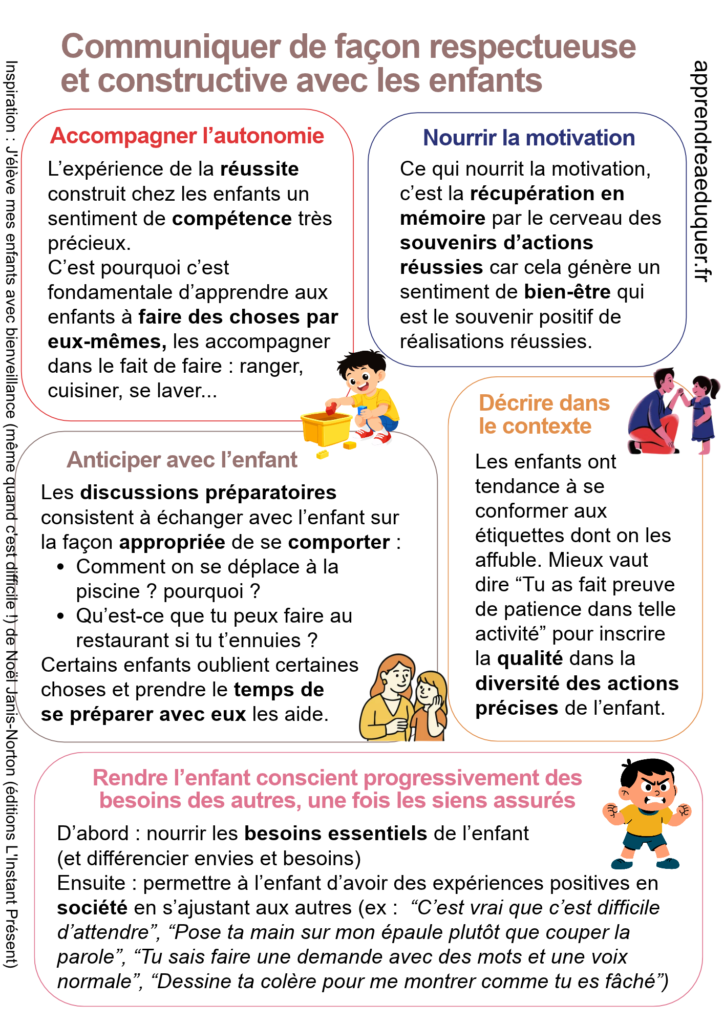
Descriptive praise rests on three simple steps. First, notice what your child does well, or at least well enough. Even a very irritating child does many appropriate things every day. Second, tell the child exactly what you have observed. Third, remove every form of evaluative compliment.
The difference is subtle but real. “You put your shoes by the door” describes. “You’re such a good boy” evaluates. The first gives the child concrete information about what went right; the second hands over a judgement they must earn again. Parents who want calmer mornings may find this pairs well with practical routines, much like the small adjustments in children's bicycle choices that make daily life smoother.
Why the wording matters
Precise wording keeps attention on the action rather than the child’s identity. That makes the habit easier to repeat and easier to notice again tomorrow.

The Worry About Extrinsic Motivation
A fair concern is that this method relies on extrinsic motivation: we want to awaken the child’s desire to please parents and teachers. What about the child’s own desire? Are we using their need to be accepted to shape them?
Marlène Martin, who works at a Lab School applying research-linked pedagogies, takes the question seriously. She notes that some education philosophers, such as Alfie Kohn, write more from philosophy than from research findings, and that some books can feel detached from daily life or even guilt-inducing. She recalls advice to simply leave the supermarket if a tired child struggles, which felt unrealistic with three young children and an empty fridge.
Her view is that Janis-Norton stays far more grounded in real life, which is what makes the approach appealing. The same practical spirit shows in ideas like snow games and children, or in choosing the best outdoor toys for 6 year olds.

| Situation | Evaluative compliment | Descriptive praise |
|---|---|---|
| Child tidies toys | “You’re so tidy!” | “You put all the blocks in the box.” |
| Child waits | “Good boy for waiting.” | “You waited while I finished the call.” |
| Child helps cook | “Amazing helper!” | “You stirred the batter carefully.” |
| Child shares | “You’re so kind.” | “You gave your sister a turn.” |
| Child gets ready | “Finally listening!” | “You put on your shoes by yourself.” |
Grounded in Children’s Basic Needs
Janis-Norton’s message centres on essential needs: food, sleep, contact with nature, and quality time with each parent. Meeting these basics comes first, before any behavioural technique. Parents juggling a household may also appreciate small practical checks, such as reviewing what products we use at bath time, along the lines of bath products safety.
She also encourages teaching children to do things for themselves: helping at home, tidying, cooking, and even preparing meals of children's characters together. The experience of success builds a valuable sense of competence. Martin links this to John Hattie’s work on visible learning: what feeds motivation is the brain retrieving memories of successful actions, because that generates wellbeing. Many parents share these everyday wins online, much like the influencer mothers who turn simple routines into relatable content.
Success as a memory
Each small accomplishment becomes a positive memory the child can draw on later. Descriptive praise helps that memory form clearly.

Finding Your Way as an Adult
Many parents were raised with behaviourist methods and were not encouraged toward autonomy. Some react by becoming very non-directive with their own children. Martin observed this among home-educating families: a number of children struggled in groups because their sense of respect for others had not been sufficiently developed.
Children need accompaniment in learning to wait, for example. Janis-Norton holds that the adult’s attention to the child’s needs is essential and comes first; children’s needs can take priority over parents’. After that, the task is gradually making the child aware of other people’s needs.
This does not mean raising an obedient little sheep. It means giving the child positive experiences in society while adjusting to others. That adjustment is central to education, even when it conflicts with other priorities.
Everyday Examples and Adjustments
Martin recalls a mother with a two-year-old who loved playing on the computer. Rather than banning the screen outright, the parent can describe what goes well: “You asked before touching the keyboard.” Such specific feedback guides behaviour without a lecture.
Parents often wonder how to handle outings and tiredness. Planning around basic needs, and describing the small successes along the way, is more realistic than abandoning the shopping trip entirely. Families preparing for trips may find ideas in family attractions planning, where realistic expectations matter as much as the destination. The same gentle approach helps when your child cries at appointments, and it supports imaginative play, as when considering an imaginary friend.
Over time, the habit becomes natural: you notice, you name it, and the child builds a picture of themselves as capable.


My hands-on take
I tried descriptive praise for a week with my own children, and the hardest part was not the technique but my own habits. I kept catching myself saying “well done” out of reflex. When I paused and named what I actually saw, the response was different: my child looked at what they had done, not at me for a verdict.
What helped was keeping it small. I did not overhaul our routines; I picked one moment a day, usually tidying or getting ready, and described it. Some days I forgot entirely. Still, the shift in tone was noticeable, and it made me more aware of how often I evaluate rather than observe.
Frequently asked questions
Is descriptive praise just manipulation?
It can feel that way if praise is used to control. The method works best when it gives the child honest information about what they did, so they can repeat it and build competence.
Should I never say “good job” again?
You do not need to police every word. The aim is to shift the balance toward specific description, which tells the child more than a general judgement does.
Does this approach ignore the child’s own desires?
The concern is legitimate. In practice, descriptive praise is paired with meeting basic needs and respecting the child, not with shaping them into obedience.
What if my child is very difficult?
Even a very irritating child does many appropriate things daily. Look for those small moments and describe them plainly.
Product Reviews
 Best Toys for Dogs With High Prey Drive |
Best Outdoor Toys for 3-4 Year Olds |
Best Outdoor Toys for 6 Year Olds |
Best Harness for Poodle |
Best LEGO Sets for Adults |
Best Travel Toys for 4 Year Olds on Airplane |
Best Toy Stores in Washington DC |
Best Potty Training Toys |
Best Toys for Tripod Dogs |
Maillot equipe de france







