


Counterwill is the instinct that makes young children resist being controlled or pressured by adults. Every parent has seen it: the more you urge a child to hurry, the more they dawdle or hide. It is as if a default mode of resistance switches on.
Psychologist Deborah Macnamara explains this behavior through the counterwill instinct. It is not defiance for its own sake, but a defensive reaction to what a child perceives as control and coercion.

Understanding it changes how we read the everyday "no" and helps us respond with connection rather than a power struggle.
Quick takeaways
- Counterwill is a defensive reaction to perceived control, not deliberate naughtiness.
- It peaks around age two to five, when "no" is the default first answer.
- The drive to say no protects the self and supports healthy individuation.
- Stronger attachment weakens counterwill, so connection before correction matters.
- Insisting at all costs raises the risk of power struggles and harsh reactions.
- More autonomy for the child means less need to resist the adult's will.
A shared observation: the more adults insist, the more children resist
The counterwill instinct kicks in whenever young children, roughly aged two to five or six, feel controlled or constrained by others. It shows most openly around age two, when the favorite word is "no." Their first answer to almost anything is no, even if that no can later turn into a yes: the no simply comes first.
Young children can easily become preoccupied with forbidden things. Tell them not to use rude words and they tend to keep repeating them. Without warning they can become disobedient, stubborn, resistant, quarrelsome, critical and unwilling to cooperate. Parents sometimes wonder what happened to their pleasant, easygoing child who suddenly explodes in defiance.
This capacity to say no is exhausting for parents, yet it is above all a developmental achievement worth celebrating. It plays a critical role in preserving the self and in becoming a distinct person.
Why "me do it myself" matters for growing autonomy
The ability to say no comes with a drive to do everything alone. Macnamara notes that young children are allergic to other people's plans because they are still trying to work out their own, which gives their favorite phrase: "Me do it myself!" The good news is that the more a child develops their own will, the less they need to resist and oppose the will of others.
This is why open-ended play matters so much at this stage. Giving a toddler room to choose and direct the activity, as with open ended toys, feeds the very sense of agency that reduces opposition later. Simple materials work just as well; even a cardboard box can become a project the child fully owns. Respecting that early independence also shapes how we speak to mothers, as these things not remind us.
When a child is absorbed in something they have chosen, they are practicing autonomy rather than fighting yours. That is the ground where cooperation grows, much like the understanding needed when families face early daycare transitions.

| Situation | What the child may feel | A calmer response |
|---|---|---|
| Told to hurry up | Pressured and controlled | Offer a choice or make it a game |
| Told not to say a rude word | Preoccupied with the forbidden | Ignore or redirect calmly |
| Morning rush to daycare | Overwhelmed by adult stress | Prepare transitions in advance |
| Child says "me do it myself" | Building their own will | Allow safe independence |
| Parent insists on instant obedience | Fear of losing authority | Connect first, then request |
Counterwill and attachment: a complementary relationship
Macnamara defines counterwill as a defensive reaction to what is perceived as control and coercion. Counterwill and attachment have a complementary relationship: the stronger the attachment, the weaker the counterwill. A child will oppose more forcefully someone they have little or no bond with, as a way of protecting themselves.
A child will also oppose parents more strongly if those parents make no effort to create emotional connection and empathy when giving requests or instructions. If a parent issues a directive without engaging the child's attachment instincts, the child can feel constrained and controlled, paving the way for a counterwill response.
This is where small rituals of connection pay off. A few minutes of shared attention, a story, or a warm transition before a demand can shift the whole tone. Time spent together, as the idea that shared family moments become tomorrow's memories reminds us, is not a luxury but a buffer against daily friction.
The positive function of a frustrating instinct
Young children lack both the emotional maturity and the vocabulary to explain that they are in the middle of individuation and differentiation as a separate being. Instead of declaring that your will is blocking theirs, they use whatever means they have to send their counterwill message.
Like any human behavior, the instinct has a positive developmental function. First, it supports attachment to close people, parents above all, by protecting the child against outside influences and demands, such as a rarely seen grandparent, an overly authoritarian aunt, or a stranger in a shop. Second, it supports development by preparing the ground for separate functioning: the first step toward finding your own will is to counter and resist the will of others, including your parents.
Seen this way, the tantrum is not a malfunction. It is a sign that a self is forming, and it deserves patience rather than punishment.
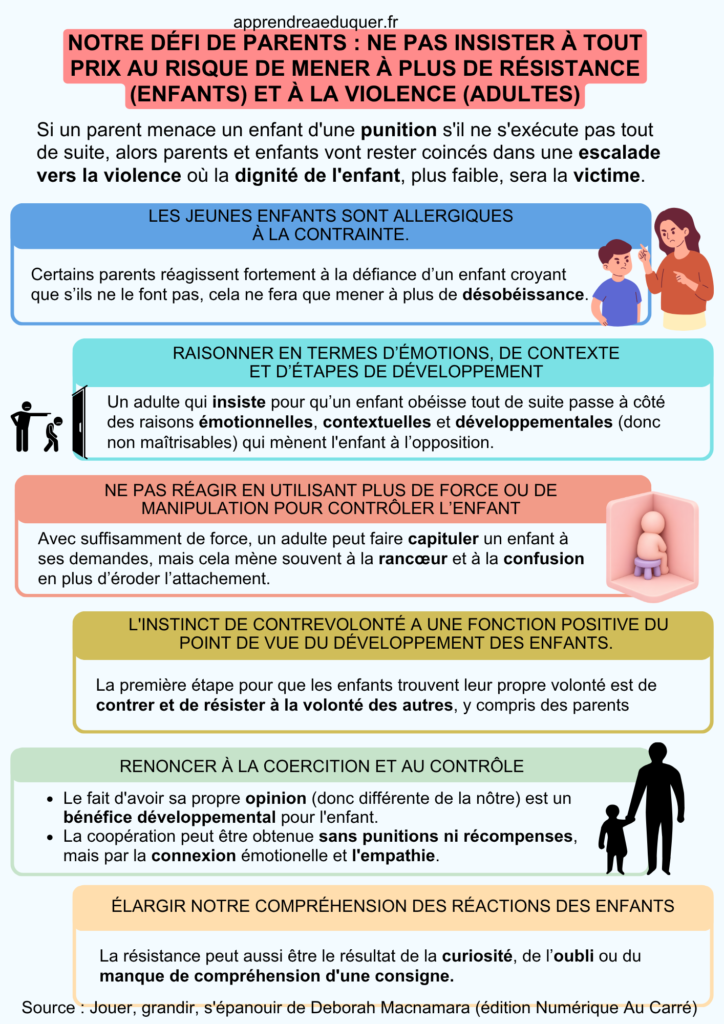
The parental challenge: not insisting at all costs
Recognizing that resisting children are in a normal developmental phase, the age of autonomy, helps us understand the "no" and the opposition. Yet adult patience can still be sorely tested. The risk of power struggles and of violence is high when a parent is under stress, for example during the morning departure for daycare or school, under the judgmental gaze of onlookers, or afraid of looking like a lax parent.
The risk rises too when a parent clings to the idea that their request is simply what "must" be done: washing, brushing teeth, going to bed early, saying hello or thank you. Macnamara regrets that some parents react strongly to a child's defiance, believing that otherwise it will only lead to more disobedience.
Yet an adult who insists a child obey immediately misses the emotional, contextual and developmental reasons, which are not controllable, behind the opposition. The child reacts while remaining unaware of their own counterwill instinct. Practical workarounds help: offering limited choices, using play and humor, and preparing transitions in advance. Daily routines such as baby sleep or mealtimes go more smoothly when the child has a sense of control within clear limits.
Keeping perspective when resistance peaks
Some children resist more intensely, and the reasons vary. A child with a different developmental profile may need adapted expectations, which is why understanding topics like the autism spectrum can help parents read behavior with more compassion. Physical factors matter too: hunger and low energy make everyone less flexible, so iron rich foods and regular meals support steadier moods.
It also helps to remember that difficult moments are part of a bigger picture. Play, rest and connection are the tools that carry a family through the stormy stretches, and small comforts, like a well-loved toy or a familiar routine, can anchor a child when big feelings rise. Knowing how to wash stuffed animals properly keeps that comforting companion available night after night.
Finally, parents do well to look after the adult side of the equation. When we understand our own stress and reactions, we are far less likely to turn a normal developmental no into a battle we both regret. Reflecting on how to educate children can help parents stay grounded in these moments.

My hands-on take
I learned this lesson the hard way during the morning rush. For a long time I treated my child's dawdling as a challenge to my authority, and I answered it by pushing harder. The result was always the same: more stalling, more tears, and a stressed adult arriving late everywhere.
What changed things was slowing down and giving my child a small piece of the plan. I started offering two acceptable options, using silly voices for the toothbrush, and warning about transitions a few minutes ahead. None of it is magic, and some mornings still fall apart. But I now recognize the "no" as information rather than an attack, and that shift alone has made our home calmer.
Frequently asked questions
Is counterwill the same as defiance?
No. Counterwill is a defensive reaction to feeling controlled, while defiance implies deliberate opposition. It is a normal developmental instinct in young children.
At what age is counterwill strongest?
It is most visible around age two, when "no" is the first answer to almost everything, and it remains common through roughly five or six years old.
Does counterwill mean my child dislikes me?
Not at all. A strong attachment actually reduces counterwill. The instinct protects the child's growing sense of self rather than expressing rejection.
What can I do in the moment?
Connect before you direct, offer limited choices, and avoid insisting at all costs. Reducing pressure usually lowers the resistance response.
Product Reviews
 Best Toys for Dogs With High Prey Drive |
Best Outdoor Toys for 3-4 Year Olds |
Best Outdoor Toys for 6 Year Olds |
Best Harness for Poodle |
Best LEGO Sets for Adults |
Best Travel Toys for 4 Year Olds on Airplane |
Best Toy Stores in Washington DC |
Best Potty Training Toys |
Best Toys for Tripod Dogs |
Maillot equipe de france







