


Therapeutic tales for kids are short, gentle stories designed to help a child move through everyday emotional difficulties, and this collection of sixteen metaphorical tales does exactly that for children roughly aged five to eleven. Each story is meant to be read aloud by a parent, and the book presents itself as a kind of first-aid kit for small troubles rather than a replacement for professional care.
The tales rest on the principles of Ericksonian therapy, aiming to bring calm, a sense of well-being and a stronger parent-child bond. The author is a psychotherapist, Ericksonian hypnosis practitioner and educational psychologist, and she draws on that combined background to build a warm, practical approach to family support.

Quick takeaways
- Sixteen metaphorical tales for children roughly aged five to eleven
- Built on Ericksonian hypnosis and child psychology principles
- Each story follows a fixed protocol: benefits, induction, tale, return, questions
- Brackets mark pauses and colours mark words to emphasise
- Designed as a first-aid kit for everyday emotional troubles
- Not a replacement for professional help in serious cases
What Makes a Tale Therapeutic
The stories are described as kind, soft and poetic, written to be read to your child so they can work through the little worries of daily life. Rather than naming a problem directly, each tale uses metaphor and imagery, which lets a child approach a difficult feeling sideways instead of head-on.
The author reminds readers in her foreword that these tales draw on therapeutic references linked to Ericksonian hypnosis and child psychology. They are presented as effective tools for emotional troubles, and the book is clear that they do not replace a professional's expertise when difficulties are serious.
Parents who want to build a wider reading habit around this kind of material may also enjoy Benji Davies books and collections such as flap and pop up books, which keep young listeners engaged while a story unfolds.

How Ericksonian Hypnosis Shapes the Stories
A long introduction explains how the tales work and how to use them with children, including a few broad lines on the principles of hypnosis. In Ericksonian hypnosis, the unconscious is treated as an ally, because it holds everything that drives how a person functions — memories, automatic habits, beliefs and learning — that is not consciously available.
Therapeutic hypnosis aims to create an altered state of attention so that the unconscious can be reached. In practice, that means a calm induction, a story rich in mental images, and a gentle return to ordinary awareness at the end.
Why the Protocol Matters
The structure is what makes the tool usable at home: a parent does not need any training to follow it. If your child is working on pronunciation or language, pairing story time with speech therapy toys can reinforce the same skills in play.

| Stage | What the parent does | What the child experiences |
|---|---|---|
| Benefits page | Reads the hidden meaning of the story | Nothing yet — preparation for the adult |
| Induction | Guides pleasant mental images | Settles and focuses attention |
| The tale | Reads aloud, pausing at brackets | Follows the metaphor and imagery |
| Return | Brings the child back to ordinary awareness | Gentle close of the exercise |
| Questions | Asks a few small open questions | Puts words to what they imagined |
The Sixteen Tales and What They Address
The collection covers a wide range of everyday struggles. One tale helps a child express needs and unspoken emotions when they fear bothering others or hurting them; another addresses teasing and bullying along with low self-esteem. A third supports children dealing with bedwetting or going through regression or depression.
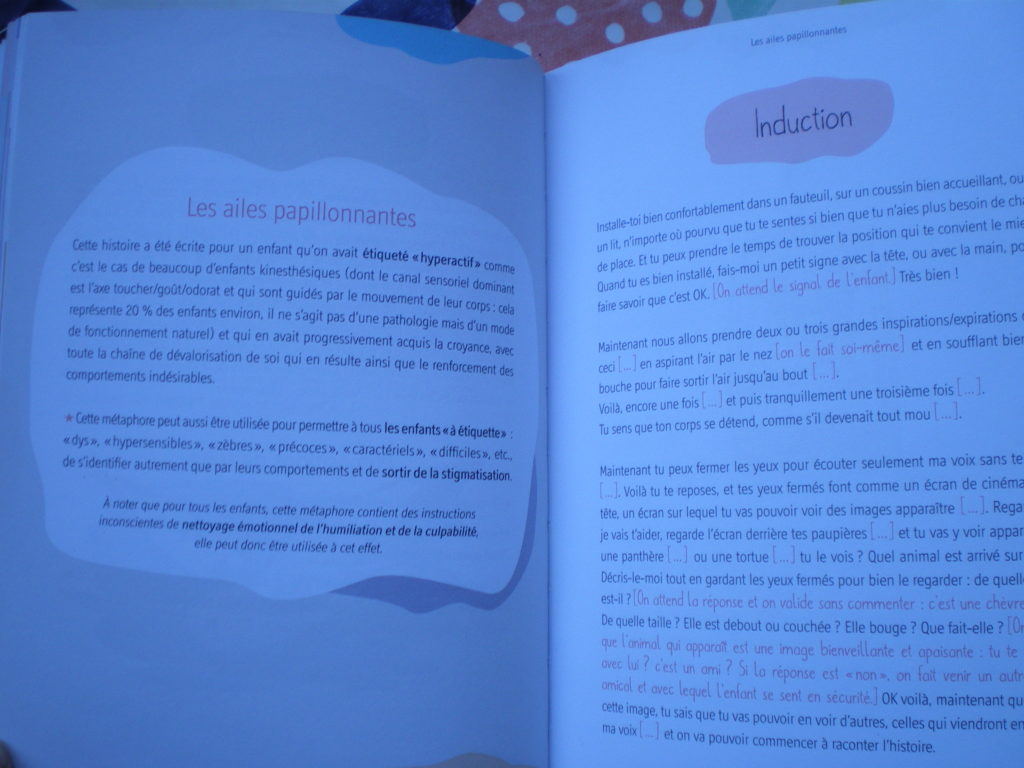
Other stories help a child step out from under a label such as "difficult" or "hyperactive", or ease sleep troubles and difficulty falling asleep. One tale targets children stuck in inappropriate behaviour and communication difficulties, including the classic "middle child" position, and it has a follow-up story.
Further tales accompany an autism diagnosis and soothe hypersensitivity, ease speech difficulties and fear of abandonment, or give courage and strength. One stimulates resilience after a shock, another addresses the physical expressions of bottled-up emotions, and one mobilises inner resources for children who are oppositional or unhappy with their life, again with a sequel. Two closing pieces are guided daydreams.

The Reading Protocol, Step by Step
Every tale follows an identical structure. A page presents its benefits, then a page gives instructions to prepare the child for the reading — the induction — notably by generating pleasant mental images. The tale itself comes next, with brackets marking pauses and colours marking words to emphasise while reading.
A final page closes the activity with an exit from the trance state and a few small questions to elaborate and go further with the child. This gentle debrief is where a lot of the value sits, because it invites the child to put words to what they imagined.
Each story is easy to read even for people new to Ericksonian hypnosis and is well suited to children from about four or five up to ten. The airy, colourful layout makes it a simple tool for parents to pick up. For younger siblings, Montessori toys can occupy them while an older child listens.
Where the Collection Fits in Everyday Parenting
The book sits within a broader approach of benevolent education and effective support for children facing emotional difficulties. It is not a cure-all, but a ritual: a quiet moment, a story, a short conversation afterwards.
Because the tales are read aloud and depend on calm attention, the setting matters as much as the words. A predictable bedtime routine helps, and parents who are themselves short on rest may find the mother's sleep worth protecting first.
Some families also use story time to open conversations about safety and the body, which pairs naturally with resources on mouldy teether risks or wider guides such as baby care tips for younger children in the house.

Reading the Tales Sensitively
Not every tale will fit every child, and the book's own framing encourages parents to choose according to the difficulty at hand. A story about teasing lands differently for a child who is being mocked than for one who is doing the mocking, so read the parent page first.
Keep the tone light and never force the exercise; if a child resists, simply close the book and try another evening. For children who respond to scarier material, it is worth knowing how scary television trailers can affect young viewers, so you can judge what your child can handle.
If a child's difficulties are severe or persistent, the tales are a complement, not a substitute, for professional help. Used with that in mind, they remain a warm and practical addition to family life.

My hands-on take
I have tried reading metaphorical stories at bedtime with mixed results, and what changed things was slowing down. The idea of marking pauses and emphasising certain words sounded fussy on paper, but in practice it gave the reading a rhythm my child settled into far more easily than my usual rushed delivery.
The closing questions were the part I underestimated. I expected them to feel like a test, but asking just one small question — what did you see in the story? — often produced a remark I would never have heard otherwise. I now treat the whole thing as a short ritual rather than a task, and I skip it entirely on evenings when everyone is too tired.
Frequently asked questions
What age range are these tales for?
The collection is aimed at children from about five to eleven, and the stories are described as suitable from roughly four or five up to ten. Younger children can listen, but the follow-up questions suit older ones better.
Do I need training in hypnosis to use the book?
No. Each tale is easy to read even for people new to Ericksonian hypnosis, and the fixed structure guides you through induction, reading and closing. The airy, colourful layout is designed for parents to pick up without preparation.
Can these stories replace therapy?
No. The book presents them as effective tools for emotional troubles but explicitly says they do not replace a professional's expertise when difficulties are serious. Think of them as a complement to, not a substitute for, outside help.
When is the best time to read one?
A calm, predictable moment such as bedtime works well, because the tales rely on relaxed attention. Read the parent page first so you know the hidden meaning before you begin.
Product Reviews
 Best Toys for Dogs With High Prey Drive |
Best Outdoor Toys for 3-4 Year Olds |
Best Outdoor Toys for 6 Year Olds |
Best Harness for Poodle |
Best LEGO Sets for Adults |
Best Travel Toys for 4 Year Olds on Airplane |
Best Toy Stores in Washington DC |
Best Potty Training Toys |
Best Toys for Tripod Dogs |
Maillot equipe de france







