


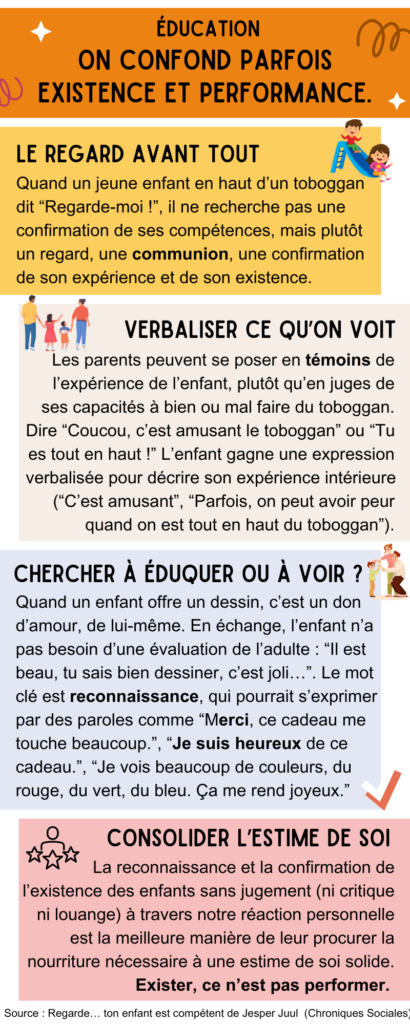
Confusing existence with performance is one of the most common traps in parenting, and it shows up in tiny everyday moments. A child at the top of a slide shouts "Look at me!" and we answer "Well done, you're so good at this!" or "Careful, don't fall!" Both replies sound kind, yet they miss what the child is actually asking for.
What the child wants is not a verdict on their sliding skills. It is a look, a shared moment, a confirmation that their experience exists and has been witnessed. Learning to answer that need changes the tone of family life far more than any reward chart.

Quick takeaways
- "Look at me" usually means "see me", not "rate me".
- Praise and warnings both miss the child's request for a shared gaze.
- Name what you see: "you're at the top", "that looks fun".
- Verbalising feelings builds the child's personal language.
- Receive a drawing as a gift, not as a performance to evaluate.
- Aim for recognition without judgment, neither criticism nor praise.
Why "look at me" is not a request for praise
Family therapist Jesper Juul used the slide example to show how easily adults mix up two different things: a child's existence and a child's performance. At that age, the child does not even know that one can be good or bad at going down a slide. They are not asking for a score. They are asking to be seen.
When we reply with praise or with a warning, Juul calls it a dialogue of the deaf: two people talking, nobody meeting. The child's inner experience goes unconfirmed, and the adult's comment lands somewhere else entirely. If this pattern repeats, children learn early that attention arrives when they produce something, not when they simply are. That lesson sits underneath a lot of later anxiety around achievement, and it is worth unpacking gently, much like the fears explored in accompanying from love.
What the child actually needs
The need behind "look at me" is communion: a gaze, a shared feeling, a confirmation of existence. Nothing more complicated than that, and nothing less.
How to respond as a witness, not a judge
Juul suggests a simple alternative: find the child's eyes, wave, and say something like "Hi! The slide looks fun!" or "You're right at the top!" This places you as a witness of the child's experience rather than a judge of their ability. You are not evaluating; you are joining them for a second.
Two things happen at once. The child feels seen and confirmed. And the child gains words for their inner life: "that looks fun", "sometimes you can feel scared when you're high up on a slide". That vocabulary is the beginning of emotional literacy, and it grows the same way language does in other areas, for instance through books about colors and everyday naming games.
This kind of response takes a second and costs nothing. It also works in the middle of a crowded playground, where a quick wave often does more than a long sentence.
| Situation | Common reply | Witness reply |
|---|---|---|
| Child on a slide shouts "look!" | "Well done, you're so good!" | "You're right at the top!" |
| Child seems cold | "Put a jumper on" | "You look cold" |
| Child refuses food | "You don't like it?" | "No thanks, I'm full" as a model |
| Child hands you a drawing | "It's beautiful, you draw well" | "Thank you, this touches me" |
| Child comes back from school | "Did you do well?" | "I'm glad to see you" |
Putting feelings into words for your child
Verbalising what we see is a skill parents and educators can practise. When a child's behaviour tells us they are hungry or cold, saying "you look cold" or "you were actually hungry, weren't you?" helps build their personal language. Until children can express themselves with their own words, they live in confusion about what they are feeling and struggle to resolve conflicts with others.
A child with that personal language can say "No thanks, I'm not hungry anymore" instead of "I don't want it!" or "I don't like that!" The difference is not politeness; it is precision about their own inner state. The same principle applies to physical care routines, where naming what is happening helps a child feel like a participant rather than an object, as with removing the diaper or bath time products discussed in bathing little ones.
Naming without labelling
Describe the sensation, not the child. "You seem tired" opens a door; "you're being difficult" closes it.
Receiving a drawing as a gift, not a portfolio
The drawing handed over with "This is for you!" is the same lesson in another form. It is a gift of love, a gift of the child's own existence. In exchange, the child does not need an evaluation: "It's beautiful, you draw so well, how pretty". Praise of the object misses the offering.
The key word is recognition. Something like "Thank you, this gift really touches me", "I'm happy to receive this" or "It seems I was missed while I was away, and I'm glad to see you too" answers the relationship rather than the artwork. If you want to encourage making and creating without turning it into a test, open-ended materials help, and the ideas in Montessori toys or sensory toys can support that kind of play.
None of this means never praising a child. It means noticing when praise is answering a question the child did not ask.

Being versus doing: the long view
Juul's conclusion is compact: the prospects in a child's life are to be, not to be able, and to exist, not to perform. Recognition and confirmation of a child's existence, without judgment, neither criticism nor praise, through a personal and spontaneous reaction, is the best way to give them what a solid self-esteem is made of.
This is not a technique to apply mechanically. It is a stance: choosing to see rather than to educate all the time. That stance shows up in how we handle mealtimes, bedtime, fears and play, and it pairs naturally with gentle approaches to sleep such as baby sleep tips or to water fears covered in overcoming water fear.
Children whose attention is directed toward their own sensations, emotions and experience grow up better able to name what they need and to say it clearly to others.

My hands-on take
I tried this on a rainy afternoon at the playground, mostly because I was tired of hearing myself say "good job" on autopilot. My daughter climbed to the top of the slide, shouted "Maman, regarde!", and instead of the usual "bravo", I waved and said "you're really high up there". She looked at me for a second, nodded seriously, and went down again, then did the whole thing over so I could watch. No score, no lesson, just a loop of seeing and being seen.
What surprised me was how much easier it felt. Praise always left me hunting for something specific to say; describing what was in front of me took no effort at all. It also calmed the small voice in my head that worried about saying the wrong thing. I still catch myself mid-"well done", but now I notice it, and I often follow it with what I actually saw.
Frequently asked questions
Does this mean I should never praise my child?
No. Praise has its place, especially for effort the child chose to make. The point is to notice when a child is asking to be seen rather than evaluated, and to answer that request first.
My child asks "am I good at this?" What then?
Answer honestly and specifically, then hand the question back: "What do you think?" This keeps the focus on their own sense of the experience instead of on your verdict.
Is this only for small children?
The need to be seen does not disappear with age. Older children and teenagers still want recognition of who they are, even if the words and the moments look different.
How do I start without overthinking every sentence?
Pick one routine, such as pickup from school or bedtime, and practise describing what you see there. Once it feels natural, it spreads to other moments on its own.
Product Reviews
 Best Toys for Dogs With High Prey Drive |
Best Outdoor Toys for 3-4 Year Olds |
Best Outdoor Toys for 6 Year Olds |
Best Harness for Poodle |
Best LEGO Sets for Adults |
Best Travel Toys for 4 Year Olds on Airplane |
Best Toy Stores in Washington DC |
Best Potty Training Toys |
Best Toys for Tripod Dogs |
Maillot equipe de france







