


Choosing a toy is a question many parents, educators and relatives of young children ask themselves, and it deserves more thought than a quick glance at a shop shelf. The right toy is not simply the newest or the flashiest one; it is the one that matches what a child is actually doing when they play.
A useful starting point is to stop separating play from work. For children, the two are one and the same thing: it is through play that they build themselves. When we reconcile play and work, we help a child develop a taste for activity and effort, which are rewarding and lead to real results.

Quick takeaways
- Treat play and work as one for children; play is how they build themselves.
- Judge a toy by the seven pillars: movement, understanding, concentration, senses, rules, joy, creation.
- Watch how long and how deeply a child plays before deciding a toy is a success.
- Look for repetition and sensory exploration, not just first-minute excitement.
- Match the toy to the child's current stage, not to the packaging age label.
- Keep the selection small and accessible so concentration and autonomy can grow.
Why play and work are the same for children
Before looking at any checklist, it helps to reset an assumption. Adults tend to split the day into "play time" and "work time", but children do not experience that division. For them, playing is the serious business of growing, and every game is a small act of construction.
When we accept this, choosing a toy becomes less about entertainment and more about opportunity. A toy that invites effort, repetition and focus feeds the same drive a child brings to any task. This is the same principle behind reward toys that mark effort rather than simply filling time, and it shapes how we read a child's engagement.
It also changes how we talk about activities. Instead of praising a child for "working hard" and letting play be mindless, we can treat both as valuable. The tone we use matters, much like the positive phrases that help a child settle at night, because encouragement shapes how a child approaches effort.
The seven pillars of a well-chosen toy
Rather than judging a toy by its packaging, it is more useful to ask which functions it fulfils when it is chosen with awareness. Seven pillars stand out. A good toy should put the child in movement, exercising gross motor skills through their comings and goings. It should help them understand the world, take part in it, adapt and gain autonomy.
It should favour concentration, and stimulate the five senses and fine motor skills so the hand is used well. It should adapt to rules, let the child play in joy, and leave room to create and imagine. A toy does not need to tick every box, but knowing these pillars makes it easier to spot a toy that only looks good.
Movement and understanding
Toys that invite crawling, carrying, building or balancing support the whole body, and this is why toys for crawling matter so much in the early months. Later, toys that mirror daily life help a child make sense of the world and become more independent.
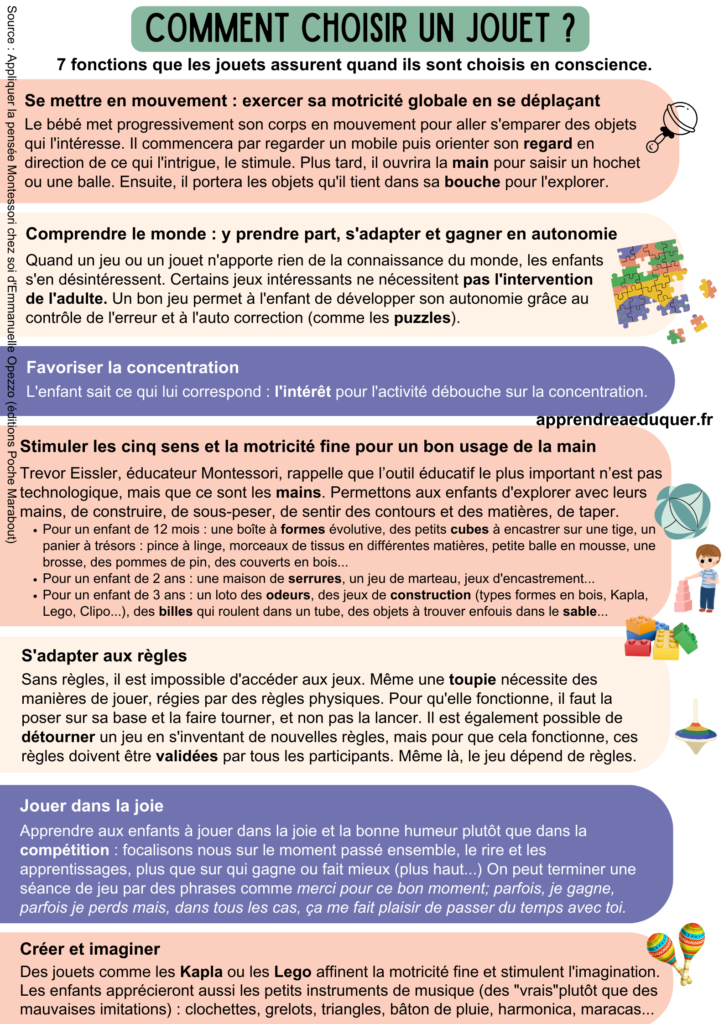
| Pillar | What it looks like in play | Question to ask |
|---|---|---|
| Movement | Crawling, carrying, balancing | Does it get the whole body going? |
| Understanding the world | Imitating daily life, solving | Does it help my child make sense of things? |
| Concentration | Long, absorbed play | Does my child stay with it? |
| Senses and fine motor skills | Touching, sorting, fitting | Does it engage the hand and the senses? |
| Rules | Turn-taking, simple games | Can my child learn to follow a rule? |
| Joy | Laughter, willing return | Does my child come back to it happily? |
| Creation and imagination | Building, pretending, inventing | Does it leave room for my child's ideas? |
Reading a child's interest as the real test
The best indicator of a well-chosen toy is not the price or the label but the child's interest. Watch how long they play with it and whether they look concentrated. Then ask whether that interest is only tied to novelty or whether it holds over time.
Notice whether the child takes the toy and examines it with all their senses, and whether they keep the activity going for a sustained stretch. Do they repeat the game several times to perfect it? That repetition is the sign of genuine engagement, not a sign that the toy is too simple.
This same observation works outside the playroom. A toy that keeps a child absorbed is invaluable on a journey, which is why toys for flights are chosen for their ability to hold attention rather than their noise. Even a birthday or a family event can be read this way, as when we plan children at weddings and watch what actually keeps them engaged.
Matching toys to the child's stage
A toy that suits a two-year-old will frustrate a five-year-old, and the reverse is just as true. Matching the toy to the stage means watching what the child can already do and offering something just beyond it. This is why toys for 5 year olds look very different from the simple grasping and stacking toys of toddlerhood.
Budget matters too, and a well-chosen toy does not have to be expensive. A small, open-ended object often gets more use than a large electronic one, which is worth remembering when browsing toys under $25. The same logic applies when choosing a gift for a school return, where school reward toys should support effort rather than distract from it.
Finally, think about longevity. Some toys grow with a child, and building sets are a classic example, which is why collectors and parents alike seek out retired LEGO sets that still invite construction and imagination long after the first build.
Building a play space that supports good choices
How toys are stored and presented matters as much as which ones we buy. A small, rotating selection that a child can reach and put away independently supports concentration and autonomy far better than a crowded box. Fewer toys, well displayed, invite deeper play.
This connects to the wider environment of family life. A calm, predictable routine, much like the indoor games we keep ready for quiet or confined days, helps a child settle into play. And when a new sibling arrives, the choice of toys can ease tension, as we see with Big brother's jealousy when attention is shared.
The guiding idea stays simple: choose with the child's real activity in mind, observe closely, and let interest be the judge. A toy that supports movement, understanding, concentration, the senses, rules, joy and imagination will rarely disappoint.

My hands-on take
In my own home, the toys that survived the longest were never the ones with the most buttons. The favourites were a set of wooden blocks, a basket of everyday objects and anything that let my child carry, stack and rebuild. I learned to test a toy by leaving it out for a week and simply watching what happened.
What helped most was cutting down the visible pile. When I rotated the toys and kept only a few within reach, play became calmer and longer, and tidying stopped being a battle. I also started asking one question before buying anything: what will my child actually do with this? That single question has saved me from more impulse purchases than any list.
Frequently asked questions
How can I tell if a toy is genuinely well chosen?
Watch your child rather than the packaging. Notice how long they play, whether they look concentrated, and whether the interest lasts beyond the first novelty. If they examine it with their senses and repeat the game to improve, the toy is working.
Should I avoid toys that look like "just fun"?
No. Joy is one of the pillars of a good toy, so a toy that makes a child happy is doing real work. The point is to balance fun with the other functions, such as movement, concentration and imagination.
Do expensive toys make better choices?
Price is not a reliable indicator. A simple, open-ended toy is often used longer than a large electronic one, so focus on what the toy invites a child to do rather than what it costs.
How many toys should be available at once?
A small, rotating selection that a child can reach and tidy independently tends to support deeper play. Too many toys at once can scatter attention rather than build concentration.
Product Reviews
 Best Toys for Dogs With High Prey Drive |
Best Outdoor Toys for 3-4 Year Olds |
Best Outdoor Toys for 6 Year Olds |
Best Harness for Poodle |
Best LEGO Sets for Adults |
Best Travel Toys for 4 Year Olds on Airplane |
Best Toy Stores in Washington DC |
Best Potty Training Toys |
Best Toys for Tripod Dogs |
Maillot equipe de france







