


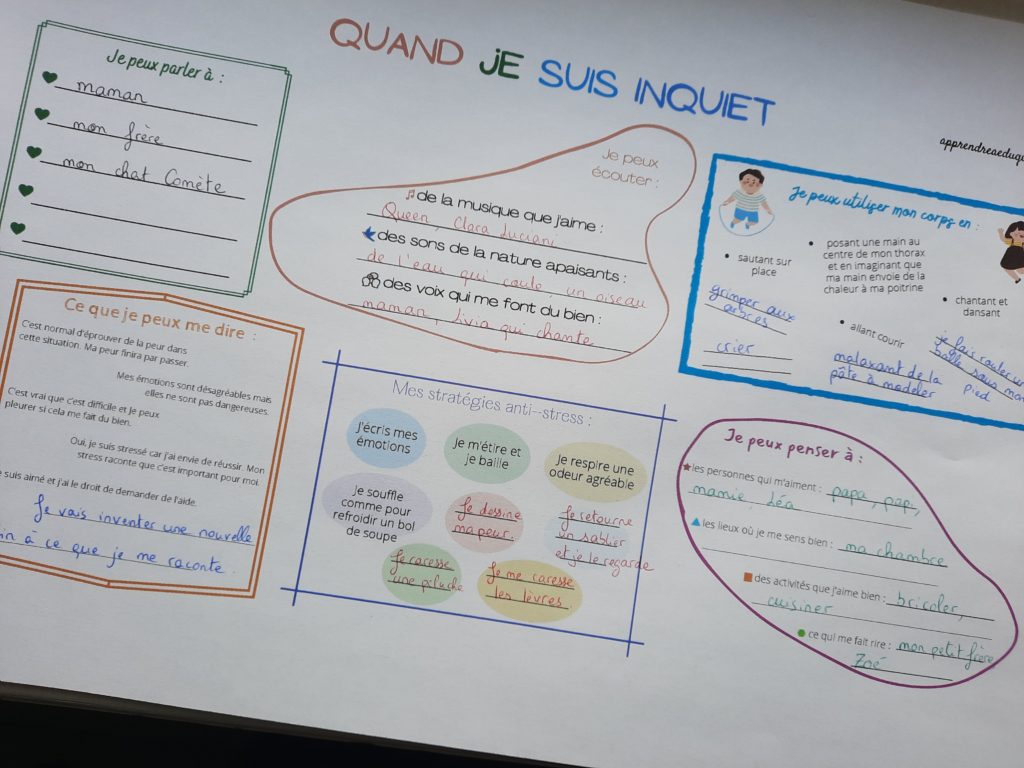
Stress regulation for kids starts with a simple, visible tool they can reach for on their own. This printable sheet invites children to fill in, with an adult, the people, sounds, movements, words and thoughts that help them feel calm again.
It is designed to be completed together, four hands on the page, so you can co-create a list of calming activities rather than impose them. Once filled, the sheet can be displayed somewhere visible so a child can turn to it independently when stress starts to feel overwhelming.

The aim is not to remove stress but to give children a menu of strategies they already know work for them.
Quick takeaways
- Fill the sheet together, in a calm moment, using the child's own words.
- Cover six areas: people, sounds, body, self-talk, strategies and thoughts.
- Test body ideas on the spot so the list stays honest.
- Display the finished sheet where the child can reach it alone.
- Revisit it every few months as friendships and tastes change.
- Use it as a daily habit, not only in a crisis.
Why a written stress plan helps children
When stress rises, thinking gets harder, even for adults. A written plan takes the guesswork out of a difficult moment: instead of asking a flooded child what would help, you can point to a list you built together when everyone was calm. This is why the sheet is best filled in during a quiet moment, not in the middle of a crisis.
Writing things down also gives children language for what they feel. Naming a person, a song or a place turns a vague sense of being overwhelmed into something concrete and manageable. That naming is itself a first step in regulation, and it works best when the child's own words are used, not yours.
Keep it collaborative
Fill the sheet at four hands: your ideas and the child's ideas sit side by side. If a child suggests something you would not have thought of, keep it. Ownership is what makes the sheet get used. For more on supporting a child's own thinking and initiative, see encourage creativity children.

The categories on the sheet
The sheet is organised into simple categories, each one a different doorway into calm. The first is the people I can talk to: name the adults and friends a child trusts. The second is the things I can listen to that soothe me, such as music, nature sounds or familiar voices.
Then comes the ways I can use my body. Movement has a regulating effect on the energy of stress, so this section might include stretching, walking, jumping or squeezing something. After that, the words and phrases I can say to myself to feel reassured, followed by my anti-stress strategies and the things I can think about.
What goes in the thinking section
The final category invites children to list what they can think about: the people who love them, places where they feel good, activities they enjoy and what makes them laugh. These are portable comforts a child can call on anywhere, no equipment needed.
If you want playful, hands-on calm-down ideas to add to the strategies section, a simple box of open-ended materials offers hours of absorbing play, as explored in box gives play.
| Category | What to ask | Example entry |
|---|---|---|
| People I can talk to | Who helps you feel better? | A grandparent, a friend |
| Soothing sounds | What sound calms you? | Rain, a favourite song |
| Using my body | What movement helps? | Stretching, jumping |
| Reassuring words | What can you tell yourself? | "I can handle this" |
| Things to think about | Where do you feel good? | A safe place, a funny memory |
How to fill it in step by step
Start with one category at a time rather than the whole page in one sitting. Ask open questions: who makes you feel better when you are sad? What sound helps you fall asleep? Which place feels safe to you? Write the child's answers in their words, even if they are short.
For the body section, try each idea briefly as you write it, so the child notices whether it actually helps. A few jumps, a slow stretch, a tight hug of a cushion: let the body vote. This keeps the list honest and practical.
Make it visible and revisitable
Once complete, display the sheet where the child can see it, and revisit it every few months as tastes and friendships change. A strategy that worked at six may need replacing at nine. Children who struggle with tiredness or low energy may need gentler options, a topic covered in son always tired.
For children who respond well to movement, outdoor play is a natural stress regulator and pairs well with the body section, as you will find in outdoor toys preschoolers.

Using the sheet in daily family life
The sheet works best when it is normalised, not reserved for emergencies. Refer to it casually after a hard day at school, or model it yourself by saying which strategy you are using. When an adult names their own calming move, a child learns that regulation is a skill for everyone.
Keep the tone neutral and non-judgemental. The goal is not a perfectly filled page but a living reference the child trusts. Some children will want to draw their answers, others will dictate them; both are fine.
When to seek more support
This sheet is a everyday tool, not a substitute for professional help. If stress seems constant, affects sleep or eating, or a child withdraws, talk to a health professional. You can also read more about recognising distress in children misbehaving and about protecting a child's physical wellbeing in protecting children backs.
For families who like structured calm-down routines, pairing the sheet with quiet screen-free time, such as a family film chosen together from coolest movies children, can round off the day gently.

Adapting the sheet to different ages
With younger children, keep the categories visual: draw a face, a musical note, a running figure. With older children, add a line for what they can do first, second and third, turning the list into a small sequence. Teenagers may prefer a private version kept in a notebook rather than on the wall.
The principles stay the same at every age: the child's own words, a visible or accessible reminder, and regular revisiting. A child who learns to reach for a plan early carries that habit into adolescence and beyond.
If your child is drawn to building and making, a construction project can itself be a regulating activity worth adding to the strategies list, as shown in bricks helped child.
My hands-on take
I made a version of this sheet with my own child on a rainy afternoon, and the most useful part was not the finished page but the conversation. I had assumed music would be his go-to, and he told me it was actually the sound of the tap running and the smell of clean laundry. I would never have guessed either.
We kept the sheet on the inside of a kitchen cupboard door, low enough for him to open himself. For the first few weeks I had to remind him it existed, and then one evening he simply walked over and pointed at the "people I can talk to" line. That small gesture told me the sheet had done its job. My advice: keep it short, let the child's odd answers stand, and do not tidy the list into something more sensible than they are.
Frequently asked questions
At what age can a child use this sheet?
Children of primary school age can fill it in with an adult, and older children can keep a private version. The categories work at any age if the wording stays simple.
Should the sheet stay on the wall?
Yes, visibility is the point. A child who can see the sheet can reach for it without asking, which builds independence in managing stress.
What if my child cannot name a strategy?
Offer a few examples and try them together briefly. Children often discover what helps by doing rather than by describing.
Is this a replacement for professional support?
No. It is an everyday tool. If stress is persistent or affects sleep, eating or mood, speak to a health professional.
Product Reviews
 Best Toys for Dogs With High Prey Drive |
Best Outdoor Toys for 3-4 Year Olds |
Best Outdoor Toys for 6 Year Olds |
Best Harness for Poodle |
Best LEGO Sets for Adults |
Best Travel Toys for 4 Year Olds on Airplane |
Best Toy Stores in Washington DC |
Best Potty Training Toys |
Best Toys for Tripod Dogs |
Maillot equipe de france







