


Non-punitive reactions to inappropriate child behavior start with a simple shift: when a child's action blocks one of our needs, the problem belongs to us, and it is our adult responsibility to respond without punishment.
Thomas Gordon's approach in "Educating Without Punishing" gives concrete examples: noise while we are on the phone, a brother hit with toys, play when we are in a hurry. In each case the child's behavior causes us a problem, so we look for a response that solves it without blame.

This article walks through eight such reactions, from discovering the need behind the behavior to changing the environment and speaking in I-messages. Each one is practical, respectful of the child's self-esteem, and usable the same day.
Quick takeaways
- When a behavior blocks your need, the problem is yours to solve without punishment.
- Uncover the need first: belonging, mattering, attention, contact, play.
- Substitute an acceptable behavior, often through active play.
- Change the environment before trying to change the child.
- Use I-messages that express your feeling without blame or labels.
- Listen actively and prevent conflicts with routines and collaboration.
Uncover the need behind the behavior
Beyond physical needs like hunger, thirst, sleep, movement or temperature, children carry strong emotional needs. Jane Nelsen highlights two fundamentals: the need to belong, feeling like an active member who counts in the family, and the need to matter, sensing that one's contribution is wanted and useful.
Children also need attention, physical contact, tenderness, respect, play and laughter. Child psychologists call this the attachment framework, and Lawrence Cohen uses the image of a tank that must be refilled whenever it runs empty, with parents as the filling station the child returns to between outings into the world.
That tank empties through hunger, fatigue, isolation, stress after a punishment or a school dispute, or an injury. We refill it by loving the child, offering contact and tenderness, comforting, calming, or simply playing together. When you notice signs of stress or fatigue, small adjustments help too, much like the practical care described in sunburns in children or the everyday routines in housework according.

Substitute an acceptable behavior
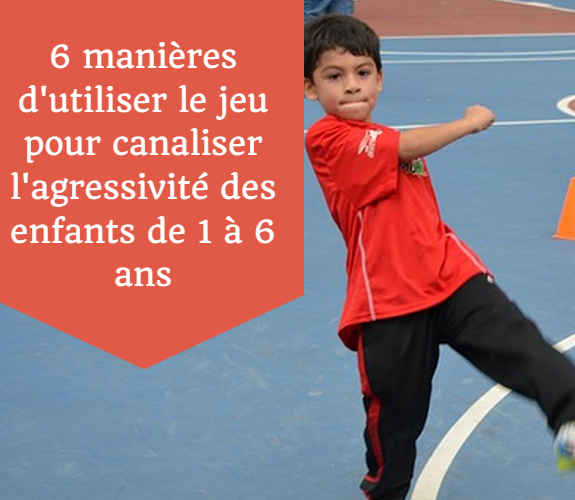
Substitution means replacing a behavior we find unacceptable with one we find acceptable. Play is often the easiest channel for a child's aggression, because it keeps the energy and changes only the target.
If a child throws forbidden objects, offer a throwing session with soft toys: the child throws, the parent catches and throws back. At home, a plush monkey with a long tail can be spun in the air before launching. The same logic applies to toys that invite safe, repeated action, such as the sets reviewed in foam block toys or the open-ended play of Montessori toys.
Why substitution works
Substitution respects the impulse while redirecting it, so the child does not feel rejected for wanting to move and act. It also gives you something to offer instead of a plain no, which is far easier for a young child to accept.

| Reaction | When to use it | What it replaces |
|---|---|---|
| Uncover the need | Child seems off, tired or stressed | Punishing the "bad" behavior |
| Substitution | Child throws, hits or needs to move | A flat no or a reprimand |
| Environment change | Boredom, overstimulation, small space | Repeated reminders and scolding |
| I-message | Your need is blocked right now | You-messages full of blame |
| Active listening | Child is upset or withdrawn | Lecturing and interrogating |
Modify the environment instead of the child
It is easier and more effective to change the environment than to change the child. A child who is bored, overstimulated before bedtime, set up to fail, or short on space to play and move will often adopt behaviors we find unacceptable.
Parents and teachers can simplify life by placing the objects children use within reach, posting rules where children can see them, providing a small step stool or observation tower, and labeling drawers, storage furniture, files and cupboards. A well-prepared space supports independence, the same principle behind Montessori housework routines and the age-appropriate picks in toys for toddlers.
Look at the room before you look at the child: chairs too high, toys out of reach, or a lack of room to run all push a child toward frustration. Removing one obstacle often removes the behavior with it.

Send a confronting I-message
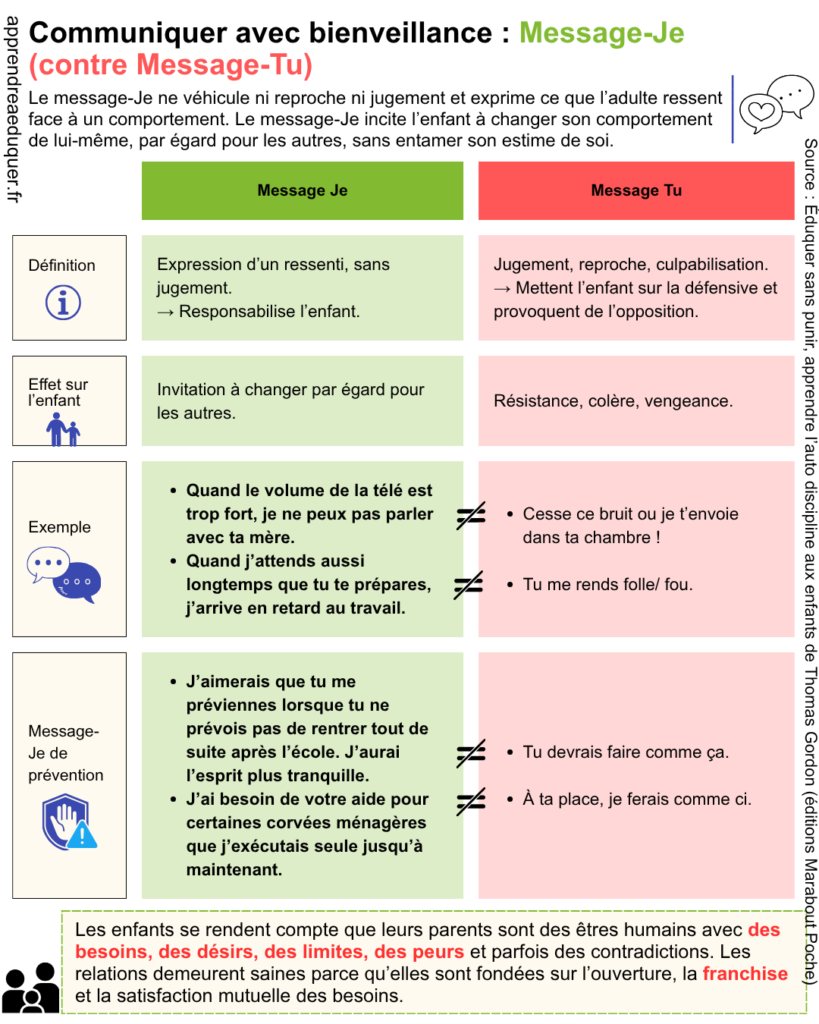
Thomas Gordon defines the confronting I-message as a message that carries no reproach or judgment and expresses what the adult feels about an unacceptable behavior, so that the behavior stops. I-messages invite the child to change on their own, out of regard for others, without damaging self-esteem.
Instead of "Stop that noise or I send you outside," try "When the TV volume is that loud, I can't talk with your mother." Instead of "You must know you shouldn't do that," try "I'm afraid I won't be able to enjoy the flowers I planted if they get trampled." Instead of "You make me crazy," try "When I wait that long while you get ready for school, I arrive late for work."
By contrast, you-messages carry reproach, judgment, criticism and constraint. The "you" judges, blames and labels, which puts children on the defensive and closes the conversation. Clear, calm wording also helps when a child is learning to express themselves, as with the tools in language development toys.
Listen actively and reflect feelings
Active listening is the natural partner of the I-message. Before you correct, name what you think the child feels: "I get the impression your day went badly. Do you want to talk about it?" or "Did something happen at school?" This opens a door rather than starting a defense.
When a child comes home tense after a punishment or a conflict, the need is often to recharge with love, and a long hug is frequently the best option. Reflecting feelings teaches emotional vocabulary, which grows alongside speech, much like the milestones described in my son's brain.
Listening first also prevents escalation: a child who feels heard has less reason to push the behavior further. Keep your tone low, stay close, and let silence do part of the work.
Prevent, collaborate and stay consistent
Prevention rounds out the eight reactions. Anticipate transitions, warn before leaving the park, and prepare the environment before tiredness hits. A predictable rhythm lowers the number of conflicts, just as steady routines support health and rest, topics covered in influenza symptoms and in pregnancy symptoms for the youngest families.
Collaboration matters too: when a problem belongs to both of you, invite the child to help find a solution. "We keep running late in the morning. What could make getting ready easier?" Children commit far more readily to a plan they helped build.
Finally, stay consistent. Apply the same non-punitive reactions across days and caregivers, and repair quickly when you slip. Consistency is what turns these eight reactions into a reliable family culture rather than a one-off technique.



My hands-on take
In our house, most of my daughter's discharge meltdowns come straight from school: a punishment, a stressful day, a conflict at recess. I have learned to read the signs with questions and active listening: "I have the impression your day went badly. Do you want to talk about it?" or "Did you get told off by the teacher?" In those moments she does not need a lecture; she needs to recharge with love, and the big hug is always the best option.
I also lean on substitution more than I expected. When the throwing starts indoors, we switch to a soft toy session rather than a fight. And I try to catch myself mid-sentence when a "you" is coming out, replacing it with what I actually feel. It is not perfect, but it keeps the connection intact, and that is what I want to protect.
Frequently asked questions
What is a non-punitive reaction?
It is a response to a behavior that solves the problem without blame, shame or punishment. It focuses on the need behind the behavior, the environment, or a clear message about your own feelings.
Why do I-messages work better than you-messages?
I-messages describe your feeling and the concrete effect of the behavior, so the child can adjust without feeling attacked. You-messages judge and label, which usually puts children on the defensive.
Does changing the environment really reduce conflicts?
Yes, because many unacceptable behaviors come from boredom, overstimulation, frustration or too little space. Adjusting reach, rules and layout removes the trigger before the conflict starts.
Can these reactions be used at school too?
Absolutely. Teachers can place materials within reach, post rules visibly, label storage, and use I-messages and active listening in the same way parents do at home.
Product Reviews
 Best Toys for Dogs With High Prey Drive |
Best Outdoor Toys for 3-4 Year Olds |
Best Outdoor Toys for 6 Year Olds |
Best Harness for Poodle |
Best LEGO Sets for Adults |
Best Travel Toys for 4 Year Olds on Airplane |
Best Toy Stores in Washington DC |
Best Potty Training Toys |
Best Toys for Tripod Dogs |
Maillot equipe de france







