


Apologizing sincerely is not easy for most of us, yet it is a skill that can be learned. Asking for forgiveness matters because it repairs the bond and shows a genuine wish to keep the relationship alive with respect for the other person.
This is especially true between parents and children. A real apology can reset the tone of a household, while a careless one can quietly teach children that saying sorry is just a way to end an argument.

This article looks at what makes an apology meaningful, how the five apology languages work, and how parents can model honest repair without losing authority.
Quick takeaways
- A real apology repairs the bond; a weak one only ends the argument.
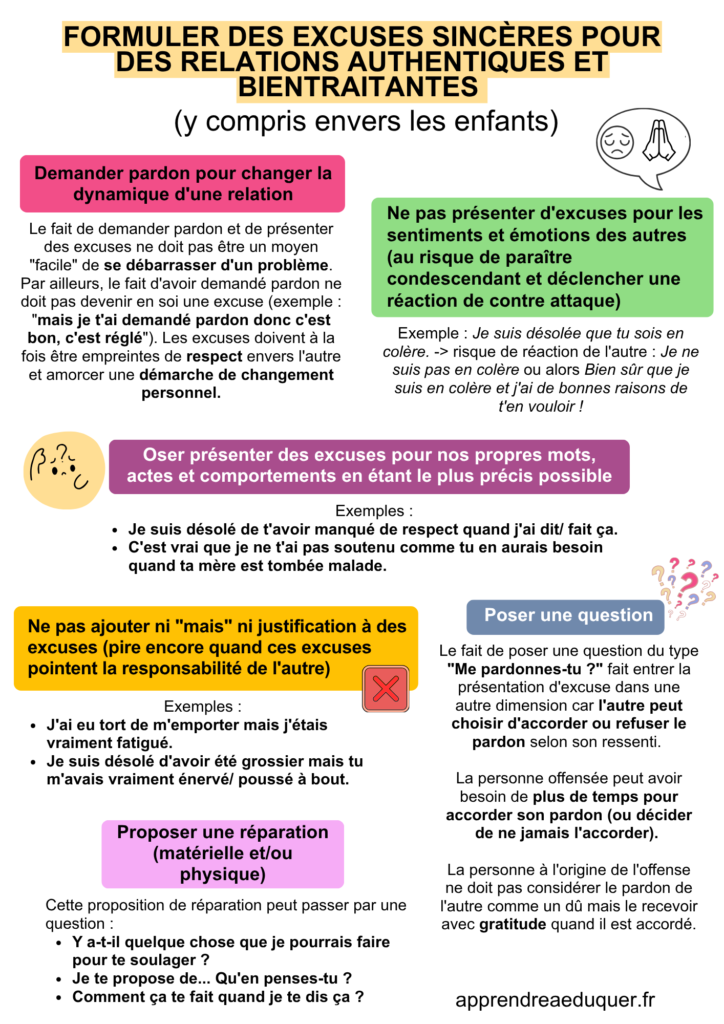
- Never apologize for someone else's feelings, only for your own actions.
- Drop the “but” and every justification from your apology.
- Ask “Would you forgive me?” and accept that the answer may take time.
- Offer concrete repair, practical or emotional, as part of saying sorry.
- Parents who apologize sincerely model emotional intelligence for their children.
Why a Real Apology Changes a Relationship
Apologizing should never become an easy way to sweep a problem away. Saying sorry to stop someone being annoyed at you, or apologizing for shouting and then shouting again the next day, does not repair anything. Nor should an apology become a free pass: “but I said sorry, so it's settled” misses the point entirely.
Genuine apologies act as a turning point in conflict. They bring relief to both sides: the person who caused harm takes responsibility, and the person who was hurt feels understood. Often an argument involves hurtful words on both sides, so an apology is frequently mutual.
That said, apologies offered only to keep the peace or to give in do not rebuild trust. Weak apologies never do the work. If you want to understand how small everyday interactions shape a child's sense of safety, the way we handle slapping discipline or the tone we set under stress matters as much as the words we choose afterwards.

The Five Languages of Apology
Gary Chapman, best known for the five love languages, wrote a book on this subject describing different ways of expressing and receiving apologies. Just as with love, each of us tends to have a preferred apology language, and in a couple or a family these can differ.
That mismatch can fuel misunderstandings even when someone has genuinely apologized. In his book on reconciliation, Chapman names five apology languages:
What the Five Languages Look Like
Expressing regret out loud (“I'm sorry”); acknowledging responsibility (“I was wrong to…”); offering compensation, whether emotional or practical; committing to change and keeping that commitment; and asking for forgiveness while accepting the risk that it may not be granted.
These languages can be combined so that an apology feels both sincere and received as authentic respect. Understanding different communication styles helps here, much as it does in other areas of family life such as phone habits that quietly shape how present we are with each other. The same attention to connection matters from the first three years onward, and later through shared reading.
| Language | What it sounds like | When it helps most |
|---|---|---|
| Expressing regret | “I'm sorry.” | When the other person needs to hear it plainly |
| Acknowledging responsibility | “I was wrong to…” | When trust was damaged |
| Offering compensation | “Can I do something to help?” | When actions hurt more than words |
| Committing to change | “I won't do that again.” | When the same issue repeats |
| Asking forgiveness | “Would you forgive me?” | When vulnerability is needed |
How to Formulate a Sincere Apology
Several details make the difference between a real apology and a defensive one. First, do not apologize for other people's feelings. Saying “I'm sorry you're angry” can sound condescending and often triggers a counter-attack: “I'm not angry” or “Of course I'm angry, and I have good reason.”
Instead, apologize for your own words, actions and behaviour, as precisely as possible. “I'm sorry I disrespected you when I said that” or “You're right, I didn't support you the way you needed when your mother fell ill” lands very differently from a vague gesture.
Avoid adding “but” or justifications, and never point to the other person's responsibility: “I was wrong to lose my temper, but I was really tired” or “I'm sorry I was rude, but you pushed me” undoes the apology. Asking forgiveness with a question (“Would you be willing to forgive me?”) adds vulnerability, because the other person can choose. They may need time, or never grant it, and that forgiveness should be received with gratitude rather than expected.

Offering Repair and Giving Time
Offering compensation, practical or emotional, is one of the most concrete apology languages. It can be framed as a question: “Is there something I could do to ease this for you?” or “I'd like to suggest this; what do you think? How does that feel when I say it?”
Timing matters too. The person who was hurt may need more time before forgiving, and the person apologizing must not treat forgiveness as owed. Patience here is part of respect, and it is the same patience that helps in other slow, tender situations, such as accompanying a family through pregnancy loss or supporting a loved one through the menstrual cup transition with sensitivity. The same steady patience helps when a child takes hours to settle at night, or when young children get car sick on a journey.
When we give the other person room to respond honestly, an apology becomes a conversation rather than a performance. That shift is what makes repair durable, whether between partners or between a parent and a child.

Apologizing as a Parent to Your Child
Asking a child for forgiveness is a sign of emotional intelligence. The idea can be frightening, and admitting fault can even feel paralysing: fear of losing face, of seeming weak, of humiliating yourself. The clinical psychologist Claude Steiner noted that few people are emotionally skilled enough to apologize sincerely without becoming defensive; in short, few know how to say “I'm sorry.”
Taking responsibility for our own behaviour is the hard part, and it is exactly what children watch. A parent who apologizes precisely, without “but”, and then changes something concrete teaches more than any lecture. This modelling connects to everyday moments, from choosing open ended toys that invite shared play to handling the small frustrations of crawling babies with calm.
Children learn emotional honesty by watching us repair, not by hearing us insist we are always right. An apology that names the behaviour and offers a change gives a child a template they can carry into friendships and, later, their own family life.
My hands-on take
I learned this the hard way. For years I apologized to my daughter with a “but” attached, and I could see her shoulders stay tense even after I had said sorry. One evening I tried something different: I named exactly what I had done, left out every excuse, and asked whether she would forgive me. She was quiet, then nodded. It took a few more days before the mood really shifted.
What struck me most was how much calmer I felt afterwards. Apologizing did not make me weaker as a parent; it made the house easier to live in. Now I try to keep my apologies short, specific and followed by one small change I can actually keep.
Frequently asked questions
Why is apologizing so hard for parents?
Admitting fault can feel like losing authority or face. In reality, a precise apology strengthens trust, because children see honesty rather than defensiveness.
Should I apologize if my child was partly at fault too?
Yes. Apologize for your own part only, without blaming. Mutual responsibility can be discussed afterwards, once the connection is repaired.
What if my child refuses to forgive me?
Give them time and do not treat forgiveness as owed. Keep the commitment you made and let your changed behaviour speak for itself.
Can an apology replace a change in behaviour?
No. Words without follow-through become hollow. The apology opens the door, but consistent change is what keeps it open.
Product Reviews
 Best Toys for Dogs With High Prey Drive |
Best Outdoor Toys for 3-4 Year Olds |
Best Outdoor Toys for 6 Year Olds |
Best Harness for Poodle |
Best LEGO Sets for Adults |
Best Travel Toys for 4 Year Olds on Airplane |
Best Toy Stores in Washington DC |
Best Potty Training Toys |
Best Toys for Tripod Dogs |
Maillot equipe de france







