


Creative family activities are the quiet heroes of any holiday: they fill a rainy afternoon, keep hands busy and turn a pile of odds and ends into something worth keeping. The three books below were picked for exactly that mix of making, recycling and imagination, and every idea in them was tried at home before being recommended here.
Each one targets a slightly different mood. One is all about modelling clay and small, satisfying objects; another is a cardboard workshop for builders; the third is a grab-bag of experiments, sewing and toys to make. Together they cover a wide age range and a wide range of mess levels, so there is something for a slow morning as well as a full afternoon.

Quick takeaways
- Clay modelling books teach one technique per lesson, then apply it to several projects.
- Step-by-step photos let children work without reading the instructions.
- Cardboard books are graded by age, from painting to supervised cutting.
- Templates and clear steps make upcycled projects achievable at home.
- The fifty-activity book mixes science, crafts, sewing and toys to build.
- Substituting recycled materials for listed supplies works well.
Making Clay Figures and Jewellery With Kids
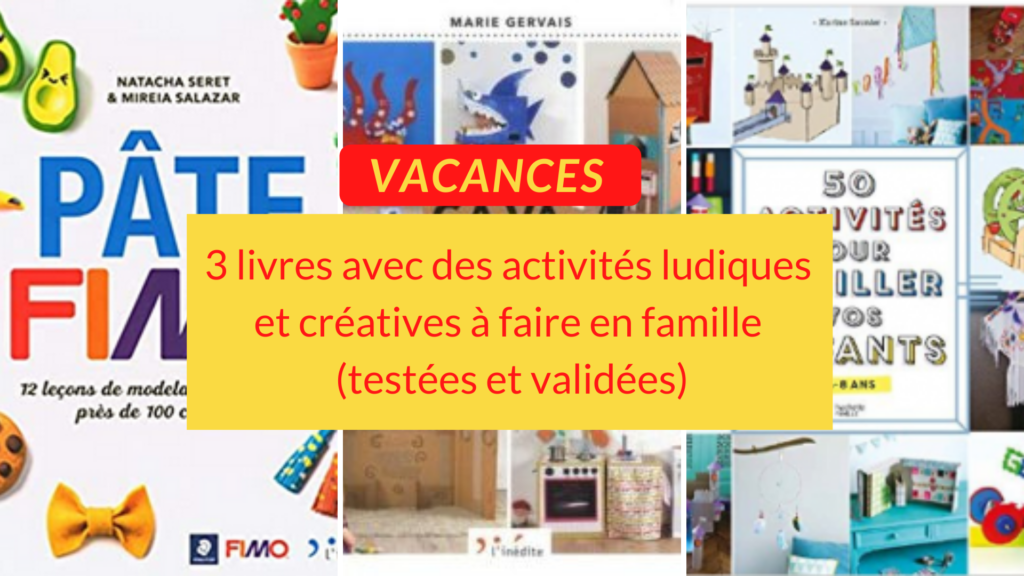
Pâte Fimo: 12 leçons de modelage is built around twelve modelling lessons, each teaching one precise shaping technique and then applying it to several projects: earrings, little dinette accessories, tiny characters, key rings and Kawai-style or unicorn designs. The many step-by-step photos make the projects easy to follow, and children can often work from the pictures alone without reading the instructions.
The quantities and sizes given are only a guide, and swapping the suggested colours works perfectly well. Once baked, the creations become real decorations and figures that live in the bedroom, and jewellery-making is a lovely way to keep little hands busy on a wet afternoon, much like the Easter holiday rest balance between homework and downtime. My daughter made enough jewellery to sell a few pieces to relatives for pocket money, and the finish is genuinely good enough to wear.
What Makes It Work
Simple base shapes, clear photos and an attractive finished result mean children see progress quickly. That early success matters, especially for a shy child who may need a gentle, low-pressure activity to feel confident in a group. It is a calm, absorbing craft, far removed from the full moon folklore that some parents joke about on busy days.
Cardboard Upcycling Projects for Young Builders
Ça va cartonner! gathers thirty creations made almost entirely from cardboard, aimed at children from roughly two or three years old. The projects are designed so families can work together according to each child's skills: a three-year-old can paint the cardboard, an eight-year-old can handle the cutter under supervision and glue pieces, and a twelve-year-old can enlarge the templates on squared paper.
The author states from the introduction that the goal is not to make readers drool over unreproducible creations but to offer starting points, techniques and permission to invent personal models. The book is split into three parts: playing (a witch or unicorn broom, a small theatre, a den, a sword and shield), celebrating (a photobooth, a hole board for scoring points, decorations and staging) and decorating (a photo frame, a curiosity cabinet, a toy chest, a cat house).
Practical Notes
Steps are detailed in both words and photos, and the templates at the back make the projects easy to follow, although they can take a while because paint must dry before assembly. That slow rhythm suits a calm roasting chestnuts afternoon as much as a busy one, and the themes — pirates, unicorns, cooking, dinosaurs, sharks — land well with children. Like the remarkable baby Chachat, these projects grow with the child, while parents who enjoy movies about real motherhood will recognise the same hands-on spirit.

| Book | Best for | Main materials | Age guide | Time needed |
|---|---|---|---|---|
| Clay modelling lessons | Precise, small projects | Modelling clay | Broad, with help | Short sessions plus baking |
| Cardboard creations | Builders and painters | Cardboard, paint | About 2 to 12 | Longer, paint must dry |
| Fifty varied activities | Trying something new | Recycled odds and ends | Listed 4 to 8, suits older | Varies by project |
Fifty Varied Activities for Ages Four to Twelve
The third book, 50 activités ludiques pour éveiller les enfants, offers clear explanations and materials that are easy to find, and every activity tried here was completed with recycled substitutes. A no-sew tulle skirt, for instance, worked with strips of old sheets instead of tulle, and the result pleased my daughter so much she made a second one for her cousin.
Activities are listed for ages four to eight but suit older children too, who simply work with more autonomy. The range is broad: science experiments such as a homemade lava lamp, crafts, cardboard constructions, toys to build such as a garage or a marble run, sewing, and educational tools including a timetable, an emotions mailbox and a dream catcher.
Why the Variety Helps
Because the book mixes making with simple science, it invites a genuine shared moment between parents and children rather than a solo task. It is also a good fallback when siblings need separate projects, and it pairs well with the spoiled children conversation about earning and caring for what we make.

Choosing the Right Book for the Day
Think about the child before the project. Clay suits children who like small, precise work and quick visible results; cardboard suits builders who enjoy scale and painting; the fifty-activity book suits families who want to pick something different each day.
Also consider drying and setting times, which shape how an afternoon runs. A clay project needs baking, cardboard needs paint to dry before assembly, and sewing needs a clear table. Planning around those pauses, the way you would plan around a baby sleep routine, keeps the mood calm. Keep a box of recycled materials on hand so an idea can start immediately, and let children adapt colours, sizes and templates freely. If siblings share the table, borrow a few sibling peace strategies so the crafting stays calm, and for superhero-obsessed kids, see our guide to the best superhero toys.



My hands-on take
We worked through all three books over several holidays, and the pattern that emerged was simple: the clay book produced the most treasured objects, the cardboard book produced the biggest mess and the most pride, and the fifty-activity book produced the most repeat requests. My daughter still keeps a box of her baked clay pieces, and she has given several away as gifts.
My advice is to start with one project rather than a whole chapter, keep a shoebox of cardboard, fabric scraps and old sheets within reach, and expect drying time to stretch a project across two days. Letting children change the colours and sizes freely made the biggest difference to how much they enjoyed it.
Frequently asked questions
Do we need to follow the instructions exactly?
No. Colours, quantities and sizes are given as a guide, and swapping materials for recycled alternatives worked in every activity tried.
Which book suits a three-year-old?
The cardboard book, where young children can paint and decorate while an adult handles cutting and assembly.
Are these activities only for rainy days?
They work whenever children need a focused indoor project, and many can be spread over several afternoons.
Can older children work independently?
Yes, especially with the fifty-activity book, where older children complete projects with more autonomy than the younger age guide suggests.
Product Reviews
 Best Toys for Dogs With High Prey Drive |
Best Outdoor Toys for 3-4 Year Olds |
Best Outdoor Toys for 6 Year Olds |
Best Harness for Poodle |
Best LEGO Sets for Adults |
Best Travel Toys for 4 Year Olds on Airplane |
Best Toy Stores in Washington DC |
Best Potty Training Toys |
Best Toys for Tripod Dogs |
Maillot equipe de france







