


Parent-child separation starting at birth is far more common than most of us realize, and it shapes the way we raise the next generation. Many babies are placed in a separate crib within moments of delivery, and from that point on, closeness is treated as something to be earned rather than a basic need.
Laura Gutman, a therapist who specializes in maternity, argues in her work that every human baby's fundamental need is permanent physical and emotional closeness with another person, especially a mother and father. When that need is not met, the consequences ripple outward for decades.

Quick takeaways
- A baby's core need is constant physical and emotional closeness
- Unmet early needs can make a parent tense around their own child's demands
- "Educational" language often disguises distance and ignored emotions
- Medicalized birth can strip mothers of confidence and separate them from babies
- Lack of touch is linked by the author to loneliness and later violence
- Closeness can be rebuilt through small daily routines and responsiveness
The Tension Parents Feel When a Baby Needs Contact
Gutman observes that some parents find the constant physical contact a baby demands almost unbearable. The closeness triggers a kind of fury in them, because their own early need for closeness was never heard or acknowledged. As adults, these parents are put under strain by their own children's requests for proximity from the very first day.
When a baby's need for contact becomes a genuine problem for a parent, the easiest solution is to push the child away from the body. Parents whose history is marked by emotional deprivation and a lack of warmth may even come to shake or hit a crying baby when the tension grows too intense. Isolating the child, ignoring them, or striking them resolves that tension for the adult, but at a real cost to the child.
Why the Body Matters
This is why the everyday objects that keep a baby close, from best crawling toys to a soft carrier, matter more than we think. Even small routines like the daily nap can become moments of connection rather than isolation when a parent stays nearby.
How Educational Language Disguises Harm to Children
The harm done to babies is then dressed up in "educational" language. We tell ourselves that distance and ignoring a child's emotions are for their own good, and even for the good of humanity, since we cannot let children live by the pleasure principle or the species would collapse under lazy, selfish humans with no limits.
Gutman points out that no other mammal species would do something so unusual with its young. Yet for humans it is common to decide that "letting them cry" is best so they "don't pick up bad habits" or "become spoiled." We treat it as completely normal that a baby's body is separated from its mother's, alone in a crib, alone in a stroller, alone in a little chair.
We assume a baby should sleep alone. As soon as the child grows a little, we decide they are too big to ask for arms or cuddles. Then they are too big to cry, and always too big for bedwetting, for being afraid of mosquitoes, or for not wanting to go to school. Yet all they needed since birth was contact, and they did not get it.
| Common habit | What it signals to the child | Connected alternative |
|---|---|---|
| Letting a baby cry alone | Needs are not answered | Respond and comfort |
| Separate sleep from day one | Closeness is conditional | Room-sharing where possible |
| "Too big for cuddles" | Contact must be earned | Offer affection freely |
| Ignoring fears and bedwetting | Emotions are unwelcome | Acknowledge and reassure |
| Rigid feeding routines | Body signals are secondary | Follow hunger cues |
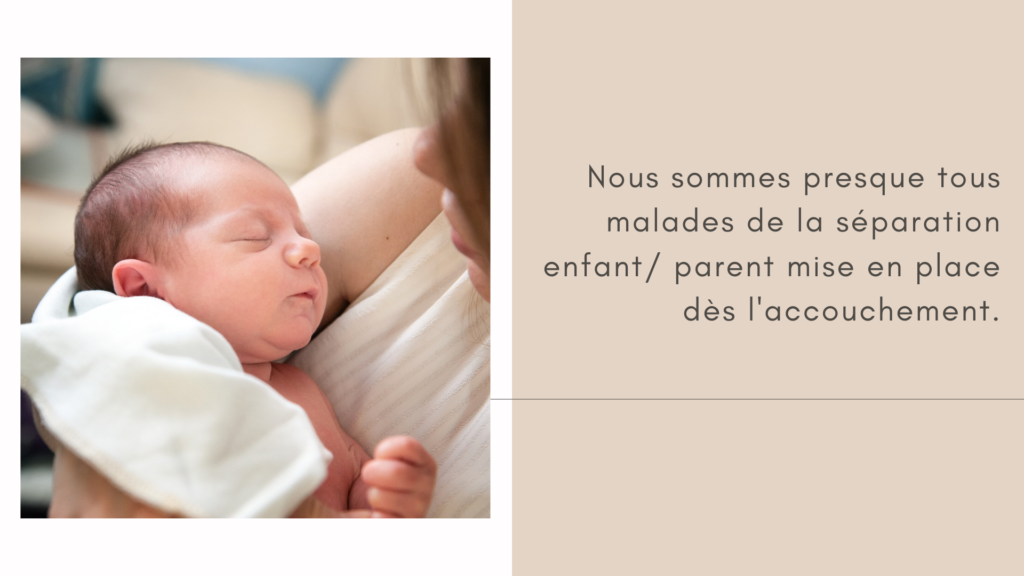
Almost All of Us Are Ill From This Separation
Gutman argues that we have lived for centuries under a form of repression that treats the body, and women's bodies in particular, as impure and indecent, while the mind is considered pure and noble. This shows up in the hyper-medicalization of birth itself, where chorionic biopsy and similar procedures become routine talking points rather than exceptions.
A vicious circle begins at delivery. Most women and caregivers accept a heavily medicalized, dehumanized birth because women have been stripped of their inner knowledge, their sensations, their emotions, and their power. Gutman describes a birth "in captivity: tied down, injected, threatened and frightened."
Separation Right After Birth
Meanwhile, babies are separated from their mother's body almost immediately, and mothers have learned to submit to rigid hospital routines that disregard a baby's needs. As a result, mothers struggle to object to the breaking of the bond, and babies learn from birth that bodily sensations are undesirable. That early loss of closeness connects to the same themes explored in controversial parenting issues, where opinions on separation run deep.
The Illness of Solitude and the Roots of Violence
Gutman calls this the illness of solitude. She goes further, arguing that it is the absence of physical contact between parents and children that prepares the ground for violence, contrary to the cultural message that legitimizes separation from birth and throughout life. Every child not touched by their mother, she writes, will serve the wheel of indifference, war, and the submission of some people by others.
She asks at what moment we learn there is no place for the body and for pleasure. The answer, she says, is at the precise moment of birth: a few seconds after being born, we stop being touched. This is a heavy claim, and it is worth holding alongside the everyday reality of caring for a newborn, from six month old toys to the simple act of holding a baby during a feed.
None of this means parents must be perfect. It means noticing when we pull away out of our own discomfort, and choosing closeness when we can, whether through quiet toys shared on the floor or a calm bedtime routine.

What a More Connected Approach Looks Like
Rethinking separation does not require rejecting all structure. It means questioning routines that exist for adult convenience rather than for the baby's need for contact. Skin-to-skin time, responding to cries, and keeping a baby close during the day are simple places to start, and they cost nothing.
As children grow, the need for contact does not disappear; it changes form. A child who asks for a cuddle, a story, or company at bedtime is expressing the same need that was there at birth. Simple tools help here too, like potty training toys that make daily care less of a battle, or learning toys that invite a parent to sit down and play alongside the child.
For parents preparing for a new baby, small practical choices support this approach, from maternity bag choices to planning who will be present and how much quiet time the family will protect in the first weeks. The goal is not a perfect method but a direction: toward contact rather than away from it.

My hands-on take
When my first child was born, I followed the hospital routine without questioning it. The baby went into the plastic crib beside my bed, and I remember feeling relieved to finally rest. It took me weeks to notice that every time I picked her up, my shoulders tensed, as if I were doing something wrong. Reading about this tension helped me understand it was not about her at all; it was about me never having been held that way.
With my second child, I did things differently, not perfectly. I kept him closer during the day, answered his cries faster, and stopped apologizing for holding him. The change was small and unglamorous, but it shifted something in me. I am not a therapist and I do not have all the answers, but I have learned that noticing my own discomfort is the first step toward not passing it on.
Frequently asked questions
Does this mean parents should never put a baby down?
No. The point is responsiveness rather than constant holding. Babies need rest and parents need rest too; what matters is answering a baby's signals for contact rather than routinely ignoring them.
Is it harmful to let a child sleep alone?
The author's view is that early separation is a loss, not that every separate sleep arrangement is damaging. Many families find a gradual, responsive approach works best for them.
Can parents who were themselves deprived still connect with their child?
Yes. The tension described comes from unmet early needs, and noticing it is the first step. Responding to a baby's cries and seeking support can help break the pattern.
Why does the article focus so much on birth?
Because the first moments set a tone. A calm, supported birth with early contact helps mothers trust their instincts and makes later closeness feel natural.
Product Reviews
 Best Toys for Dogs With High Prey Drive |
Best Outdoor Toys for 3-4 Year Olds |
Best Outdoor Toys for 6 Year Olds |
Best Harness for Poodle |
Best LEGO Sets for Adults |
Best Travel Toys for 4 Year Olds on Airplane |
Best Toy Stores in Washington DC |
Best Potty Training Toys |
Best Toys for Tripod Dogs |
Maillot equipe de france







