


When you can't take it anymore as a parent, the first thing to know is that this feeling is not a personal failure. Raising a child is genuinely hard, and many parents find that gentle parenting adds another layer of mental load to already full days.
This guide gathers practical paths forward: questions worth asking yourself, the contextual reasons behind parental exhaustion, the importance of speaking up, and how to repair the relationship after you lose your temper. None of it requires perfection — only small, honest steps.

Quick takeaways
- Exhaustion is a signal, not a personal failure
- Ask concrete questions about couple time, support and rest
- Name unpleasant emotions out loud or in writing
- Use local parent groups and helplines instead of isolating
- Apologise after slipping up, then change the behaviour
- Surround yourself with people who listen without judging
Illuminating questions to ask yourself
Before looking for solutions outside, it helps to look inward with a few simple questions. Is there enough exchange in your couple? Do you take time to talk about the children and the education you want to give them? Do you know moments of happiness together — as a couple, with the children, as a family — and do you have exciting projects that bring you together?
Then ask about support: when you feel overloaded, can you ask your partner for help and count on them so the legitimate demands of the child don't leave you at the end of your rope? On an individual level, do you have moments of relaxation, time to read, see friends, dance, sleep in or do sport if you want to? These questions are not a test — they are a map of where the pressure comes from.

Understanding the contextual reasons parents are exhausted
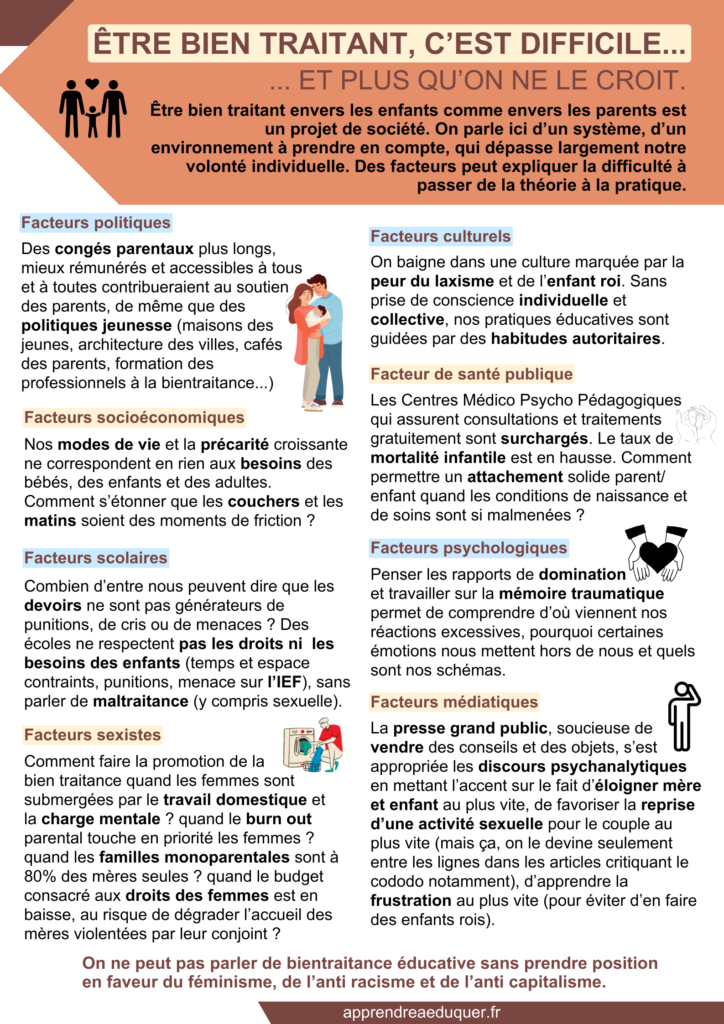
Thinking you can't take it anymore is not purely an individual matter. Being a well-treating parent is far harder than people believe, because the Western socioeconomic context makes parenting genuinely difficult: scattered support, long working days, and the constant feeling of being judged.
Recognising this matters, because it lifts some of the guilt. As motherhood reshapes priorities, the pressure to get everything right can feel overwhelming. If your child is child's fatigue after a disrupted routine, or if outings turn into meltdowns, the problem is often the situation rather than your competence. Naming the context is the first step toward asking for the help you actually need.
| Area | Question to ask | If the answer is no |
|---|---|---|
| Couple | Do we talk about the children and our plans? | Plan a short regular talk |
| Happiness | Do we share enjoyable moments together? | Schedule one simple family moment |
| Support | Can I ask my partner for help? | Name one specific task to share |
| Personal time | Do I get moments to rest or see friends? | Protect one slot in the week |
| Repair | Can I apologise after losing my temper? | Prepare a short honest phrase |
Talk about it and don't stay alone
Putting emotions into words
Speaking about what you feel is essential. Unpleasant emotions — fatigue, exhaustion, irritation, anger — that you refuse to hear simmer quietly, then bubble up more and more until they explode in the open, bringing suffering to you and to those around you. Saying them out loud or writing them down reduces their effects.
All feelings are legitimate for children, and that is just as true for parents. Asking for help is not a sign of weakness, incompetence or lack of love. When a parent doesn't take care of themselves and their needs, frustration and fatigue echo negatively on themselves and on the children. If you are exploring a calmer approach, it's worth asking conscious parenting what it really involves. Just as every LEGO Friends character has a distinct personality, each parent brings their own temperament to these moments.

Parent support groups and where to find them
Many parent discussion groups exist where you can share experiences and then rehearse and practise new ideas to improve the relationship with your children. They are places of kindness and mutual help, led by professionals in parental support, and they suit parents of babies as well as those navigating returning to school transitions. Whether you are curious about celebrities after giving birth or simply need a laugh, these groups welcome every parent.
There are also parent-family information and listening points, parent-child welcome centres for children under six, and family houses. Town halls know the names, addresses and contact details of these places. Public support includes family information points, early childhood centres, listening and support networks for parents, family mediation and maternal and infant protection services. A free, anonymous helpline supports parents from pregnancy to the child's third year, and shared humour helps too, as these reasons dad makes us laugh show.

Surround yourself with kind people
Surrounding yourself with kind people helps you bounce back. When you feel understood, supported and welcomed as you are — when your suffering is recognised — you feel better. The company of benevolent people sets off a virtuous circle precisely when you can no longer cope.
This can be a friend who listens without judging, a grandparent who takes over for an afternoon, or a group where nobody pretends it's easy. Practical help matters too: a partner who handles bedtime, or a friend who reminds you that independent play is a skill children build with time, not a luxury you must earn.

When you slip up, talk with your children
Recognising slips, apologising for an excessive attitude or a humiliating word, has educational value. It is a chance for the child to learn that adults make mistakes too, that these are inherent to the path of life, and that apologising is proof of strength of character. A child will respect adults much more if they have been able to acknowledge their missteps.
Something as simple as "I'm sorry. I regret saying that, threatening or shouting. I was very angry and didn't take time to think. I don't want to behave like that anymore" carries weight. For real educational value, apologies must be followed by efforts not to repeat the behaviour — the hardest part, because it demands introspection. Apologies also leave room for children to express how they felt, and to name emotions such as throwing everything in frustration.
My hands-on take
I remember a week when every bedtime turned into a battle and I kept telling myself I just needed to be more patient. What actually helped was far less noble: I wrote down what I felt on a scrap of paper, told my partner exactly which task I needed him to take, and called a friend instead of scrolling. None of it fixed everything, but the pressure dropped enough to breathe.
The other thing I learned is that apologising works. I once sat on the bedroom floor and said I was sorry for shouting, and my child's shoulders visibly relaxed. It didn't make me a perfect parent — it made me a repairer, which turned out to be far more useful.
Frequently asked questions
Is it normal to feel like I can't take it anymore?
Yes. Parental exhaustion is common and is partly linked to the socioeconomic context rather than to your abilities. Naming it is the first step toward getting support.
Does asking for help mean I'm a bad parent?
No. Asking for help is not weakness, incompetence or lack of love. A parent who doesn't care for their own needs becomes more frustrated and fatigued, which affects the whole family.
What should I do after shouting at my child?
Recognise the slip and apologise simply, explaining what you felt. Then make real efforts not to repeat it, and let your child express how they felt.
Where can I find parent support?
Discussion groups, parent-child welcome centres, family information points, family mediation and maternal and infant protection services all exist. Your town hall can give you names and addresses.
Product Reviews
 Best Toys for Dogs With High Prey Drive |
Best Outdoor Toys for 3-4 Year Olds |
Best Outdoor Toys for 6 Year Olds |
Best Harness for Poodle |
Best LEGO Sets for Adults |
Best Travel Toys for 4 Year Olds on Airplane |
Best Toy Stores in Washington DC |
Best Potty Training Toys |
Best Toys for Tripod Dogs |
Maillot equipe de france







