


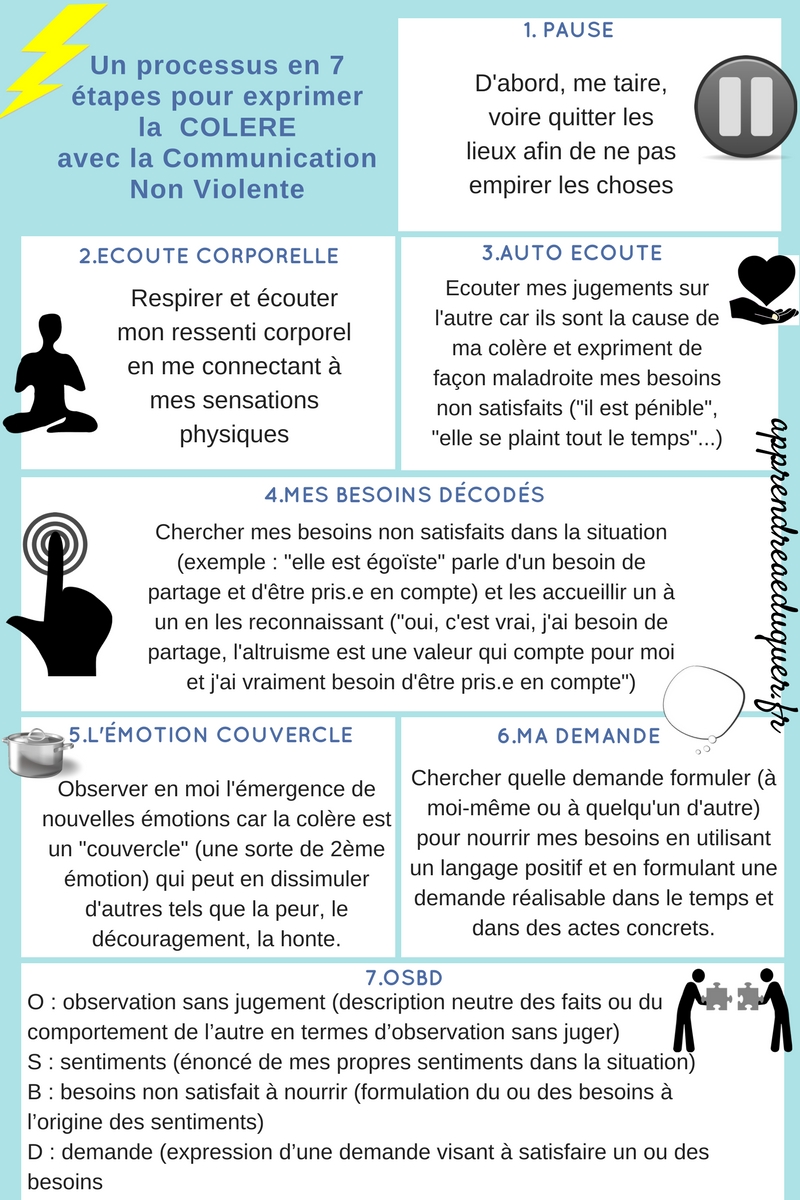
Expressing anger nonviolently means using the energy of anger to serve your needs rather than to attack other people. In the Nonviolent Communication approach, anger is a signal that you are cut off from your needs. Once you see it that way, you can reason in terms of needs and use the energy of anger constructively, in a way that feeds the relationship instead of damaging it.
This matters at home as much as anywhere. Children push buttons, partners misunderstand, and the first impulse is often to blame. The process below offers another route: a short, repeatable sequence you can practise until it becomes a habit.

Quick takeaways
- Anger signals that you are cut off from a need, not that the other person is wrong.
- Pause or leave the room before you speak, so the situation does not escalate.
- Breathe and track body sensations to return to the present.
- Treat your judgments as clumsy clues to unmet needs, then name those needs.
- Look for the feelings under the anger: sadness, fear, shame, helplessness.
- Make a concrete, positive request, then express it with observation, feeling, need and request.
Why anger is a signal, not an enemy
Anger is uncomfortable, so most of us try to suppress it or let it out at whoever is closest. Nonviolent Communication suggests a third option: treat anger as information. It tells you that something you value is not being met, and that you have drifted away from your own needs.
That reframing is not about denying the feeling. It is about giving the energy somewhere useful to go. Instead of spending it on reproaches, you spend it on understanding what is missing and what you would like to happen next. The same intensity that fuels an argument can fuel a clear request.
Parents often notice this with siblings who argue over toys. The shouting is real, but underneath it sits a need for fairness or for being seen. independent play works better when children have had a chance to name what they wanted before the conflict escalated.
Steps 1 and 2: stop, then breathe
The first step is to say nothing, or even leave the room, so the situation does not get worse. This is not withdrawal or sulking; it is buying yourself a few seconds before you speak. If you can, step into another room or onto the doorstep.
Then breathe and listen to your body. Notice the tight jaw, the heat in your chest, the clenched hands. Connecting to physical sensation brings you back into the present and slows the reaction down. It is the same principle behind baby sleep routines: the body settles first, and the mind follows. The same holds for learning to speak, which unfolds step by step.
Why the pause feels so hard
Because anger moves fast and our habits move faster. Practising the pause when you are calm makes it more available when you are not. Even a single deliberate breath counts as practice.

| Step | What you do | What it protects |
|---|---|---|
| 1 | Stay silent or leave the room | The relationship |
| 2 | Breathe and notice body sensations | Your nervous system |
| 3 | Listen to your judgments | Self-awareness |
| 4 | Identify and welcome unmet needs | Clarity |
| 5 | Notice feelings under the anger | Emotional honesty |
| 6 | Formulate a concrete request | Usefulness |
| 7 | Express observation, feeling, need, request | Connection |
Steps 3 and 4: hear your judgments, then find the needs
If you can, listen to your own judgments about the other person. They are the cause of the anger, and they express unmet needs clumsily: "he is unbearable", "she complains all the time", "he is dishonest". These thoughts are not the truth about anyone; they are clues.
Next, look for the unmet need behind each judgment. "She is selfish" might point to a need for sharing and for being taken into account. Welcome each need one at a time and acknowledge it: "Yes, that is true, I need sharing, generosity matters to me, and I really need to be considered."
This step takes honesty rather than polish. The same patience helps when you are helping a child work through frustration, whether over homework during Easter holidays or over a game that will not go their way.
Step 5: look for the feelings underneath
Anger is often a lid. It sits on top of other emotions and hides them: sadness, fear, discouragement, helplessness, shame. Once the needs are acknowledged, watch for these quieter feelings emerging. They are usually closer to what is really going on.
Naming them privately is enough at first. You do not have to announce "I am ashamed" to anyone. But knowing it changes your tone, and tone is most of the message. A parent who can say "I felt helpless" is far less likely to shout than one who can only say "you are impossible".
This kind of emotional literacy is worth building early. It shows up in small daily moments, much like the habits described in parenting TED Talks, where the emphasis is on connection before correction. The same patient, encouraging spirit can guide everyday routines, from choosing back to school reward toys to picking out Christmas outfits.
Steps 6 and 7: make a request, then say it clearly
Ask yourself what request would feed the need, addressed to yourself or to someone else. Use positive language and make it doable in time and in concrete actions. Saying what you do not want does not make clear what you do want.
If needed, express your feelings, needs and request to the person concerned, following the four pillars of Nonviolent Communication: observation without judgment, feelings, unmet needs, and a request. As Anne van Stappen puts it, what makes all the difference is that you express your experience not in terms of reproaches but in terms of what you aspire to.
Someone once asked, "But who can do that?" The answer is probably: the people who practise it. You can rehearse the wording during calm moments, the way you might plan family travel so that the difficult parts are handled before they arrive.
Keeping it realistic at home
No one runs all seven steps in the middle of a heated moment. In practice you will often manage step one, then come back later for the rest. That is fine. The process is a map, not a test.
It also helps to lower the stakes. A toddler melting down over a toy, a school-age child refusing a bath, a partner who forgot something: these are the training ground. The six month old stage is a good time to start, because the conflicts are simple and the stakes are low.
Over time the sequence becomes shorter and more automatic. You pause, you notice, you ask for what you need. The anger does not disappear, but it stops running the conversation.

My hands-on take
I first tried this on a morning when everything was running late and a small delay turned into a shouting match. I managed step one, which for me meant walking into the hallway and saying nothing, and that alone felt unnatural. Then I breathed and noticed how tight my shoulders were. By the time I came back, I could say what I actually needed, which was help rather than an apology.
What surprised me was how much easier the later steps became once I had named a need out loud, even to myself. I still lose my temper. But I now catch the judgment earlier, and I have stopped treating anger as proof that someone else is at fault. Practising on the small stuff, like a dropped cup or a slow shoe-tying, has made the bigger moments less frightening.
Frequently asked questions
Do I have to complete all seven steps every time?
No. In a heated moment you may only manage to pause and breathe. You can return to the remaining steps later, once you are calm, and the conversation will still benefit.
What if the other person does not respond well?
You cannot control their reaction, only the clarity of your own expression. Speaking in terms of needs and requests rather than reproaches gives the conversation a better chance, and it protects you from escalating.
Is this only for adults?
The same structure works with children, adapted to their age. Naming a feeling and a need, then offering a simple request, is often enough to defuse a conflict over a toy or a routine.
How long does it take to become automatic?
It varies from person to person, and it depends on how often you practise. Starting with small, low-stakes moments makes the sequence more available when the stakes are high.
Product Reviews
 Best Toys for Dogs With High Prey Drive |
Best Outdoor Toys for 3-4 Year Olds |
Best Outdoor Toys for 6 Year Olds |
Best Harness for Poodle |
Best LEGO Sets for Adults |
Best Travel Toys for 4 Year Olds on Airplane |
Best Toy Stores in Washington DC |
Best Potty Training Toys |
Best Toys for Tripod Dogs |
Maillot equipe de france







