


Replacing "hurry up" and "I'm leaving without you" with calmer phrases is one of the simplest shifts a parent can make, and it starts with understanding how young children experience time. While we are preoccupied with schedules and goals, a small child is firmly anchored in the present. Where we act with destinations in mind, the child explores here and now, at their own rhythm.
That gap explains most morning battles. The good news is that you do not need to abandon your schedule or become endlessly patient. You simply need a few concrete swaps that respect the child's sense of time while still moving everyone out the door.

Quick takeaways
- Replace "hurry up" with a song that names the steps and the child.
- Turn routines into silly animal races, but keep competition light.
- Ask "what do you need before we go?" and honor one last ritual.
- Use a visual timer or clock to make time concrete and visible.
- Name the child's feelings, then share your own calmly and with humor.
- Respect the child's present-tense rhythm while still announcing transitions.
Singing instead of scolding
One teacher noticed a little girl who loved taking her time and was regularly scolded for being last. To help her get ready for playtime, the teacher invented a short song using the child's name and the steps to follow: shoes first, then coat, hat, scarf and finally gloves.
The song did three things at once. It personalized the routine without pinning a negative label on the child, it showed her exactly how to proceed, and it made clear that dressing faster meant more time to play. And singing has a hidden benefit for adults too: when we sing, we do not get angry.
Why melody works
A tune carries the sequence for you, so you repeat instructions less. It also softens your tone, which keeps the child cooperative rather than defensive. This is the same principle behind reading to your baby early: rhythm and repetition make information easier to absorb.
Turning the routine into a race
A classic but effective trick. When motivation for the shower stalls, propose a race: "Shall we go like a spider or like a backward giraffe?" Then vary it — side steps, duck walk, hopping on one foot. Adding silly options keeps it playful.
Use this one in moderation, though. The goal is not to breed a competitive spirit, which is why the humorous variants matter: they tilt the game toward fun rather than winning. Keep the emphasis on the journey, not on who arrives first.
Adapt it to your child
Some children respond to animal walks, others to counting steps or hopping to a outdoor toys landmark in the hallway. Watch what makes your child giggle and reuse that formula. The same playful spirit can help your child learn when you turn practice into a game.

| Instead of | Try | Best for |
|---|---|---|
| "Hurry up!" | A personalized getting-ready song | Dressing, shoes, coats |
| "We're leaving now!" | "What do you need before we go?" | Leaving the park or a shop |
| "I'm going without you!" | A visual timer set to five minutes | Transitions at home |
| "Stop dawdling!" | "Spider or backward giraffe?" | Bathroom, stairs, hallway |
| Silent frustration | "My patience is a shrinking tomato" | Naming your own feelings |
Asking what they need before leaving
Instead of pushing, ask: "What do you need before we go?" Recently, at the pharmacy, a child was playing with wooden rails and naturally did not want to stop. Asked what she wanted to do before leaving, she answered: "One last technique for laying the rails."
The parent agreed while mentioning she was starting to walk toward the exit. The child finished her construction, showed it from afar, and put the rails away. The parent waited on the steps, putting on hat and gloves to signal she was genuinely ready to leave while still waiting.
They then walked away calmly, talking about train circuits and the techniques used. Giving a child a small closing ritual respects their focus and often shortens the negotiation. It pairs well with the kind of focused attention described in first three years guidance.
Using a timer and giving advance warning
A visual timer is a regular tool here, though a kitchen timer, an alarm or an hourglass also work — the visual countdown is simply easier for children to grasp. Sometimes you set it yourself: "In five minutes, we go." Sometimes you ask the child how long they need to finish, when you are not too pressed.
You can also use a clock with hands ("when the big hand reaches the six, we go") or a digital display ("when you see the number 30 on the right"). Time can even be counted in slides: three more turns down the slide, then we leave.
Make time visible
Abstract time is hard for young children; visible time is not. A countdown turns an invisible demand into something the child can watch and anticipate, which reduces the sense of being ambushed. This also helps when family members interfere and routines need to stay consistent.
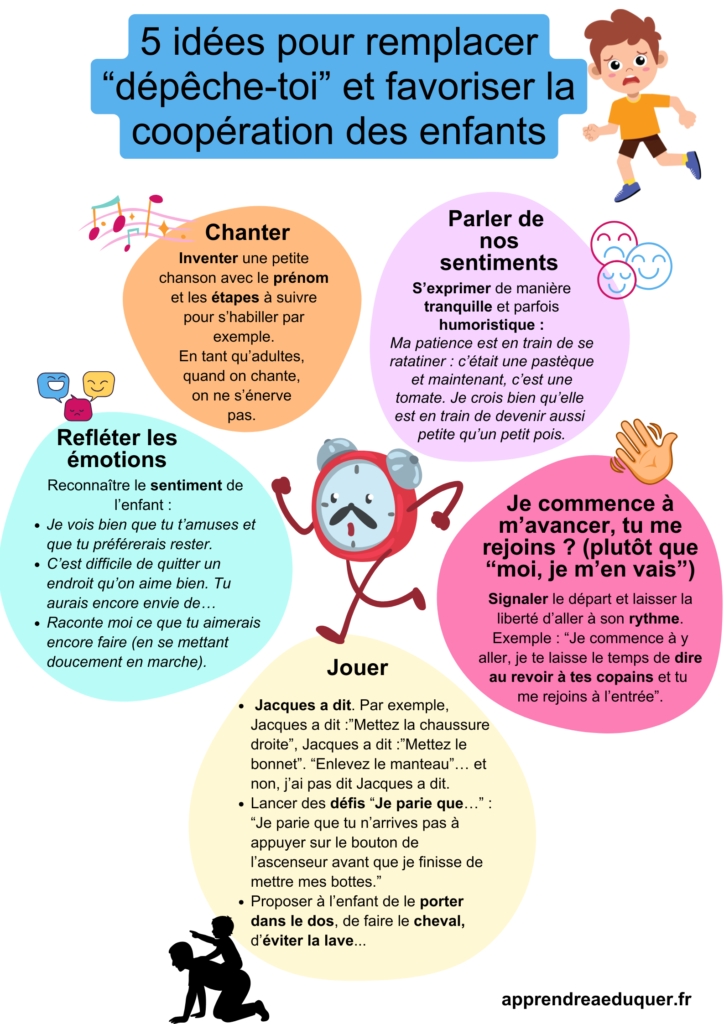
Reflecting feelings and naming your own
Adults also dislike leaving places they enjoy — a warm bed, for instance. We know we must get up eventually, but we prefer to do it gently rather than be yanked out. The same holds for children.
Name the feeling: "I can see you're having fun and would rather stay. It's hard to leave a place you like. Tell me what you'd still like to do," while slowly starting to move. This empathetic listening defuses many crises before they start, much like the patience needed when you transmit love of reading over years rather than days.
You can also state your own feelings calmly and sometimes humorously: "My patience is shrinking — it was a watermelon, now it's a tomato, and I think it's becoming a pea." Expressing what you feel, and what you need, without blame gives the child information instead of pressure.
Building a calmer routine over time
None of these swaps work every single day, and that is fine. The point is to widen your repertoire so "hurry up" is no longer the default. Children who hear cooperation instead of commands tend to cooperate more, because they are not busy defending their pace.
Respect for a child's rhythm does not mean abandoning your plans. It means announcing transitions, offering choices, and letting the child close their own activity. Over weeks, these small habits shape a household where motherhood changes the daily rhythm rather than the clock ruling it. The same patience pays off when you introduce children's knives and let them help at their own pace.
If you want more playful tools for filling waiting moments, family games and shared stories are reliable allies. A little humor, a song, a countdown — these are the everyday building blocks of a calmer start to the day.

My hands-on take
I first tried the song trick with a child who was always last to get ready, and I was surprised by how quickly the scolding stopped being necessary. Once the steps had a melody and her name in it, she started moving through them on her own, and I stayed calm because I was singing rather than nagging.
The question "what do you need before we go?" has become my default at the playground. Sometimes the answer is one more slide, sometimes it is simply a hug. Either way, I get a warning instead of a meltdown, and we usually leave talking about something else entirely. The timer sits on our shelf and gets used most mornings — not perfectly, but often enough to make the day start softer.
Frequently asked questions
Why does "hurry up" backfire with young children?
Young children live in the present and cannot yet plan around a schedule, so the command feels abrupt and confusing. It often triggers resistance or distress rather than speed.
Do timers really help toddlers transition?
Yes, because they make time visible. A child who can watch a countdown or a moving clock hand understands what is coming instead of being surprised by it.
Is racing always a good idea?
It works well in short bursts, but use it in moderation. Add humorous variants so the game stays playful rather than turning every routine into a competition.
What if my child still refuses to leave?
Acknowledge the feeling first, then offer one small closing ritual and start moving slowly yourself. Waiting calmly nearby often works better than repeating the demand.
Product Reviews
 Best Toys for Dogs With High Prey Drive |
Best Outdoor Toys for 3-4 Year Olds |
Best Outdoor Toys for 6 Year Olds |
Best Harness for Poodle |
Best LEGO Sets for Adults |
Best Travel Toys for 4 Year Olds on Airplane |
Best Toy Stores in Washington DC |
Best Potty Training Toys |
Best Toys for Tripod Dogs |
Maillot equipe de france







