


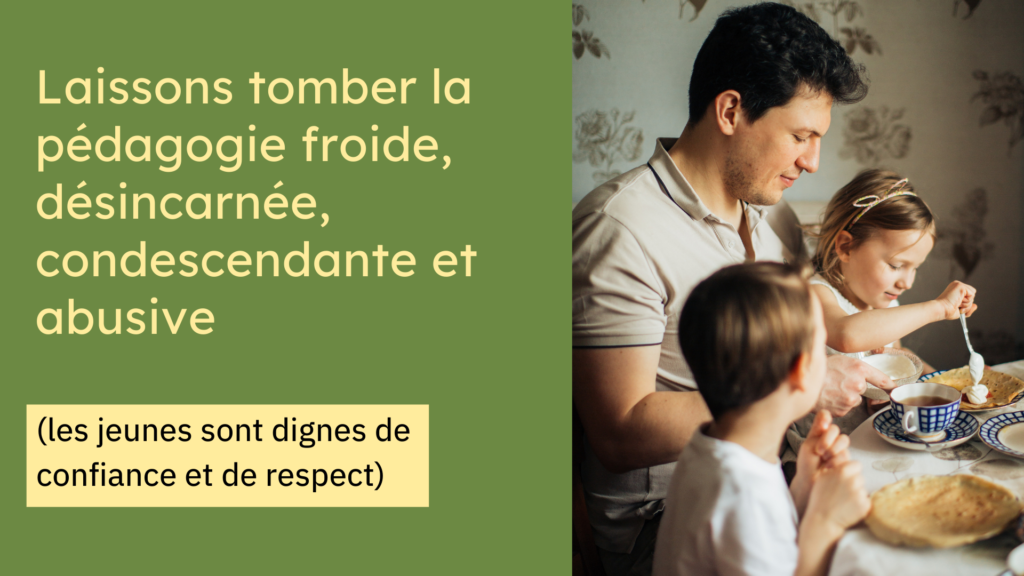
Respectful parenting starts with a simple but radical idea: children and teenagers are worthy of trust and respect, exactly as they are right now. Too often, adults slip into a cold, disembodied, condescending tone with younger humans, a tone they would never use with a friend.
This article explores why that inauthentic language quietly signals "you are not an equal person" and how small shifts in the way we speak can restore genuine dialogue. It draws on the work of family therapist Jesper Juul, who argued that children are competent and deserve the same dignity we grant adults.

You will find practical openers, a way to pause before speaking, and a reminder that honest opinions are not an abuse of power. None of this requires special tools, only the willingness to treat a child as a person.
Quick takeaways
- Children and teens deserve the same dignity, trust and respect as adults.
- Ask: would I speak this way to my best friend? If not, change your words.
- Replace pedagogical lectures with honest "I" statements about your feelings and needs.
- Use openers that invite a choice instead of imposing a verdict.
- A sincere opinion influences without ordering, manipulating or reproaching.
- Offer a loving, empathetic rearguard presence when a child stumbles.
Why Adults Use a Different Voice With Children
Jesper Juul observed that the traditional adult gaze on children leads us to adopt a language we would never use with another adult. Its hallmarks are being "sufficient, condescending and intrusive." Adults often address children by smothering them, with fake kindness, or critically and aggressively.
What this inauthentic language hides is a deep-rooted belief: that children are not yet people on equal footing with adults in terms of dignity, rights, respect, intelligence and the capacity to form an opinion. Understanding how children understand the world helps us see how quickly they read that hidden message.
Juul offers a simple test whenever we doubt whether our words are respectful. Ask yourself: if I had this conflict with my best adult friend, would I express myself this way? If not, what would I say instead? That question alone pushes us toward a more constructive, personal exchange between human beings who deserve respect.
Swap the Lecture for Personal Expression
We often trade personal expression, meaning our emotions, values, needs and the non-violent statement of what has harmed our integrity, for grand pedagogical speeches. Juul insists that even with very small children, an adult can speak gently without a teaching statement, as long as it concerns a personal relationship between human beings.
This is the heart of conscious parenting: noticing the urge to lecture and replacing it with an honest "I" statement. Instead of a moral lesson about tidiness, you might say plainly that you feel overwhelmed by the mess and need help. The child hears a real person, not a rulebook. Much like the honest stories in movies about real motherhood, this kind of openness rings true.
A Pause Before You Speak
The goal is respect for the sovereignty of another person, whatever their age. Juul suggests creating a pause in the dialogue to let the respectful nature of the exchange emerge: is this an invitation or an aggression? That pause can take the form of a question, a proposal, or simply a breath before the automatic correction, just as celebrities after giving birth remind us that real bodies and real feelings deserve honesty rather than performance.
| Situation | Cold pedagogy says | Respectful dialogue says |
|---|---|---|
| You disagree with a choice | "That's a stupid idea, do as I say." | "I have an opinion, do you want to hear it?" |
| You are worried | "You'd better be home on time." | "I need to know you're safe, can you share your times?" |
| You dislike a friend | "That friend is a bad influence." | "They're not my cup of tea, and I'm glad you're happy." |
| The child refuses to talk | "We talk about this right now." | "You seem worried, do you want to talk?" |
| A decision goes wrong | "I told you so." | "I'm here to listen if you need me." |
Openers That Invite Instead of Impose
A respectful pause can be built with simple sentence starters. Try "I have an opinion on this, do you want to hear it?" or "I feel I need to talk to you about this behavior, are you ready to listen if I do it now?" These phrases hand the child a genuine choice.
Other openers include "I'm worried about what's happening and I'd like to talk, can we do it now?" and "I'm listening to what seems reasonable to you, I'd like you to make a proposal." When safety matters, you can say you need to know they are safe and ask for departure and return times. This is far gentler than the managing child fatigue moments where a tired child shuts down and a lecture only makes things worse.
You can also respond authentically to questions while staying supportive: "Your friend isn't my cup of tea, and at the same time I'm glad to see you happy." Notice how this names your truth without withdrawing warmth.
A Sincere Opinion Is Not an Abuse of Power
Giving a sincere opinion is not an abuse of power. Children and teenagers have the right to know the adult's point of view so they can choose whether to integrate it into their decision, in the way that feels right for them. Juul speaks of "influence": we must be free to express ourselves to influence another, in adult-child as in adult-adult relationships, but without abusing power by ordering, manipulating or reproaching after the fact.
It is fundamentally important to place responsibility where it belongs: the adult's with the adult, and the young person's with the young person. This aligns with the spirit of parent education allies working together rather than pulling in opposite directions. Just as parents need to know what to expect during childbirth, they also need to know how to support their child's growing independence.
Even when a child makes a decision we consider foolish or harmful, we can choose to provide a "rearguard function." Juul defines this as offering loving, empathetic witnesses to the lives of children and teenagers, witnesses willing to manage their empathy according to whether it is needed, and according to whether they themselves feel the need to be useful. If you are planning a second child, these principles of respect and responsibility become even more valuable.

Letting Go Without Letting Down
Dropping cold pedagogy does not mean abandoning guidance. It means offering presence instead of control, and trust instead of surveillance. When you stop lecturing, you often discover that a child will come to you on their own, precisely because you are no longer a judge.
This shift takes patience, especially in seasons when family life feels stretched. If you are preparing for a new baby, the same respectful tone will help an older sibling feel like a person rather than a problem, much as you might reflect on love for baby growing alongside your attention to the child already here. It also helps to remember that children are whole people from the very start.
Over time, the rearguard function becomes a habit: you stay available, you listen without steering, and you let the young person own their choices. That is not permissiveness. It is the quiet confidence that a respected child grows into a responsible adult.

My hands-on take
I started trying the "would I say this to my friend?" test during homework battles, and it was humbling. My usual line was a clipped "Just focus," which I would never snap at a colleague. The first time I said instead, "I'm getting tense about this, can we take a short break and try again?", my child looked up, surprised, and actually agreed.
What struck me most was how often I reached for a mini-lecture when I was really just anxious or tired. Naming that out loud, briefly and without drama, changed the temperature of the room. It is not a magic fix, and I still slip into the old voice some evenings. But the pause before speaking has become easier, and my child now offers their own proposals more often, which tells me the respect is landing.
Frequently asked questions
Does respectful parenting mean never setting limits?
No. Respect means speaking honestly and placing responsibility correctly, not abandoning guidance. You can state your needs and safety concerns clearly while still inviting the child's input and choice.
What if my child refuses to listen?
Accept the refusal and respect the limits of their private life where you can. You can name your worry and stay available, then return to the conversation when they feel ready rather than forcing it.
How do I give an opinion without being controlling?
Offer it as an opinion and let the child decide how to use it. Avoid ordering, manipulating or reproaching afterward, and keep the responsibility for the decision where it belongs.
Is this approach only for older children?
It applies even with very small children. As long as the exchange concerns a personal relationship between human beings, an adult can speak gently without a teaching statement.
Product Reviews
 Best Toys for Dogs With High Prey Drive |
Best Outdoor Toys for 3-4 Year Olds |
Best Outdoor Toys for 6 Year Olds |
Best Harness for Poodle |
Best LEGO Sets for Adults |
Best Travel Toys for 4 Year Olds on Airplane |
Best Toy Stores in Washington DC |
Best Potty Training Toys |
Best Toys for Tripod Dogs |
Maillot equipe de france







