


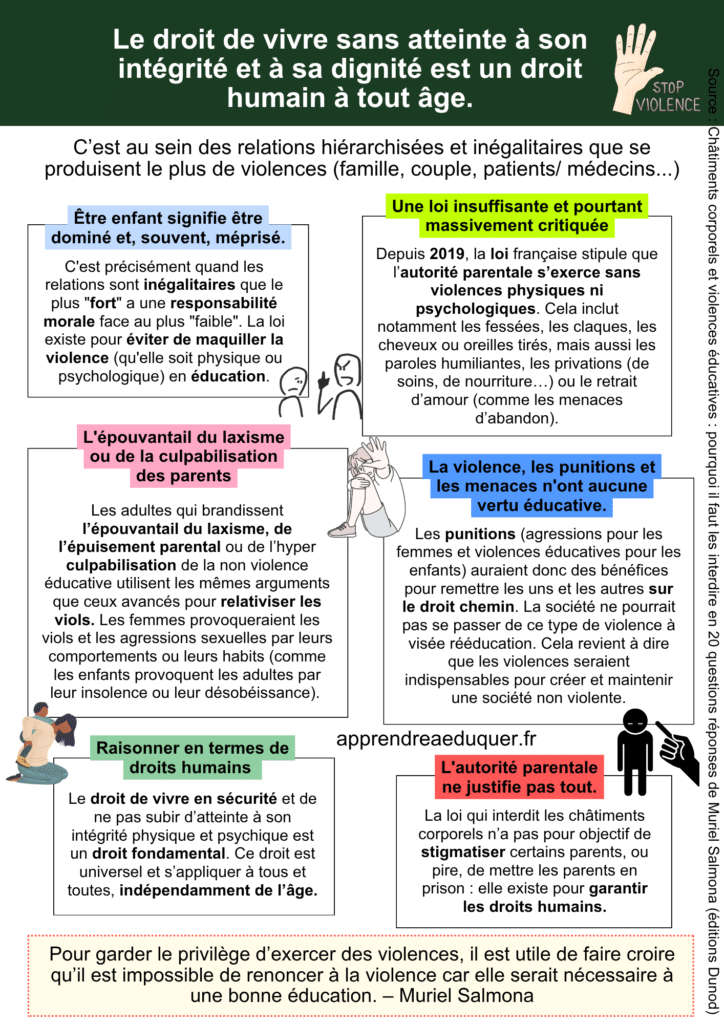
Parental authority does not justify everything, and since 2019 French law has been clear: parental authority is exercised without physical or psychological violence. That covers spanking, slaps, pulled hair or ears, but also humiliating words, deprivation of care or food, and withdrawal of love such as threats of abandonment.
Some adults, including parents, teachers and even psychologists, worry that this law harms families. They argue parents are made to feel guilty, can no longer exercise authority, and face too much state interference. On one side they fear permissiveness and "tyrant" children; on the other they claim non-violence puts an unbearable burden on parents and leads straight to burnout.

Quick takeaways
- Parental authority is exercised without physical or psychological violence.
- Humiliation, deprivation and threats of abandonment count as violence.
- The "I survived it" argument also excuses assault, which shows its weakness.
- Corporal punishment mostly stems from parental exhaustion, not educational virtue.
- Parenting advice can add to mothers' mental load; weigh benefit against cost.
- Limits and warmth can coexist without hitting or shaming.
The scarecrow of permissiveness and parental exhaustion
The same people who defend the right to punish would be indignant if the law failed to protect them from violence. No adult would accept being hit at work after a delay or a mistake, being locked in an office or a closet for disrespect, or being shouted at for breaking an object. The right to live without attacks on your integrity and dignity is a human right at any age.
Psychiatrist Muriel Salmona points out that to keep the privilege of exercising violence, it helps to make people believe it is impossible to give it up, because violence would supposedly be necessary for good education. A law banning corporal punishment is not meant to stigmatize parents or send them to prison; it exists to guarantee human rights and draw a clear line between what is acceptable and what is not.
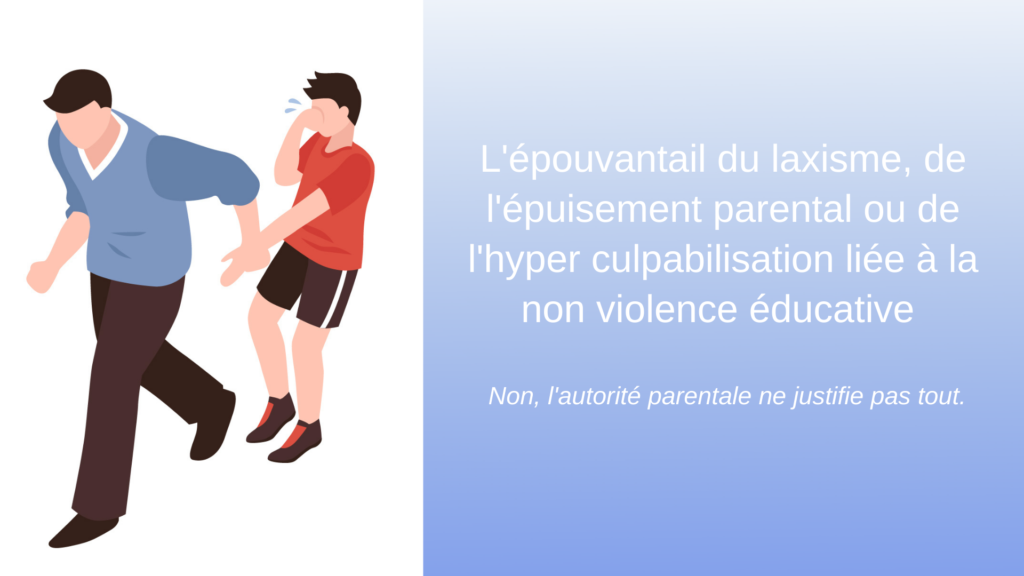
Arguments that echo the relativization of sexual violence
Salmona notices that adults raising the scarecrow of permissiveness, parental exhaustion or hyper-guilt use the same arguments once used to relativize rape. Women would provoke assaults through their behavior or clothes, just as children would provoke adults through insolence or disobedience. Punishment would then have benefits, putting both back on the right path, as if society could not do without this re-educative violence.
The "I survived it" reasoning applies here too. Many people defend slaps, forced isolation or blackmail by saying they went through it and did not die. That same logic can be applied to assault and rape, which shows how weak the argument is. It can happen that a slap slips out, or that an exhausted parent thinks shouting is the only way to be obeyed. That is not the same as feeling overwhelmed and apologizing to the child, versus claiming a right to coerce children.
| Situation | Violent or shaming | Respectful alternative |
|---|---|---|
| Child breaks an object | Shouting, slapping | Name the rule, invite repair |
| Child is insolent | Humiliating words | Calm limit, later discussion |
| Child disobeys at bedtime | Threats of abandonment | Firm, warm routine |
| Parent loses control | Claiming a right to coerce | Step back, apologize |
| Child refuses affection | Forced kiss or hug | Offer choice, respect consent |
Parental exhaustion is real, and so is the flood of advice
Research on parents shows that corporal punishment is mostly due to the parent's irritation, exhaustion or powerlessness rather than to any educational virtue attributed to spanking or humiliation. That tiredness and lack of perceived alternatives are real, but the movement for non-violent parenting is not their source. Political, cultural, social, psychological and economic factors all play a part.
Parenting advice can also add to the load carried by women, who are more exposed than fathers to recommendations about parenthood. Beyond mental, emotional and domestic work, the educational load means reading books on child psychology, thinking about daily organization, and caring for everyone's mental health. Taking mothers' physical and psychological fatigue seriously matters, and non-violent parenting must not become a burden or a factor in maternal exhaustion.
A simple question before adopting any advice
When an idea about parenting speaks to you, ask yourself whether the ratio of mental load to benefit is worth it. If the answer is no, you are allowed to let it go. You can also look at how to improve self improvement in children without turning every day into a lesson, or borrow gentle routines such as removing the diaper at the child's own rhythm rather than under pressure.
Respectful authority in everyday family life
Non-violent education does not mean giving up limits. It means setting them without hitting, humiliating or threatening abandonment. A parent can be firm about bedtime while staying warm, and can name a rule without withdrawing love. This is where tools matter: learning to greeting without kisses that respects a child's consent, for instance, shows that respect and authority can coexist.
Daily life offers many chances to practice this balance. Answering questions about the body calmly, as in talk about masturbation, or choosing gifts that leave room for imagination, like these Christmas gifts for children aged five and up, keeps the focus on connection rather than control. Even a Waldorf method approach or a housework by age routine can support cooperation instead of coercion.
Understanding development helps too. Knowing how a hip sprain is handled, or what science says about whether intelligence inherited from the mother, reminds us that children are not small adversaries. And when you plan family time, practical details like calculate the delivery date or safe Foods rich matter as much as discipline choices.

My hands-on take
I remember a evening when my child spilled a whole glass of milk right after I had cleaned the floor. My first reflex was to raise my voice, and I did. What stayed with me was not the spill but my child's face, small and closed. I apologized, we wiped it up together, and I noticed how much lighter the room felt afterward.
Since then, I try to pause before reacting. It does not always work, and I am not aiming for perfection. What helps me is remembering that limits can be firm without being cruel, and that my own exhaustion deserves care too. When I am rested, I am a calmer parent, and that is the real foundation of authority.
Frequently asked questions
Does non-violent education mean no rules?
No. It means setting clear limits without hitting, humiliating or threatening abandonment. Firmness and warmth can coexist.
Is spanking ever justified by parental authority?
Since 2019 French law says parental authority is exercised without physical or psychological violence. The right to safety and dignity applies at any age.
Why do parents feel guilty about this law?
Many parents fear being judged or losing authority. The law aims to protect children's rights, not to stigmatize families.
What if I lose my temper and shout?
Occasional overwhelm happens. What matters is recognizing it, apologizing to the child, and not claiming a right to coerce.
Product Reviews
 Best Toys for Dogs With High Prey Drive |
Best Outdoor Toys for 3-4 Year Olds |
Best Outdoor Toys for 6 Year Olds |
Best Harness for Poodle |
Best LEGO Sets for Adults |
Best Travel Toys for 4 Year Olds on Airplane |
Best Toy Stores in Washington DC |
Best Potty Training Toys |
Best Toys for Tripod Dogs |
Maillot equipe de france







