


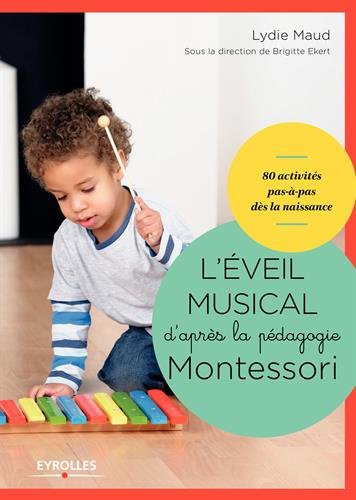
Montessori musical awakening is the focus of a boxed set built around 80 step-by-step activities that guide children from birth to age 12 through sound, rhythm and listening.
The booklet is organised into six large parts: musical activities from birth to 18 months, from 18 months to 3 years, from 3 to 6 years, and from 6 to 12 years, followed by language activities and activities for listening to works from the repertoire.

The activities vary in nature, mixing free play, sound games with rules and self-contained activity trays. The author, a musician who has worked in schools, draws on Montessori pedagogy, the Dalcroze approach to music teaching and body work to shape her proposals.
Quick takeaways
- Six sections follow the child from birth to age 12, plus language and repertoire listening
- Activities mix free play, sound games with rules and autonomous trays
- Montessori inspiration combined with the Dalcroze approach and body work
- Read the proposals first if you are a beginner; photos and cards guide you
- Modest equipment needed, with tutorials for making instruments at home
- Suitable for parents, teachers, childminders and early childhood staff
What the box contains and how it is organised
The heart of the set is a booklet whose six sections follow the child's development rather than a fixed curriculum. Each stage offers activities suited to what a child can actually do at that age, so you are never pushing a toddler into a lesson designed for a school-age pupil.
Activities come in three flavours: free exploration, sound games with simple rules, and autonomous activity trays the child can pick up alone. This variety keeps the material interesting over months rather than weeks. If you want to build a wider play shelf, our toys for newborns and airplane toys round-ups show how small, quiet objects fit into the same rhythm.
Everything is designed to be understood by a non-musician. That matters, because many parents open a music book and quietly close it again when the notation starts.
Why the author adapted her teaching practice
Lydie Maud built these activities from her experience as a musician working in schools, combining Montessori inspiration with the Dalcroze approach and a strong emphasis on body work. She gives musical education a central role in creativity, in mobilising attention and in building personality.
That is why the proposals are not just about recognising notes. They invite children to move, to listen with their whole body and to respond physically to what they hear. The same idea runs through our guide to language development toys, where sound and rhythm support early speech.
Getting comfortable before you start
If you are new to this, read the activity proposals before sitting down with your child. The activities remain very accessible, and the many photos of children in action, the material shots, the support cards and the introductory explanations do much of the teaching for you.

| Age band | What the activities focus on | What you need on hand |
|---|---|---|
| Birth to 18 months | Listening, gentle sounds, body contact | Soft voice, small bells, lullabies |
| 18 months to 3 years | Sound games, naming, simple rules | Tambourine, shakers, cards |
| 3 to 6 years | Rhythm, autonomous trays, expression | Montessori bells, metronome |
| 6 to 12 years | Repertoire listening, vocabulary, emotion | Cards, CD, homemade instruments |
Materials you will need (and what you can make)
A little equipment is required: a metronome, Montessori bells and a few affordable instruments such as tambourines, cymbals and small bells. Nothing is very expensive if you have to buy it, and the book includes several tutorials for making instruments at home.
Homemade shakers and drums are often the ones children return to most, because they helped build them. Keep the collection small and rotate it so novelty does the work. Our toys under $20 list is a sensible starting point if you want to add pieces gradually.
For families who prefer to shop in person, browsing a local store helps you judge the sound of a tambourine before buying. Our Fort Worth toy stores and Jacksonville toy stores guides give a sense of what to look for.
Who the box is for
The set addresses parents, teachers, activity leaders, early childhood specialists, nursery nurses and childminders. In other words, it works both at home and in a classroom, which is rare for a parenting resource.
If you are unfamiliar with musical notions, you will come away from reading and handling the box with new knowledge and a sharper musical ear. That learning curve is part of the appeal. Parents who want to strengthen communication at home may also enjoy our communicate effectively advice, since listening is the shared foundation.
Teachers can lift a single tray activity into a session; parents can use one game before bedtime. The format is flexible by design.
The vocabulary cards and emotional listening
The box includes cards that carry the musical vocabulary and serve as support for listening sessions. Children are invited to grasp the auditory, and even kinaesthetic, characteristics of musical feelings.
The author suggests starting with listening that matches feelings a child already knows well, such as a children's lullaby for a calm and gentle character. From there, the vocabulary grows alongside the child's emotional range.
Beyond auditory and artistic education, these activities feed emotional intelligence, physical expression and the ability to go beyond words to understand emotions. Our article on magical characters touches on a similar question of how children read the world.
Music as education for peace
Language and music both developed to become functional in every culture. Music helps human beings share more love, understanding and happiness, and in that sense it takes part in education for peace.
That is a large claim for a box of bells and cards, but it starts small: a child who learns to listen carefully to a tambourine may listen more carefully to a sibling. Our piece on big brother's jealousy shows how much sibling dynamics benefit from that kind of attention.
The box, with its CD, is available in bookshops, cultural centres and online. Treat it as a reference you return to rather than a course to finish.

My hands-on take
I tried a handful of these ideas before reading the whole booklet, and the difference was obvious. The sessions that worked best were the ones where I had already set out the tray and practised the game alone once. When I improvised, my child lost interest in under a minute.
The other lesson was volume. I assumed more instruments meant more engagement, but a single tambourine and one familiar lullaby held attention far longer than a basket of noise. I now keep most of the material in a cupboard and bring out one thing at a time, which also makes tidying up part of the ritual. If you are starting out, pick one activity, read it twice, and let the child lead from there.
Frequently asked questions
Do I need to be a musician to use this box?
No. The activities are described as accessible to non-musicians, and the photos, cards and introductory explanations carry most of the teaching. Reading ahead before starting with your child makes the first sessions much smoother.
How much equipment do I have to buy?
Only a modest amount: a metronome, Montessori bells and a few inexpensive instruments such as tambourines, cymbals and bells. The book also includes tutorials for making instruments at home, which keeps costs down.
Can teachers use it as well as parents?
Yes. The set is written for parents, teachers, activity leaders, early childhood specialists, nursery nurses and childminders, so the same activities work in a classroom or a living room.
What does the CD add?
The audio supports the listening activities, including the repertoire section and the emotion-based listening work with the vocabulary cards. It saves you from hunting for suitable recordings yourself.
Product Reviews
 Best Toys for Dogs With High Prey Drive |
Best Outdoor Toys for 3-4 Year Olds |
Best Outdoor Toys for 6 Year Olds |
Best Harness for Poodle |
Best LEGO Sets for Adults |
Best Travel Toys for 4 Year Olds on Airplane |
Best Toy Stores in Washington DC |
Best Potty Training Toys |
Best Toys for Tripod Dogs |
Maillot equipe de france







