


This Montessori reading workbook is built around a simple idea: children should reach real words quickly, because reading something meaningful is what feeds their curiosity.
Written by a Montessori educator, it offers a structured progression for children roughly aged 3 to 7, moving from two-letter words to short texts. The activities stay deliberately simple, and the adult's role is to prepare the material and then step back.

Below you'll find what the book contains, how each double page works, and how to use it at home without turning it into homework.
Quick takeaways
- Phonetic words without spelling traps let young children read real words early.
- Each double page targets one skill, from two-letter words to short texts.
- Parent notes and extra activity ideas accompany every spread.
- The book explains how to make a movable alphabet and use the three-period lesson.
- It is designed for free choice, not as homework or remedial support.
- Best used alongside read-aloud time, conversation and hands-on play.
Why phonetic words come first
In Montessori practice, early reading starts with phonetic words: words with no spelling traps, where each letter makes its usual sound. Examples include short, concrete nouns a young child already knows by ear. Because nothing irregular gets in the way, the child can decode the word alone and feel genuinely successful.
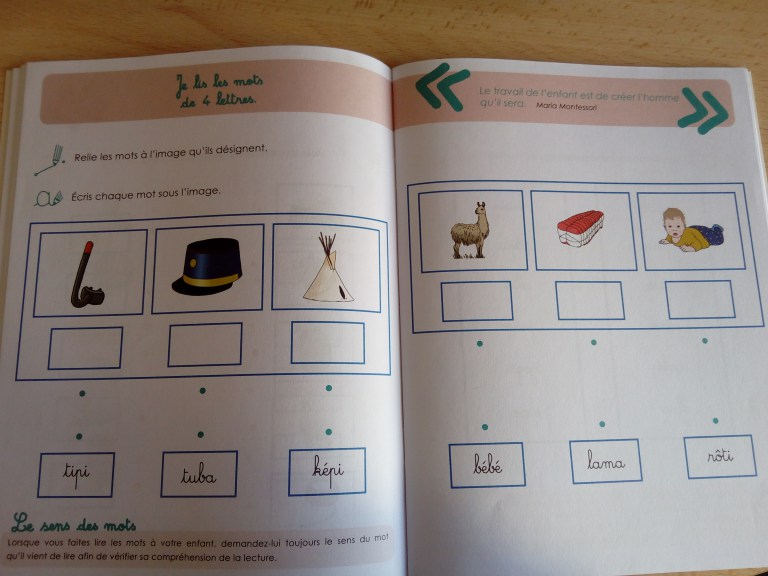
The workbook follows that logic throughout. Children match written words to pictures, do silent dictations with letter cards, and write whole words of two, three and up to four letters without any risk of making a mistake. The satisfaction of finishing a real word matters more here than speed or volume.
This approach pairs well with hands-on play, which is why many families keep a small basket of toys for three year olds nearby so the child can move between reading and manipulating objects. Movement and touch keep attention alive far longer than a worksheet alone.
What the introduction explains to parents
An opening section sets out the main principles of the Montessori spirit: natural development, attention to the child's needs, respect for concentration and silence, respect for each child's own pace, kindness, and learning through manipulation. Reading it first helps adults adjust their expectations before opening the first activity page.
The author is clear that these pages are not intended as remedial support or homework. The aim is to let the child spend as much time as they want on a page, or lose interest and come back later. That freedom is part of the method, not a loophole.
This mindset echoes wider questions parents ask about behaviour, such as whether children really are so cruel at six or simply still learning to regulate themselves. Observing rather than correcting is a habit worth building early.
| Stage | Child's activity | Skill built |
|---|---|---|
| Two- and three-letter words | Composing words with letter cards | Sound blending |
| Two- and three-letter words | Reading words and short sentences | Decoding |
| Four-letter words | Composing, then reading | Longer blending |
| Four-letter words | Reading sentences | Fluency |
| Simple texts | Reading and understanding | Comprehension |
| Throughout | Matching words to pictures | Vocabulary and meaning |
How each double page is organised
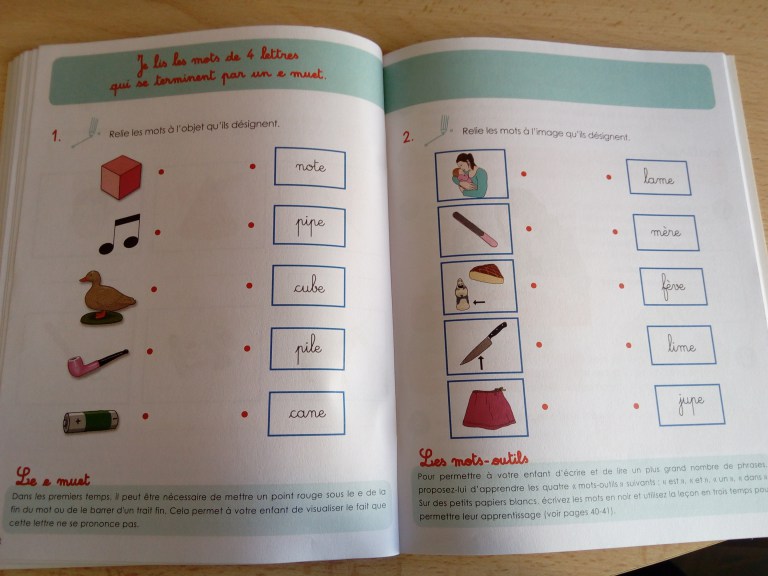
Every double page targets one skill. The sequence starts with composing two- and three-letter words, then reading those words, then reading sentences made of them. Next come four-letter words, followed by sentences with four-letter words, until the child reads and understands a short text built from simple words.
Activities vary to avoid fatigue: writing under pictures with or without a model, linking objects to the words that name them, reading a word list, and reading a sentence to connect it with the right drawing. Notes for parents or teachers sit alongside each spread, plus extra ideas such as making little booklets or playing mime and "I read, I find" games.
For children who need to burn energy between two spreads, a few outdoor toys can reset concentration nicely. Short sessions, repeated often, work better than one long sitting.

Building a movable alphabet and the three-period lesson
The book explains how to make your own movable alphabet, the set of individual letters the child arranges to build words before writing them by hand. It also walks through the three-period lesson, a classic Montessori sequence used to teach common sight words: naming, recognising, then recalling.
These two tools are what turn a workbook into an activity. The child physically builds a word, checks it against a picture, then reads it aloud. The page becomes a record of the work rather than the work itself.
Quotes from Maria Montessori appear throughout the booklet, so the philosophy sinks in as you go. If you want to extend the same hands-on logic to other skills, foam block toys offer open-ended building that supports spatial reasoning and fine motor control.

Using the workbook at home without pressure
Leave the book accessible and let the child choose it. A short invitation works better than a schedule, and stopping while things are still going well protects the desire to return. If a page frustrates your child, put it away and revisit it in a few weeks.
Read the parent notes before you present a new spread, and prepare any letter cards in advance so the child never waits. Keep the workspace tidy and limited to what the page needs.
Reading progress is uneven, and that is normal. The same patience applies to other milestones, whether you are researching martial arts or wondering about natural ways during a later pregnancy. Children rarely follow a straight line, and pressure tends to slow them down rather than speed them up.

Choosing the right moment and the right materials
This workbook suits families who want a structured but gentle path, and children who already show interest in letters and sounds. It is not a substitute for spoken conversation, stories read aloud, or free play, all of which feed vocabulary and comprehension.
Think of it as one element in a richer environment. A home where books are visible, where adults read, and where the child can choose quiet activities will do more for literacy than any single purchase. The workbook simply gives that environment a clear sequence to follow.
If you are building a small learning corner, consider how it sits alongside other interests, from toys about cars to storing finished LEGO sets neatly so the space stays usable. A calm, ordered room supports concentration more than a crowded one.
My hands-on take
I tried this kind of workbook with my own child at around four and a half, and the first thing I learned was to stop scheduling it. The days I left it on the shelf and said nothing were the days it got picked up. When I sat down with a plan, interest evaporated within minutes.
The movable alphabet was the real turning point. Cutting the letters out together took an afternoon, and after that the pages made sense to my child because the words could be built and rebuilt before being written. My advice: prepare the materials first, present one page, then get out of the way. If a spread causes frustration, close the book without comment and try again in a few weeks. That single habit did more for our reading sessions than any reward chart.
Frequently asked questions
What age is this workbook for?
It is designed for children roughly aged 3 to 7, following a progression from two-letter words to short texts. Younger children may simply compose words with letter cards, while older ones read sentences and texts.
Is it a homework book?
No. The author states clearly that it is not meant as remedial support or homework. The child should be free to spend as long as they like on a page, or set it aside and return later.
Do I need to buy a movable alphabet?
Not necessarily. The book explains how to make one yourself, along with the three-period lesson for teaching common sight words. Homemade letter sets work perfectly well.
Can it replace reading aloud to my child?
No, and it is not intended to. It works best alongside stories, conversation and free play, which build the vocabulary and comprehension that decoding alone cannot provide.
Product Reviews
 Best Toys for Dogs With High Prey Drive |
Best Outdoor Toys for 3-4 Year Olds |
Best Outdoor Toys for 6 Year Olds |
Best Harness for Poodle |
Best LEGO Sets for Adults |
Best Travel Toys for 4 Year Olds on Airplane |
Best Toy Stores in Washington DC |
Best Potty Training Toys |
Best Toys for Tripod Dogs |
Maillot equipe de france







