


Maternal burnout is what happens when the endless responsibilities of mothering slowly wear down a woman's entire reserve of energy, until the tank is empty rather than simply low.
Drawing on the work of psychologist Violaine Guéritault, who studies the emotional and physical fatigue of mothers, this article explains how burnout develops in three recognizable stages, why it is not a personal failing, and how understanding the stress behind it can help you protect yourself.

If you have ever felt ashamed of being a stressed mom, this is for you: mothering is real work, and naming its risks is a sensible long-term investment.
Quick takeaways
- Maternal burnout builds slowly as caregiving drains your whole energy reserve.
- Guéritault describes three stages: exhaustion, distancing, and denial of accomplishments.
- Burnout comes from the interaction between you and your environment, not from weakness.
- Being a stressed mom is nothing shameful and should not be minimized.
- Mothering is a job in its own right, with real risks worth taking seriously.
- Recognizing stress factors early is how you protect yourself and recover.
What Maternal Burnout Really Is
Maternal burnout, sometimes called mom burnout, appears when maternal responsibilities gradually consume the whole of a mother's energy capital. It is not a sudden collapse but a slow wearing-down, which is why it can go unnoticed for a long time.
Guéritault points out that the burnout model, first developed for professional settings, fits what thousands of mothers live through every day. The daily stress a mother meets is the raw material of that process, and it accumulates quietly.
Understanding where your stress comes from, and learning to recognize its effects, is how you become able to protect yourself and to come out of it. That is the practical heart of her message.
The Three Stages of Exhaustion
Guéritault describes three stages in maternal burnout. The first is emotional and physical exhaustion: a deep tiredness that rest and a quiet weekend no longer seem to touch.
Stage two: distancing
The second stage is depersonalization, or distancing. A mother may feel detached from her children, her partner or herself, going through the motions while emotionally stepping back. This distance is a symptom, not a sign of not loving your family.
Stage three: doubt and decline
The third stage involves a denial of past, present and future accomplishments, alongside a drop in productivity. Everything achieved seems worthless, and the sense of competence crumbles. Recognizing these three stages early makes a real difference, much as noticing the early signs covered in neurological problems helps parents act sooner rather than later.
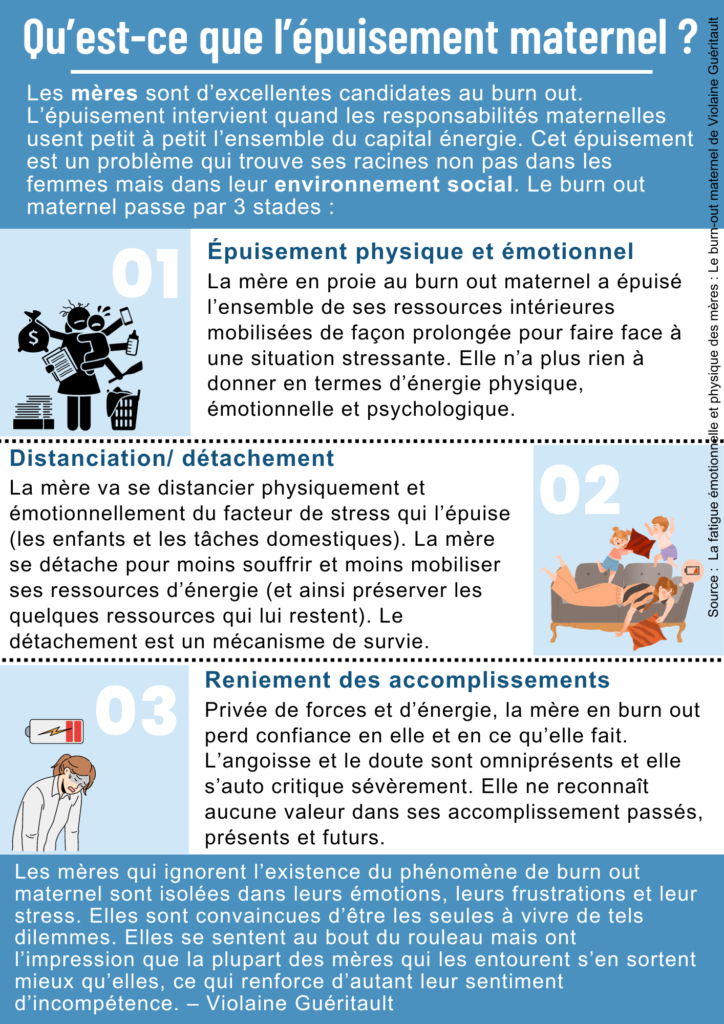
| Stage | What it looks like | Useful response |
|---|---|---|
| Emotional and physical exhaustion | Deep tiredness that rest no longer fixes | Protect sleep, ask for practical help |
| Depersonalization or distancing | Feeling detached from children, partner or self | Name the distance, reconnect gently |
| Denial of accomplishments | Past, present and future achievements feel worthless | Track small wins, seek support |
| Lower productivity | Daily tasks feel heavier and slower | Reduce load, share responsibilities |
| Prevention | Understanding your stress factors | Recognize effects and act early |
Burnout Is Not a Personal Failure
Burnout is not the result of an individual's inability to cope with the constraints around her. It comes from a complex dynamic emerging from the interaction between that person and the environment that shapes her in part.
Knowing your stress factors better means understanding them better, and understanding yourself better too. Being a stressed mom is nothing inadmissible, shameful or unspeakable. Our culture, as much as mothers themselves, needs to stop minimizing the difficulties tied to maternal responsibilities.
Being a mother is a job in its own right, and ignoring its risks and dangers can prove a very bad calculation in the long run. This is close to the spirit of parenting from love, where fear-driven pressure gives way to a calmer, more sustainable way of accompanying children.
Everyday Stress Factors to Watch
Stress in motherhood rarely comes from one dramatic event. It builds from the ordinary load: broken nights, constant availability, the mental list that never switches off, and the pressure to appear effortlessly capable.
Practical friction adds to it. Feeding, bathing and outings each carry their own small demands, and even simple routines deserve attention, as with newborn bath routine or the tips in eating out baby. Recognizing these everyday sources is the first step toward reducing them.
It also helps to notice how much of your day is spent managing things rather than being present. Small, honest adjustments, such as knowing pregnancy while breastfeeding questions or how cloth diapers errors add avoidable stress, can lighten the mental load more than grand resolutions.

Protecting Yourself Before You Break
Prevention starts with taking your own fatigue seriously instead of waiting for the third stage. Naming what drains you, and asking for concrete help with it, is not weakness but maintenance.
Rest, shared responsibilities and realistic expectations are the practical levers Guéritault's framework points toward. Protecting your energy also means choosing calmer routines and calmer spaces, whether that is conscious parenting habits or simply building in quiet play with quiet toys so the house has slower moments.
Finally, remember that recovering from burnout is possible once you understand its sources. Reading about prevention, talking to other mothers and seeking support are all legitimate steps, and none of them make you a lesser parent.

My hands-on take
What struck me most when I first read about these three stages was how familiar the middle one felt. I remember a stretch of weeks when I was doing everything for my family and feeling oddly far away from all of it, as if I were watching myself from across the room. At the time I called it being efficient. It was really distancing, and naming it honestly was the first thing that helped.
What I have learned since is that small, boring adjustments matter more than dramatic ones. I started saying out loud which part of the day drained me most, and asking for that specific help rather than a vague "I need a break." I also stopped treating my own fatigue as something to hide. If you recognize yourself in these stages, you are not failing at motherhood; you are simply running on empty and deserve to refill.
Frequently asked questions
Is maternal burnout the same as ordinary tiredness?
No. Ordinary tiredness eases with rest, while maternal burnout is a gradual draining of your whole energy reserve that rest alone does not resolve. It develops through daily stress over time.
Does burnout mean I am a bad mother?
Not at all. Burnout comes from the interaction between a person and her environment, not from a personal inability to cope. Being a stressed mom is nothing shameful.
Can I recover from maternal burnout?
Yes. Guéritault's point is that understanding the sources of stress and recognizing their effects is what allows you to protect yourself and come out of it. Support and practical changes both help.
Why does the professional burnout model apply to mothers?
The model was first applied in workplaces, but Guéritault argues it fits what thousands of mothers experience daily. The same three stages appear, driven by everyday maternal stress.
Product Reviews
 Best Toys for Dogs With High Prey Drive |
Best Outdoor Toys for 3-4 Year Olds |
Best Outdoor Toys for 6 Year Olds |
Best Harness for Poodle |
Best LEGO Sets for Adults |
Best Travel Toys for 4 Year Olds on Airplane |
Best Toy Stores in Washington DC |
Best Potty Training Toys |
Best Toys for Tripod Dogs |
Maillot equipe de france







