


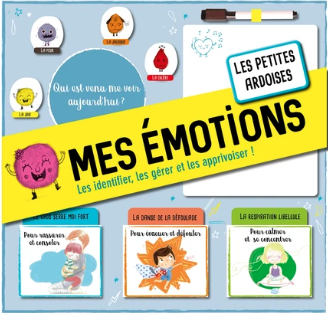
An emotions chart for kids is one of those simple tools that quietly changes the mood of a whole household. This particular one is a magnetic board that clips onto the fridge, and it has three parts working together: a set of magnets for the main emotions, a small writing slate with an erasable pen, and a set of cards offering calming strategies or ways to ask for what a child needs.
The board was created by Stéphanie Couturier, an author known for her books on children's emotions. What makes it practical is its position: on the fridge, at eye level and within reach, so nobody has to go looking for it in the middle of a difficult moment.

Quick takeaways
- The board has three parts: emotion magnets, a writing slate and strategy cards.
- Magnets cover fear, anger, sadness, joy, pride, jealousy and injustice.
- Cards are sorted into blue (comfort), red (release) and green (calm).
- It works both as a daily check-in and as support during a crisis.
- The slate lets children who struggle with words leave notes or drawings.
- A parent booklet explains the thinking behind the tool.
What is on the emotions chart
The magnets cover the feelings children most often struggle to name: fear, anger, sadness, joy, pride, jealousy and injustice. They are easy to recognise and easy to move, which matters because a child in the middle of a feeling should not have to work hard to use the tool. The idea is to slide the magnet that matches the current emotion into the centre of the circle.
Around that circle sit the other two parts. The slate takes messages or drawings, and the card pockets hold short activities. If you are building a calm corner at home, this kind of visual support pairs well with the manage stress habits you are already trying to model as a parent. The whole kit is deliberately low-tech, and that is part of its charm.

How families use it day to day
In daily use, the board works as a quick status report. When someone moves a magnet to the centre, everyone else knows immediately where that person stands emotionally. It is not only for crises: families also use it to celebrate a success or simply to mark the joy of spending time together.
The slate adds a second channel for children who find words hard. A short note or a quick drawing can carry a lot, and parents can answer later in the day. That back-and-forth is a small ritual of attention, similar in spirit to the everyday moments described in children memory tomorrow. A parent heading back to work after a break may find the morning note especially useful, much like returning to school can be eased by small routines.
Morning and evening routines
Some children use the slate before school to leave a message, and the parent replies during the day so the child can read it on returning home. It becomes a quiet check-in that does not require a long conversation, and it respects that the baby needs a calm corner of their own too.

| Part | What it holds | Best used for |
|---|---|---|
| Emotion magnets | Fear, anger, sadness, joy, pride, jealousy, injustice | Showing how you feel right now |
| Slate and pen | Short messages and drawings | Quiet check-ins, morning and evening |
| Blue cards | Comfort and reassurance | After a fright or a disappointment |
| Red cards | Physical release | When energy needs to come out |
| Green cards | Calming and focus | Before homework or bedtime |
The strategy cards and their three colours
The cards turn a feeling into an action. Thirty exercises are grouped by theme, and not all of them are for children alone; some work better with two people. The blue pocket is for reassuring and comforting, with ideas such as a kiss attack, a cuddle for everyone or building a den.
The red pocket is for releasing energy and letting off steam: a wild dance, drawing your fear, a cushion fight. The green pocket is for calming down and concentrating, with exercises like butterfly breathing, a balance game or drawing with your fingers. Think of it as a small menu of regulation options, much like choosing balanced barbecue sides: a little of each, depending on the appetite of the day.
A short booklet for parents adds some background theory, so the adults understand why the tool is built this way before asking a child to use it.

A real example of the board in action
A friend of the family came to sleep over and noticed the board straight away, asking what it was for, how it worked and what was on the cards. Later, the two children argued. They went to the fridge together, placed the anger and sadness magnets in the centre, then separated: one drew her anger in her room, the other calmed down on the sofa.
Ten minutes later they met in the living room, apologised and made up. The visiting child then came into the kitchen and asked whether they could put joy up now. That sequence is the whole point of the tool: it gives children a script to follow when feelings run high, and a way back to each other.
For parents, it is a reminder that a calm environment does a lot of the work, in the same way that a tidy, predictable space supports family health habits. Small visual cues reduce the number of times you have to explain something in the heat of the moment. Calm, hands-on moments like making homemade sweets can reinforce that same sense of connection.

Where the board fits and who it suits
The board suits families who want a daily ritual of sharing how everyone feels, and it also works as a support during a one-off crisis: anger, grief, fear or stress, jealousy, or the positive feelings worth naming out loud, like joy and pride.
It is not a cure for big emotions, and it will not replace a conversation. What it does is give children vocabulary and permission. If your child is still very young, the magnets alone are enough at first; the cards can wait. Families with several children often find that the board becomes a shared reference point, a bit like a foam block toys set that everyone knows how to use without instructions. Much like the Marie Kondo photo that sparked so much discussion, small everyday tools can quietly shape family life.
Older children may roll their eyes at first. Leave it up and use it yourself; children copy what they see far more readily than what they are told. During busier weeks, the Easter holidays tips can help you keep the ritual going without pressure.


My hands-on take
We came across this board by chance in a bookshop, and my daughter spotted it before I did. It now lives on the fridge, and the magnet in the centre of the circle tells me at a glance what kind of day she is having before she says a word.
What I did not expect was the slate. I have been left a furious note with a skull drawn underneath, and on another day a message telling me she adores me, surrounded by hearts. The gap between the two is the whole emotional range of a child in a single week. I answer in the afternoon so she can read my reply when she gets home, and that small exchange has become the part of the day I would miss most.
Frequently asked questions
What age is an emotions chart for kids suitable for?
It works best once a child can recognise and name basic feelings, which is usually around the preschool years and up. With younger children, start with the magnets alone and add the cards later.
Do we have to use it every day?
No. Some families make it a daily ritual, others only reach for it during a difficult moment or to celebrate something good. Both uses are valid, and the board does not lose its value if it sits quiet for a while.
What if my child refuses to use it?
Leave it in place and use it yourself in front of them. Children often come around once they see a parent naming their own frustration or joy without drama.
Can it help with arguments between siblings?
It can give a structured pause. Each child names a feeling, picks a card, and takes a few minutes apart before coming back together, which is often enough to break the heat of the moment.
Product Reviews
 Best Toys for Dogs With High Prey Drive |
Best Outdoor Toys for 3-4 Year Olds |
Best Outdoor Toys for 6 Year Olds |
Best Harness for Poodle |
Best LEGO Sets for Adults |
Best Travel Toys for 4 Year Olds on Airplane |
Best Toy Stores in Washington DC |
Best Potty Training Toys |
Best Toys for Tripod Dogs |
Maillot equipe de france







