


These emotions activities for kids turn feeling words into a game the whole family can play. Designed for children from about seven years old, they build emotional and relational intelligence by sharpening awareness of physical sensations and enriching emotional vocabulary.
The point is never to be right or wrong. It is to understand that the words we use for emotional states carry meaning for ourselves and for others, and that talking about them is worth the effort.

Adults hold the frame: nobody mocks an answer, every idea is legitimate, and children stay free to speak or to pass. Keep it light, keep it warm, and let the conversation go where it needs to go.
Quick takeaways
- Aim for naming feelings, not judging them; there are no wrong answers.
- Set the frame first: no mocking, all ideas welcome, the right to pass.
- Blend two emotions into one invented word to show mixed feelings are normal.
- Use three rounds of cards — free speech, one word, mime — to build vocabulary.
- Try a feelings scattergories where every answer comes from personal experience.
- Keep short check-ins going between games so the words stay in daily use.
Why feelings words deserve a game of their own
Children often have a wide emotional experience and a narrow vocabulary for it. Naming a feeling precisely helps a child recognise sensations in the body, communicate them, and receive a better response from the adults around them.
These games are rich material for exchanges with children and teenagers about how they perceive emotions and what value they give to the words used to express them. They also open heart-to-heart family conversations about oneself, about others, and about the feelings in the room. For a related angle on family bonds, see family friendships.
Before you start, agree on the safety frame out loud: no teasing, all ideas welcome, and the right to stay silent. That single sentence protects the whole session.
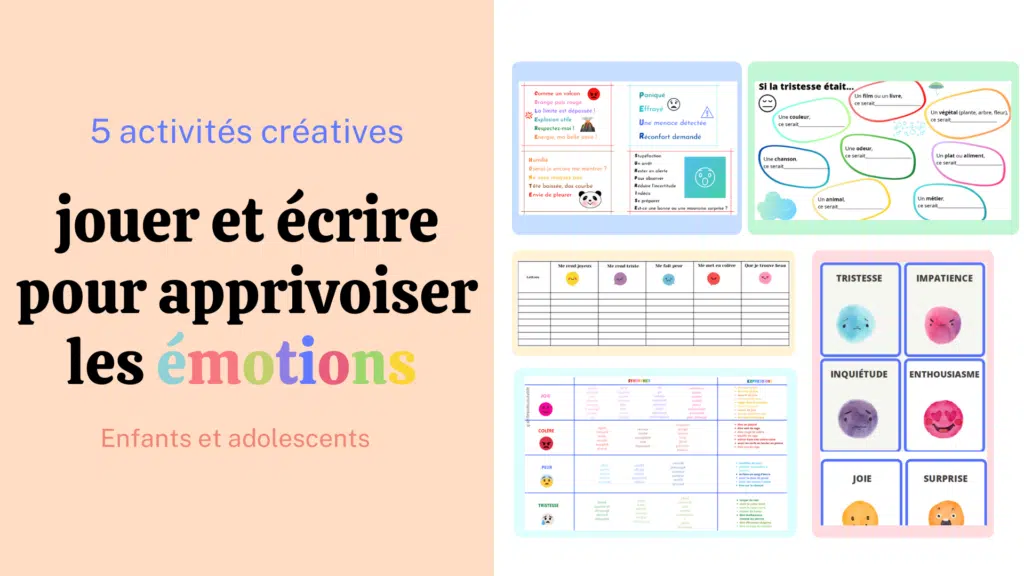
Activity 1: turned-around emotions
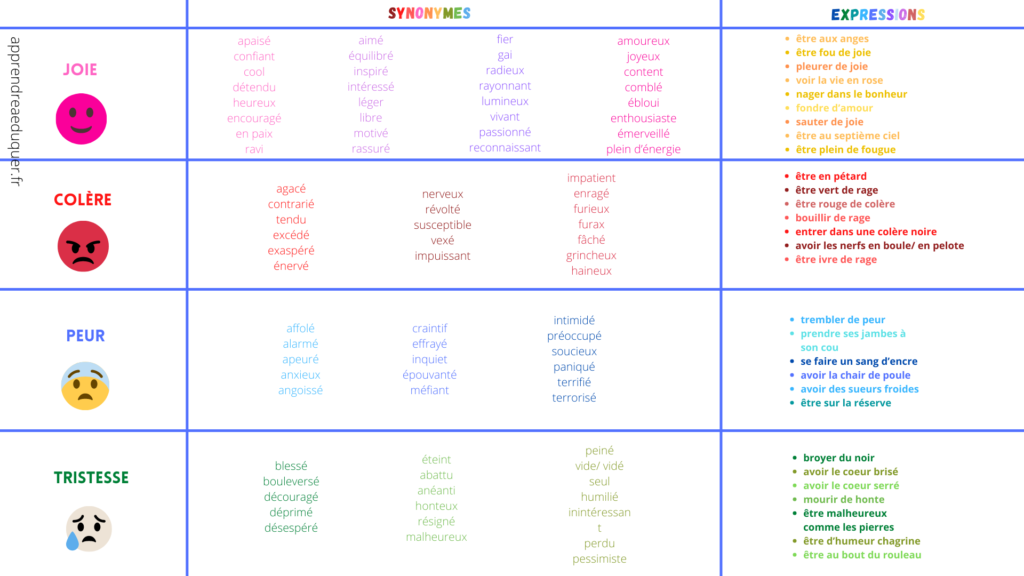
Start with a simple table of emotion words and expressions, and explain what each one means. Ask children whether they know other words to add, and add a few of your own. Then announce that you are about to say some very strange sentences about feelings and ask what sounds odd.
Offer examples such as being “peurtriste” — unhappy as a wet hen with skin of stone — or “furipeur”, boiling with heart and heavy with rage. The goal is to invent new words for feeling two emotions at once: pick two feelings, blend their names, then swap the adjectives or complements of their usual expressions.
How to run it
Choose the pair together, build the new word, then borrow one expression for each feeling and mix them up. Laughter is the point, and so is the discovery that mixed feelings are normal. If your child enjoys playful word-building, a hormone game style of silly naming keeps the mood light.
| Activity | What it trains | Material needed | Best for |
|---|---|---|---|
| Turned-around emotions | Vocabulary and nuance | Emotion word table | Ages 7 and up |
| Times-Up of emotions | Definition and expression | Twelve cards, timer | Groups and families |
| Feelings scattergories | Personal reflection | Paper and pencil | Mixed ages |
| Sensation check-ins | Body awareness | None | Daily routines |
| Charades | Non-verbal expression | None | Shy children |
Activity 2: a Times-Up of emotions
Prepare twelve emotion cards and play a Times-Up equivalent. It works because players must define each emotion — describing sensations, finding synonyms, recalling situations where it is felt — so they use words and body alike. Teams of two or more sit around the table, with teammates not side by side.
A game runs over three rounds, each with a time limit; thirty seconds is usual, and you can allow more with younger children. In round one the clue-giver may talk freely but never say the word on the card, and no card may be skipped. In round two only a single word is allowed. In round three it is mime only.
Teams count the cards guessed in each round and add them up at the end. You can print your own cards or use commercial ones. A quick round also travels well, much like the compact picks in these travel toys reviews.

Activity 3: a feelings scattergories
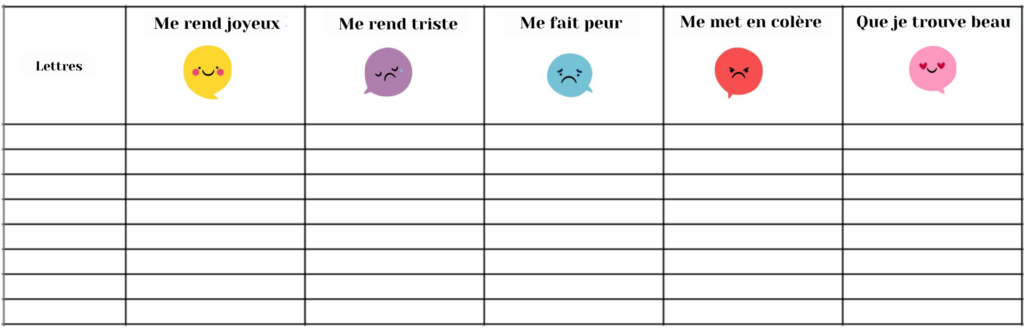
Take the classic scattergories format and replace the categories with emotional prompts: what makes me joyful, what makes me sad, what scares me, what makes me angry, what I find beautiful. One player recites the alphabet silently while another says “stop”, fixing the letter for the round.
Everyone then finds a word starting with that letter for each column. With the letter C, for example: a cuddle makes me joyful, class makes me sad, a power cut scares me, a kick makes me angry, and the Loire châteaux are beautiful. Each answer reflects personal tastes and experience, so there are no wrong answers.
Some answers deserve a longer talk, especially if they reveal a problem nobody had raised before. Keep the tone curious rather than investigative, and let children choose how much to explain. The same patience pays off in everyday routines such as learning to brush their teeth calmly.

Activity 4: sensation check-ins and feeling charades
Between the bigger games, a two-minute check-in keeps the vocabulary alive. Ask where a feeling lives in the body — tight chest, warm cheeks, heavy legs — and let children point rather than explain. This builds the sensation awareness the other activities rely on.
Charades works as a shorter version of the card game: one child mimes a feeling, the others guess and then justify the guess with a word or a situation. It is quick, needs no material, and suits mixed ages. Quiet children often shine here because the body speaks before the voice has to.
Sensory comfort helps some children settle into these talks; the benefits of sensory blankets are worth knowing if your child regulates through touch. For bigger groups, small prizes from a classroom prize box keep energy up without turning feelings into a competition.
Activity 5: keeping the conversation going
The fifth habit is the simplest: talk about emotions outside the games, in ordinary moments. Name your own feelings out loud, ask curious questions instead of diagnosing, and accept “I don’t know” as a complete answer. Children learn far more from what we model than from what we instruct.
Keep a small notebook of new words invented together and revisit it now and then. Reuse the cards on car journeys, at dinner, or during a quiet afternoon. If you are juggling work and children at home, the tips in this guide to working from home can help you carve out those short, regular slots.
When a game surfaces something heavy, stay calm and follow up later rather than forcing it open in the moment. Knowing when to step back is part of the adult’s role, much like knowing when to catch children red handed gently rather than ambush them.




My hands-on take
I started playing the invented-word game at the dinner table with no preparation at all, and it became the easiest entry point we have. My child loved mixing two feelings into one ridiculous word, and the laughter did more for the conversation than any careful question I had prepared. What surprised me was how often a made-up word turned out to describe something real that had no simple name.
The card game took more setup, but the single-word round was the one that stuck. Having to choose just one word forced everyone to think about what a feeling actually is rather than what it is called. My advice: keep sessions short, stop while it is still fun, and write down the new words somewhere you will see them again.
Frequently asked questions
What age are these activities suitable for?
They are designed for children from about seven years old and work well into the teenage years, since the discussion deepens with age. With younger children, allow more time per round and simplify the words.
Do we need to buy anything?
No. Most activities need only paper, a pencil and a timer, and you can make your own emotion cards. Commercial card sets work too if you already have them.
What if a child refuses to take part?
Let them watch. The frame explicitly gives children the choice to express themselves or not, and watching is often how a reluctant child joins later.
What should I do if an answer worries me?
Stay calm, thank the child, and return to it privately later rather than probing in front of the group. The games are a doorway to conversation, not an interrogation.
Product Reviews
 Best Toys for Dogs With High Prey Drive |
Best Outdoor Toys for 3-4 Year Olds |
Best Outdoor Toys for 6 Year Olds |
Best Harness for Poodle |
Best LEGO Sets for Adults |
Best Travel Toys for 4 Year Olds on Airplane |
Best Toy Stores in Washington DC |
Best Potty Training Toys |
Best Toys for Tripod Dogs |
Maillot equipe de france







