


Concentration activities for kids do not need special equipment or a long session at a table. The three exercises below rely on the five senses and can be started from around four or five years old, usually with nothing more than paper, pens and everyday objects.
Each one targets attention in a slightly different way: one through the continuous movement of the hand, one through listening to instructions and switching pace, and one through careful listening to the surrounding soundscape. You can use them one at a time, whenever a child seems scattered or needs help settling back into the here and now.

Quick takeaways
- Spiral drawing trains sustained attention through one unbroken line
- Layer three to five spirals, then repeat anticlockwise on a fresh sheet
- The slow-motion game builds listening and self-control from age four
- Funny sounds develops auditory focus with everyday noisy objects
- Keep sessions short and rotate the three activities
- No special equipment or budget is needed
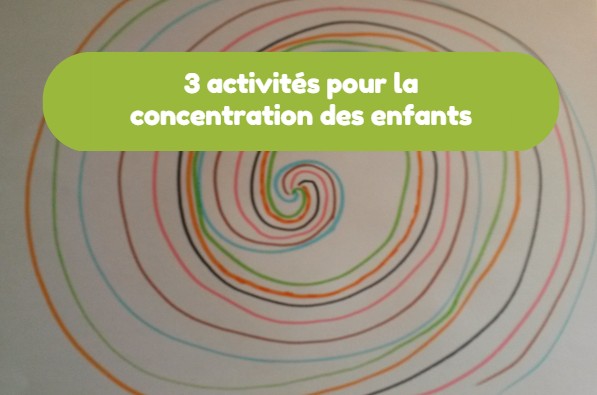
Drawing endless spirals to train sustained attention
From about five years old, and done alone. The child picks pens, felt-tips being easier because they glide more smoothly, or coloured pencils. The tip goes down in the middle of a blank sheet and the spiral grows as wide as possible, ideally across the whole width and length of the page.
What matters is the continuous line, without lifting the pen or stopping, and the direction: from the inside out, clockwise. The effort of keeping the line going without a break is what asks for real, sustained concentration. For children who like structured, incremental practice, the Kumon method builds attention in a similar step-by-step way.
Layering spirals in different colours
With a second colour, the child draws another spiral inside the first, starting just beside the original starting point. Same direction, same care with the unbroken line. Three, four or even five nested spirals are possible. If focus still has not returned, offer a fresh sheet and try the spirals anticlockwise instead.
The slow-motion game: coming back to the present
From four years old, alone or in a group in an open space, with an adult or an older child giving the cues. The player acts out a short scene, freezing on command. “Action!” You are a tiger leaping from rock to rock. “Stop!” You are a soft koala eating a eucalyptus leaf. “Action!” You are the tiger who has spotted the koala and rushes forward. “Stop!” You are the koala trying to escape, and you are scared.
Continue with the tiger looking ahead, behind and to the sides, then the koala hiding under a tree stump, then the tiger sitting down quietly to rest, and finally the koala delighted to have escaped. Breaking movements down and alternating fast and slow rhythms trains listening to instructions and thinking about the movements to make.
It is a gentle way to practise self-control, and it pairs well with the everyday consistency described in adult authority without any need for a telling-off. Like the best educational toys for young children, it builds focus through play, and it is far kinder on your body than the back contractures that come from carrying little ones all day.
| Activity | Best age | What it trains |
|---|---|---|
| Infinite spirals | From 5 | Fine motor control and sustained attention |
| Slow-motion game | From 4 | Listening, inhibition and body awareness |
| Funny sounds | From 4 | Auditory discrimination and patience |
| Setting | Alone | Spiral drawing needs a table and paper |
| Setting | Alone or group | The animal game needs open floor space |
| Setting | In pairs | The sound game needs a basket of objects |
Funny sounds: an auditory game for focus
This one asks the child to analyse the sound environment, guess where sounds come from and settle into the present moment. From four years old, in pairs. You need everyday objects that make noise: pieces of wood to knock together, newspaper to crumple, saucepans, bottles to uncork, scissors cutting, buttons to press, a keyboard to tap.
The child sits comfortably, preferably cross-legged or on the heels, palms on the knees, back straight, and is invited to close their eyes and breathe calmly. The other player makes one sound, which the child tries to identify with eyes still closed, taking as long as needed.
When the sound is not recognised
If the sound itself is not identified, the child can describe what it evokes: soft, harsh, near, far, and what it brings to mind, such as an object, an event, a moment, a person or an action. If they are stuck, move on to the next sound, starting with easily recognisable everyday noises before gradually introducing harder ones. Swap roles at the end.
Because it removes visual overload, this exercise works well after screen time, much like the calm that rest during pregnancy aims to give an expectant mother.
Setting up a short daily practice
None of these activities needs to last long. A few minutes of spirals before homework, a round of the slow-motion game when energy runs high, or a listening session after a busy afternoon is enough to bring attention back. Rotate them so the novelty holds and the child does not see the exercise as a chore.
Keep the material close at hand: a stack of blank paper and a pot of felt-tips for the spirals, a clear floor space for the animal game, and a small basket of noisy objects for the listening game. A predictable little ritual helps children settle, and it works alongside the kind of patient, playful guidance you would use when you first shave a nervous child. If you want fresh ideas for the basket, browse these learning toys.
For siblings of different ages, the listening game adapts well, and it can be a calm option on a rainy day, much like the quiet activities you might plan when choosing party favor toys for a mixed-age group. For travel days, airplane toys keep little hands busy.

Why sensory focus games work
Attention is a muscle that grows through repetition, and these three exercises each load it differently. The spiral demands fine motor control and a steady hand. The slow-motion game demands listening, inhibition and body awareness. The sound game demands auditory discrimination and patience.
Together they cover the senses rather than leaning on screens, which is useful when you are trying to balance digital and hands-on play, as with the children's apps many families now use. They also need no special budget, which makes them easy to slot into an ordinary afternoon.
If a child struggles to stay with an exercise, shorten it rather than abandoning it, and praise the effort rather than the result. Over time, the same few minutes become a reliable way to reset a scattered mind.

My hands-on take
I started with the spirals because they need the least preparation, and I was surprised how quickly a restless child settled into the rhythm of keeping the line going. The first attempts were shaky and stopped every few centimetres, but after a few days the spirals grew wider and smoother, and the whole exercise became a quiet few minutes we both looked forward to.
The slow-motion game took more practice, mainly because I had to remember to give the cues slowly enough. Once we got the hang of it, the tiger-and-koala story became a favourite, and it was a good way to burn off energy indoors. The sound game I saved for calmer moments, and it worked best right after lunch when the house was quiet.
Frequently asked questions
How long should each activity last?
Keep sessions short, a few minutes is usually enough. Stop while the child is still engaged rather than waiting for frustration to build.
What if my child refuses to close their eyes for the sound game?
Let them keep their eyes open at first and simply turn away from the objects. The listening challenge still works, and closing the eyes can come later.
Can these activities be done with several children?
Yes. The slow-motion game works especially well in a group, and the sound game can be played in pairs with children taking turns to make the noises.
Do I need to buy anything?
No. Paper, felt-tips and a handful of everyday objects from the kitchen or desk are all you need.
Product Reviews
 Best Toys for Dogs With High Prey Drive |
Best Outdoor Toys for 3-4 Year Olds |
Best Outdoor Toys for 6 Year Olds |
Best Harness for Poodle |
Best LEGO Sets for Adults |
Best Travel Toys for 4 Year Olds on Airplane |
Best Toy Stores in Washington DC |
Best Potty Training Toys |
Best Toys for Tripod Dogs |
Maillot equipe de france







